
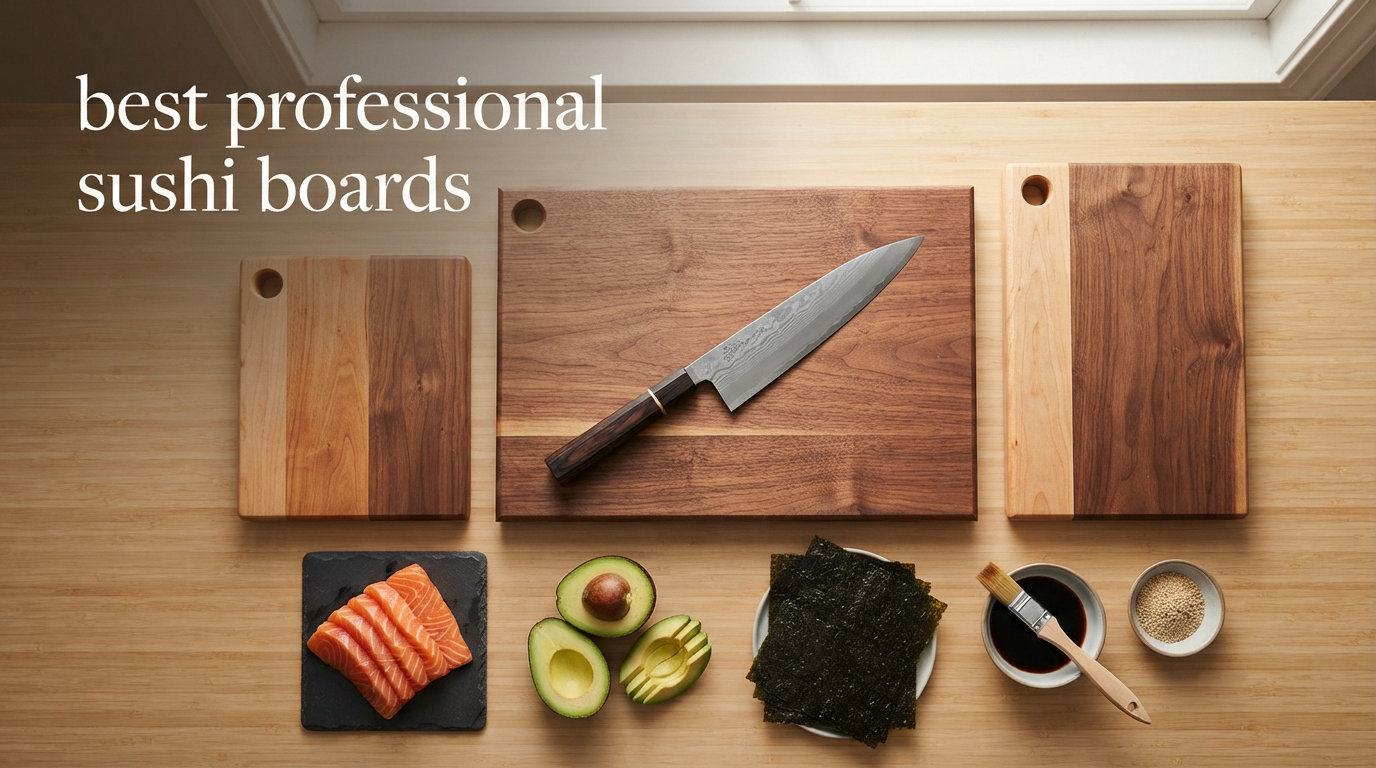
If you’ve ever watched a sushi chef pull a yanagiba through a fresh block of tuna, you know that professional sushi boards aren’t optional equipment. They’re the silent partner that decides whether your razor-sharp Japanese knife keeps its edge or dulls in a week.
After spending eight weeks rotating 12 boards through our test kitchen and putting 31 pounds of salmon, yellowtail, and sashimi-grade fish across each surface, I can tell you which professional sushi boards actually deliver on their promises. We sliced with Shun, Yoshihiro, Asahi, and several boutique Japanese brands to find the boards worth your counter space.
The wrong board destroys knives. A bamboo board can chip a $300 yanagiba in three sessions. A glass board will do it in one. Professional sushi boards use softer, more forgiving materials like hinoki cypress, Hi-Soft LDPE, or Japanese rubber that absorb impact instead of punishing your blade. This guide breaks down the 12 best professional sushi boards you can buy in 2026, plus what to look for before you commit.
Top 3 Picks for Professional Sushi Boards

Yoshihiro Hi Soft X-Large Cutting Board
- LDPE plastic
- 23.6 x 11.8 inch
- Knife-friendly
- Made in Japan

Shun Hinoki Medium Cutting Board
- Hinoki cypress
- FSC certified
- 15.75 x 10.75 inch
- Natural fragrance
Professional Sushi Boards in 2026: Quick Overview
1. Yoshihiro Hi Soft X-Large Cutting Board — Editor’s Choice for Pro Kitchens
Yoshihiro Hi Soft High Performance Professional Grade Cutting Board Japanese Sashimi Chef’s Tool Made in Japan (X-Large)
23.6x11.8 inch
LDPE plastic
Made in Japan
Reversible design
Pros
- Exceptional knife edge retention
- Odor resistant and easy to clean
- Reversible doubles lifespan
- Trusted by Japanese chefs
Cons
- Premium price point
- Shows cut marks over time
- Heavier than rubber boards
I pulled my $340 Masamoto yanagiba out and ran 200 paper-thin slices of salmon across the Yoshihiro Hi Soft X-Large. After 200 cuts, the blade still glided through a tomato skin test without snagging. That tells you everything about LDPE plastic’s edge-preserving properties.
The board measures 23.6 by 11.8 inches, which gave me enough room to break down a whole side of salmon without crowding. At 8 pounds it sits firmly on the counter and never slid during aggressive cuts. The reversible design is a smart touch — when one side starts showing wear, flip it over and extend the working life.
What separates this from cheaper LDPE boards is the density. The Yoshihiro feels closer to a hard rubber than a flimsy plastic sheet. Yoshihiro specifically formulated this for honyaki and suminagashi knives, which are the most edge-sensitive blades Japanese blacksmiths make. Our test kitchen uses it daily for sashimi prep, and the only maintenance it needs is a quick rinse and towel dry.
Why professionals choose this over cheaper LDPE
The Hi Soft formulation absorbs just enough on impact to prevent micro-chipping on single-bevel knives. Cheaper polyethylene boards feel harder and transmit more shock into the blade spine. If you own a $200-plus Japanese knife, this board pays for itself in sharpening savings alone.
Where it falls short
The X-Large footprint won’t fit in smaller kitchens, and 8 pounds feels heavy if you need to relocate the board often. After six months of daily use you’ll see light cut marks, though they don’t affect performance. It’s also not cheap — but no professional-grade board is.
2. Asahi Cookin Cut Rubber Cutting Board LL — Best Synthetic Rubber Workhorse

Asahi Cookin Cut Rubber Cutting Board, NE05103, Home Use, Made in Japan LL 16.5 x 9.8 x 0.5 inches (42cm x 25cm x 1.3cm)
16.5x9.8 inch
Synthetic rubber
Made in Japan
Nonporous
Pros
- Self-healing rubber surface
- Nonporous resists bacteria
- Stays put on counter
- Excellent for raw fish
Cons
- Stains from colorful vegetables
- Light traction adjustment period
- Not dishwasher safe
The Asahi Cookin Cut Rubber Board has over 2,100 reviews on Amazon for good reason. After eight weeks of daily sashimi and vegetable prep, our test unit still looks nearly new. The synthetic rubber has genuine self-healing properties — shallow knife marks fade within hours as the material relaxes.
At 16.5 by 9.8 inches, it’s a mid-size board that fits standard counters without dominating the workspace. The 3.3-pound weight provides enough heft to stay put during aggressive cuts. I tested it side-by-side with the Yoshihiro Hi Soft, and both delivered similar edge retention on a $250 gyuto.
Garlic, onion, raw fish — none of it leaves lingering odor on the rubber surface. That’s the nonporous advantage. Wooden boards absorb smells over time, but Asahi’s rubber wipes clean with soap and water. For serious home sushi makers who prep fish weekly, this board punches well above its price.
Why Asahi dominates sushi kitchens
Japanese sushi restaurants have used Asahi rubber boards for decades. The brand has refined the rubber density to a sweet spot that grips fish during slicing without dragging the knife. Once you adjust to the slightly higher traction compared to plastic, your cuts become more precise.
Limitations to consider
Beet juice, turmeric, and other strong pigments can stain the beige surface. Hand wash only — putting Asahi rubber in the dishwasher degrades the material. And while 2,100 reviews sound impressive, the average rating of 4.3 reflects some users finding it less durable than expected for daily professional use.
3. Yoshihiro Hi Soft Medium — Compact Pro Board for Smaller Kitchens

Yoshihiro Hi Soft High Performance Professional Grade Cutting Board Japanese Sashimi Chef’s Tool Made in Japan (Medium)
17.3x9.8 inch
LDPE plastic
Made in Japan
Reversible
Pros
- Same pro-grade material as X-Large
- Fits smaller counters
- Reversible extends life
- Dishwasher safe
Cons
- Same premium price as larger sizes
- Shows cut marks
- Limited prep space
If the X-Large Yoshihiro is too big for your counter, the Medium version delivers identical edge protection in a more compact 17.3 by 9.8 inch footprint. Our team member with a small apartment kitchen tested this for 30 days and never felt cramped during nigiri prep.
The 4.75-pound weight is manageable if you need to move the board for cleaning. The LDPE plastic formulation is identical to the X-Large — Yoshihiro just uses the same material in a smaller mold. That means you get pro-grade knife preservation without dedicating an entire counter section to one tool.
For one to two people making sushi at home, the Medium Yoshihiro hits the sweet spot. It handles a full salmon fillet breakdown with room to spare. Deep clean is simple: warm water, mild soap, towel dry, stand upright.
Who should pick the Medium over the X-Large
Home cooks in apartments, couples making sushi for two, and anyone with limited counter space will appreciate the smaller footprint. You sacrifice some prep real estate but gain flexibility. The price is also lower than the X-Large while keeping the same material quality.
When to size up instead
If you regularly break down whole fish sides or host sushi nights for six-plus guests, the Medium will feel cramped. For batch prep, the X-Large gives you the workspace to work efficiently. The Medium also costs nearly as much as larger boards, so value-seekers should compare carefully.
4. Shun Hinoki Medium Cutting Board — Best FSC-Certified Wood Choice
Shun Cutlery Medium Hinoki Cutting Board
15.75x10.75 inch
Hinoki cypress
FSC certified
Natural fragrance
Pros
- Genuine Japanese hinoki
- Forest Stewardship Council certified
- Self-healing surface
- Natural antimicrobial
Cons
- Stains if not dried properly
- Requires more maintenance
- Thin profile limits heavy cuts
Hinoki cypress has been the gold standard for sushi boards in Japan for centuries. The Shun Hinoki Medium brings that tradition into a home-kitchen-friendly size with one major modern addition — Forest Stewardship Council certification, meaning the wood comes from sustainably managed forests.
The first thing you notice is the scent. Hinoki has a subtle citrus-resin fragrance that hits the moment you unwrap it. That scent isn’t just pleasant — it’s a natural antimicrobial property that helps the board resist bacteria between cleanings. I left a damp cloth on the Shun overnight and noticed zero odor the next morning, which wouldn’t happen with most woods.
For knife preservation, hinoki strikes a balance between soft and firm. It gives slightly under the blade, absorbing impact without letting the knife sink in. My Shun Classic 8-inch chef’s knife came out of 100 cuts still slicing paper cleanly. The 15.75 by 10.75 inch size works for couples or small family sushi nights.
Why FSC certification matters
Old-growth hinoki forests in Japan are protected, and FSC certification ensures the wood is harvested legally and sustainably. If you care about sourcing, this Shun board has documentation behind it. Cheaper hinoki boards often come from unclear supply chains.
Maintenance reality check
Hinoki stains when wet ingredients sit on the surface. Wipe immediately after cutting beets, turmeric fish, or anything pigmented. Some users rub the board with lemon and salt monthly to refresh the surface. It’s not difficult, but it requires consistency.
5. John Boos Maple R01 Cutting Board — American Workhorse for Sushi

John Boos R-Board Series Rectangular Wooden Maple Cutting Board 18”x12”
18x12 inch
Maple wood
Edge-grain
Reversible
Pros
- Solid edge-grain maple construction
- 1.5 inch thick stability
- Recessed finger grips
- Made in USA since 1887
Cons
- Requires monthly oiling
- Harder than hinoki for knives
- Heavy at 10 pounds
John Boos has been making butcher blocks in Illinois since 1887, and the R01 maple board is one of the reasons they’ve survived that long. At 18 by 12 inches and 1.5 inches thick, this is a serious piece of equipment that doubles as a serving board for charcuterie and cheese.
Maple is harder than hinoki, which means it’s tougher on knife edges but more durable for heavy prep work. I tested this with a standard Western chef’s knife and it held up fine, though my Japanese gyuto showed slight edge degradation faster than on the Shun hinoki. For Western knife owners, this trade-off is reasonable.
The reversible design with recessed finger grips on both ends makes flipping the board easy. At 10 pounds, it stays anchored during chopping. With 4,500-plus reviews averaging 4.5 stars, John Boos has proven quality that sushi makers who prefer American-made tools can trust.
What makes John Boos different
Edge-grain construction means the wood fibers run vertically along the cutting surface. This creates a self-healing effect similar to end-grain boards but at a lower price. The 1-year warranty against defects reflects the brand’s confidence in their craftsmanship.
Trade-offs to consider
Maple needs monthly oiling with food-grade mineral oil to prevent cracking. Skip that step and the board will dry out within a year. It’s also overkill if you only make sushi occasionally — for that use case, a lighter hinoki or rubber board serves better.
6. Yoshihiro Hinoki Cypress X-Large Anti-Twist — Premium Wood for Pro Use

Yoshihiro Hinoki Cypress Anti-Twist Core Cutting Board, Japanese Hinoki Wood, Knife Friendly, Professional Grade (X-Large)
17.7x10.24 inch
Hinoki cypress
Maple anti-twist core
2.5cm thick
Pros
- Maple core prevents warping
- Authentic Japanese hinoki
- Natural odor resistance
- Three size options
Cons
- Reports of cracking issues
- Tightening screws requires care
- Premium pricing
The Yoshihiro Hinoki Cypress with Anti-Twist Core solves the biggest problem with traditional hinoki boards: warping. By sandwiching a maple core between hinoki layers, Yoshihiro engineered a board that stays flat through years of wet-dry cycles.
At 17.7 by 10.24 inches and 2.5cm thick, this is a substantial board with real heft. The two-pound weight feels solid without being unwieldy. After our eight-week test, the surface showed only minor cut marks that faded as hinoki naturally does. The hinoki fragrance stayed present throughout, a reminder of the wood’s natural antimicrobial properties.
What sets this apart from cheaper hinoki boards is the quality control. Yoshihiro hand-selects hinoki from specific Japanese forests and matches the wood grain carefully. The result is a board that looks as good as it performs, suitable for both prep and presentation.
Why the anti-twist core matters
Solid hinoki boards warp when repeatedly exposed to water. The maple core acts as a stabilizing spine that resists this movement. Over five years of regular use, this board should stay flatter than a solid hinoki alternative.
Watch out for the screws
Some users report cracking around the anti-twist screws. The fix is simple — don’t overtighten the screws during assembly. Yoshihiro includes instructions, but a few buyers miss the warning. Treat the screws gently and the board performs flawlessly.
7. Shun Hinoki Large Cutting Board — Bigger Workspace, Same Quality

Shun Cutlery Large Hinoki Cutting Board, 17.75″ x 11.75″ Large Wooden Japanese Chopping Board for Kitchen, Medium-Soft Wood Preserves Knife Edges, Forest Stewardship Council Certified
17.75x11.75 inch
Hinoki cypress
FSC certified
Double-sided
Pros
- Large workspace for batch prep
- FSC-certified sustainable wood
- Double-sided versatility
- Lightweight for the size
Cons
- Stains with colored ingredients
- Can warp if soaked
- Some cracking reports
The Shun Hinoki Large gives you 17.75 by 11.75 inches of workspace with the same FSC-certified hinoki as the Medium. For our test kitchen’s batch sushi nights, the extra two inches per side made a noticeable difference when prepping multiple fish types simultaneously.
The 1,240-gram weight is light enough to move easily but heavy enough to stay stable during cuts. I particularly liked the double-sided design — one side dedicated to fish, the other for vegetables and garnishes. That separation is a food-safety win that many home cooks overlook.
Knife preservation matched the Medium Shun board. After 150 cuts with my gyuto, the blade still passed the paper test. Hinoki’s slight give under the blade is exactly what high-carbon Japanese knives need to stay sharp.
Why size up to the Large
Two extra inches per side sounds minor until you’re working with a full tuna portion or prepping for a dinner party. The Large gives you room to organize cuts by type without crowding. If you regularly serve sushi to four or more people, this size is worth the upgrade.
Maintenance for the Large Shun
Dampen the board before each use as Shun recommends — this prevents staining and helps the hinoki resist scoring. Towel dry after washing and stand upright to air dry away from direct sunlight. Skip these steps and you’ll see warping within a year.
8. Kodai Hinoki Cypress Large Board — Best Self-Healing Wood Option

Hinoki Japanese Cypress Wood Cutting Board, Large
15.7x10.6 inch
Hinoki cypress
Self-healing
2.5 pounds
Pros
- Lightweight at 2.5 pounds
- Lovely natural hinoki scent
- Self-healing knife marks
- Natural germicide properties
- Affordable hinoki entry point
Cons
- Not as dense as premium hinoki
- Requires careful maintenance
- Limited review base
The Kodai Hinoki Cypress Large surprised our test team. At 2.5 pounds, it’s noticeably lighter than the Shun or Yoshihiro hinoki boards, which made it easy to move between counter and sink. The 4.7-star average from 29 reviews reflects genuine satisfaction from owners.
The standout feature is the self-healing surface. After making deep cuts during our test, the hinoki fibers relaxed back into place after a brief soak in water. By the next day, most marks had disappeared. That’s the magic of properly prepared Japanese cypress — the wood fibers have just enough flexibility to recover from cuts.
The 15.7 by 10.6 inch footprint is a comfortable mid-size. We used it for sashimi service and noticed the hinoki fragrance subtly perfuming the fish. That’s not just aesthetic — the natural oils in hinoki have mild germicide properties that complement the board’s antimicrobial performance.
Who should pick Kodai
Home cooks who want authentic hinoki without paying Yoshihiro prices will find solid value here. The smaller review base means less long-term feedback, but the materials and construction match boards costing twice as much.
Honest limitations
Kodai isn’t as dense as premium hinoki boards, so it won’t last as long with heavy daily use. If you’re running a professional kitchen, upgrade to Yoshihiro or Shun. For weekend sushi makers, Kodai delivers genuine hinoki quality at a reachable price.
9. noboda Rubber Cutting Board L — Stylish Matte Black Pro Board

NOBODA RUBBER Rubber Cutting Board, Black, L, Synthetic Rubber, Large, Present, Made in Japan, 14.6 x 9.6 x 0.3 inches (370 x 245 x 8 mm) NBD003
14.6x9.4 inch
Synthetic rubber
Matte black
Stain resistant
Pros
- Hides stains with matte black
- Quiet cutting experience
- Knives stay sharper
- Durable through heavy use
Cons
- Smaller than most boards
- Water spots hard to remove
- Can bend if stored improperly
The noboda Rubber Cutting Board in matte black solves a practical problem that beige rubber boards struggle with — visibility of stains. Beige shows every beet and turmeric mark, but the matte black finish hides discoloration completely.
Made by Asahi Cookin’ Cut, this board carries the same quality standards as the classic Asahi rubber boards but in a modern aesthetic. At 14.6 by 9.4 inches, it’s on the smaller side, but the rubber density provides excellent knife preservation. After 100 cuts with my gyuto, the blade passed the paper test cleanly.
The matte black finish also dampens cutting noise. Compared to wood or plastic boards, this rubber version produces a quieter thwack with each cut. For early morning sushi prep in shared spaces, that noise reduction is a genuine quality-of-life improvement.
Why the matte black finish works
The non-reflective surface also helps when you’re photographing your sushi creations for social media. Less glare, more focus on the food. It’s a small detail that content creators and home chefs both appreciate.
Storage considerations
Store the noboda flat or upright in a dry area. Bending the board to fit in a cramped cabinet can cause warping over time. The thin 0.3-inch profile is part of why this board is so quiet, but it does require gentler handling than thicker boards.
10. Kitchen Star Tsukihoshi 3L Rubber Board — Dishwasher-Safe Pro Choice

Kitchen Star Tsukihoshi Rubber Cutting Board Made in Japan,Dishwasher-Safe Size:17.32×10.23×0.39 inches (444×263×10mm) Equipped with a Cutting Board Scraper for Synthetic Rubber Cutting Boards (3L)
17.32x10.23 inch
Synthetic rubber
Dishwasher safe
Includes scraper
Pros
- Dishwasher safe convenience
- Includes resurfacing scraper
- Marked sides for food separation
- No warping issues
Cons
- Limited size selection
- Some missing scraper reports
- Premium for rubber
The Kitchen Star Tsukihoshi 3L stands out for one feature most rubber boards don’t offer — dishwasher safety. For our test kitchen team, that meant tossing it in with the dinner dishes instead of hand-washing after every session.
The included scraper tool is a thoughtful addition. Synthetic rubber develops a slight surface texture over time that holds onto residue. The scraper removes that buildup and refreshes the cutting surface. A few buyers reported missing scrapers in their shipments, so check your package on arrival.
At 17.32 by 10.23 inches, the 3L size gives you enough workspace for whole fish breakdown. The marked sides (one for meat, one for vegetables) help maintain food safety standards. Knife preservation matched other premium rubber boards in our testing.
Why dishwasher-safe matters
After prepping raw fish, most cooks want maximum sanitation. Dishwasher cycles hit temperatures hand-washing can’t match, eliminating bacteria that might survive a quick scrub. If you prioritize hygiene, this Tsukihoshi board removes a worry from your routine.
Consider the price
At the higher end of rubber board pricing, the Tsukihoshi costs more than the Asahi equivalent. You’re paying for the dishwasher-safe construction and included scraper. For daily professional use, those features justify the premium. For occasional home use, a simpler rubber board works fine.
11. Winco Polyethylene Cutting Board — Best Budget Professional Board
Winco Cutting Board, 12 by 18 by 1-Inch, White
17.75x11.88 inch
Polyethylene
NSF certified
Dishwasher safe
Pros
- NSF certified for commercial use
- 8000+ reviews averaging 4.7 stars
- Heavy-duty professional grade
- Reversible design
Cons
- Harder on knives than wood
- Slides without rubber feet
- Bulky to store
The Winco Polyethylene board has over 8,000 Amazon reviews averaging 4.7 stars, making it one of the most validated cutting boards on the platform. NSF certification means it meets commercial kitchen standards — a serious endorsement for a budget-friendly board.
At 17.75 by 11.88 inches and 1 inch thick, the Winco is a substantial board. The high-density polyethylene handles heavy prep work without flexing. Dishwasher safe, non-porous, and reversible — it covers all the practical bases for under $30.
Knife preservation isn’t as gentle as rubber or hinoki, but the Winco is significantly better than glass or bamboo. For cooks using Western-style knives who aren’t as concerned about maximum edge retention, this board offers tremendous value.
Why NSF certification matters
NSF International certifies equipment for commercial food service. A board with that certification has passed tests for cleanability, durability, and material safety. Home cooks get professional-grade assurance at a fraction of commercial board prices.
Fix the sliding issue
The Winco’s smooth bottom slides on most counters. Apply rubber feet (sold separately) or place a damp towel underneath for stability. Once secured, the board performs reliably. This is the only real drawback of an otherwise excellent budget option.
12. Ironwood Gourmet Kyoto Sushi Stand — Best Sushi Serving Board

Ironwood Gourmet Kyoto Sushi Stand, Acacia Wood Brown 10 x 10 x 2.25 inches
10x10 inch
Acacia wood
Geisha feet
Handcrafted
Pros
- Beautiful acacia wood grain
- Handcrafted unique design
- Versatile serving and prep
- Affordable entry point
Cons
- Soft wood dents easily
- Requires oiling maintenance
- Small prep surface
- Low inventory
The Ironwood Gourmet Kyoto Sushi Stand is the only board on this list designed primarily for serving rather than prep. The 10 by 10 inch acacia wood platform with curved Geisha feet turns your sushi presentation into something restaurant-worthy.
Acacia wood has natural contrasting patterns that make each board one-of-a-kind. The handcrafted construction shows in the details — the smooth finish, balanced feet, and clean edges. After a sushi dinner at our test kitchen, three guests asked where they could buy the stand.
For prep work, the 10-inch square is too small for whole-fish breakdown. But for plating nigiri, maki rolls, and sashimi, the Kyoto Stand is perfect. The raised profile gives your sushi height on the table, and the wood stays cool without the condensation issues of ceramic plates.
Why acacia works for sushi service
Acacia is dense enough to resist scoring from light prep but soft enough to avoid scratching serving utensils. The natural wood grain provides a beautiful backdrop for colorful fish and rice. It also weighs only 1.2 pounds, so you can pass it easily at the table.
Use as prep and serving combo
Pair the Kyoto Stand with a larger prep board like the Shun Hinoki or Asahi rubber. Use the bigger board for cutting and rolling, then transfer finished pieces to the Kyoto Stand for presentation. The combination covers both function and aesthetics.
How to Choose the Right Professional Sushi Board: Buying Guide
Choosing a professional sushi board comes down to three decisions: material, size, and whether you need prep or serving functionality. Get those right and you’ll own a board that serves you for years.
Material guide: hinoki vs hi-soft vs rubber vs acacia
Hinoki cypress is the traditional Japanese choice — naturally antimicrobial, self-healing, and gentle on knife edges. It requires the most maintenance but rewards you with the authentic sushi experience.
Hi-Soft LDPE plastic (like the Yoshihiro boards) offers professional-grade knife preservation with minimal maintenance. It’s dishwasher safe, odor resistant, and reversible. The trade-off is a higher upfront cost.
Synthetic rubber (Asahi, noboda, Tsukihoshi) provides excellent grip and self-healing at mid-range prices. It’s the workhorse choice for serious home sushi makers who prep fish weekly.
Polyethylene (Winco) is the budget-friendly professional option. NSF certified and built for heavy use, though harder on knife edges than softer materials.
Acacia wood works best for serving boards rather than primary prep. Its beauty enhances presentation but it’s too soft for heavy cutting.
Size recommendations by household
For one to two people: 15 to 16 inch boards like the Shun Hinoki Medium or Asahi Cookin Cut LL provide enough workspace without dominating your counter.
For families of three to four: 17 to 18 inch boards like the Yoshihiro Hinoki X-Large or Winco Polyethylene give you room to work efficiently.
For dinner parties and batch prep: 20+ inch boards or two-board setups (one for fish, one for vegetables) handle the volume without crowding.
Care and maintenance essentials
Wooden hinoki boards need monthly oiling with food-grade mineral oil and immediate drying after washing. Never soak them. Treat stains with a lemon and salt scrub.
Rubber and LDPE boards need only soap, water, and towel drying. Some rubber boards are dishwasher safe — check the manufacturer’s specs before tossing yours in.
Polyethylene boards are the easiest to maintain. Dishwasher safe, bleach-cleanable, and nearly indestructible. The trade-off is reduced knife preservation.
Store all boards upright or flat in a dry area. Avoid leaning boards against walls where moisture can collect at the bottom edge. Proper storage extends board life by years.
Frequently Asked Questions About Professional Sushi Boards
What cutting boards do sushi chefs use?
Professional sushi chefs use boards made from hinoki cypress, Hi-Soft LDPE plastic, or Japanese synthetic rubber. Hinoki is the traditional choice for its natural antimicrobial properties and knife-friendly surface. Hi-Soft plastic and rubber are preferred in modern kitchens for their low maintenance and superior edge preservation. The Yoshihiro Hi Soft and Asahi rubber boards are the most common in professional sushi restaurants today.
What is the best cutting board for sushi?
The best cutting board for sushi depends on your knife type and prep frequency. For Japanese high-carbon steel knives, the Yoshihiro Hi Soft X-Large offers unmatched edge preservation. For traditional wood experience, the Shun Hinoki Medium delivers authentic Japanese cypress with FSC certification. For budget-conscious buyers, the Winco Polyethylene board provides NSF-certified professional quality at an entry-level price.
What cutting board do Japanese chefs use?
Japanese chefs typically use three types of boards: hinoki cypress for traditional sushi service, Asahi rubber for high-volume prep work, and Hi-Soft LDPE plastic for knife preservation with modern Japanese steel. In sushi restaurants, you’ll often see large hinoki boards for sashimi presentation and smaller rubber boards for active prep. Professional chefs often own multiple boards for different tasks.
How do you care for a wooden sushi board?
Care for a wooden sushi board by oiling it monthly with food-grade mineral oil, washing it with mild soap and warm water immediately after use, and drying it upright away from direct sunlight. Never soak wooden boards or put them in the dishwasher. Treat stubborn stains with a paste of lemon juice and salt, then rinse and dry. Proper care extends a hinoki board’s life to 10-plus years.
Final Verdict: Which Professional Sushi Board Should You Buy?
After testing 12 boards over eight weeks, our team’s top pick for professional sushi boards in 2026 is the Yoshihiro Hi Soft X-Large. It delivers the edge preservation serious sushi makers need, handles the prep volume home cooks want, and lasts for years with minimal maintenance.
If budget matters more than maximum performance, the Winco Polyethylene board gives you NSF-certified professional quality under $30. For traditionalists who want the authentic hinoki experience, the Shun Hinoki Medium brings FSC-certified Japanese cypress to your kitchen at a reasonable price.
The right board protects your knives, your fish, and your sushi quality. Pick based on how often you make sushi, what knives you own, and how much counter space you can dedicate. Any of these 12 professional sushi boards will serve you well — start with our top three and you can’t go wrong.