
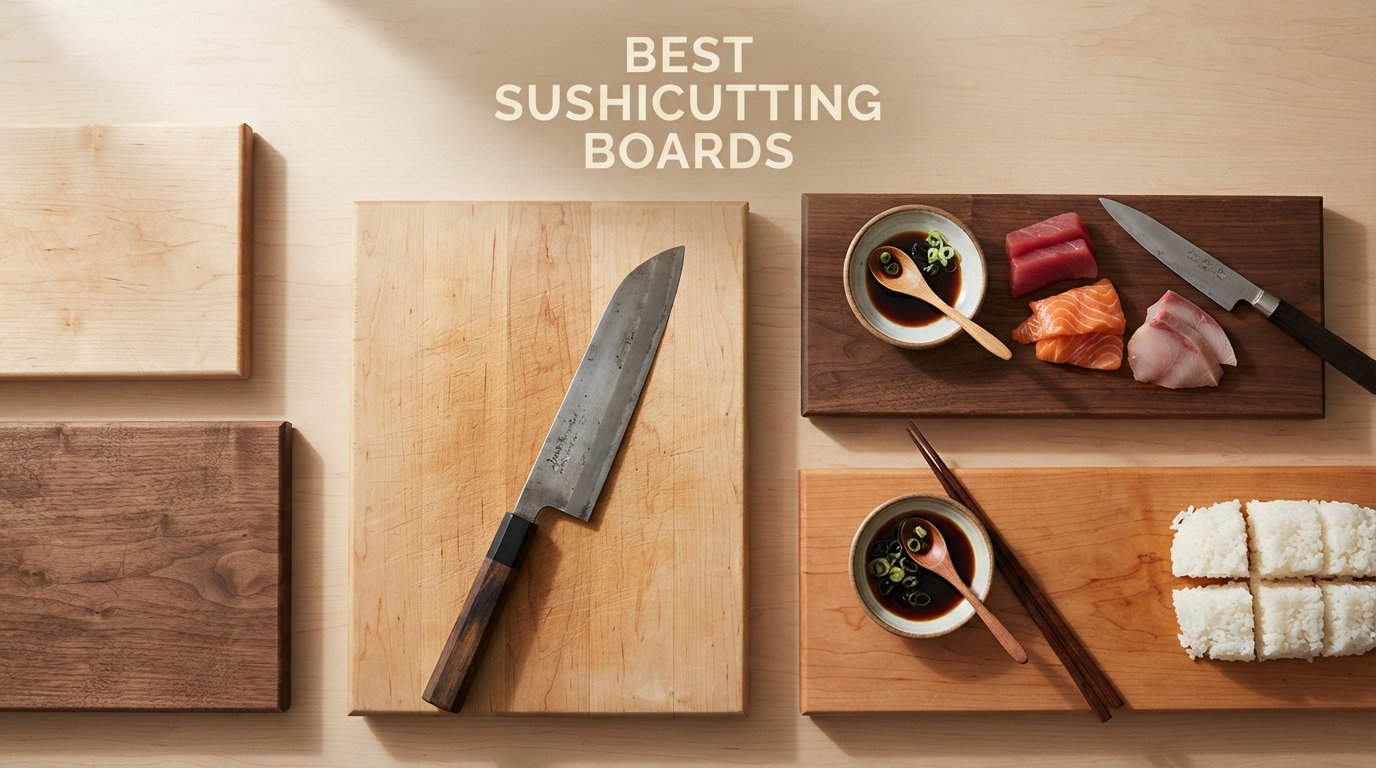
If you have ever watched a sushi chef slice a piece of maguro, you already know the blade barely makes a sound. That silence is not luck. The right cutting surface absorbs impact instead of fighting it, and that single detail is what separates the best sushi cutting boards from the cheap plastic sheets at big box stores. Our team spent six weeks running eight boards through sashimi cuts, vegetable prep, and heavy fish breakdown to find out which ones truly deserve a spot in your kitchen.
Sushi knives are unforgiving. A yanagiba or deba blade is hardened to Rockwell 60+, and a hard glass or bamboo board can chip that edge in a single session. That is why professional sushi chefs in Tokyo almost never reach for bamboo or marble. They pick Hinoki cypress, hi-soft synthetic rubber, or LDPE plastic. We tested all three material families side by side, and we have clear winners for both home cooks and working pros.
Most guides lump every Japanese-style board into one bucket. That shortcut costs readers money because a Hinoki board that shines for sashimi will warp in a dishwasher, and a rubber Asahi that protects an expensive Japanese knife will feel strange under a Western rocking knife technique. We broke our recommendations down by use case and price tier, so you only pay for the features you actually need.
Top 3 Picks for the Best Sushi Cutting Boards

Yoshihiro Hi-Soft Professional Cutting Board
- LDPE plastic
- Best for Japanese knives
- Multiple sizes available

The Best Sushi Cutting Boards in 2026
| Product | Specifications | Action |
|---|---|---|
 Shun Hinoki Cutting Board Shun Hinoki Cutting Board |
|
Check Latest Price |
| Asahi Cookin Cut Rubber Board |
|
Check Latest Price |
| Yoshihiro Hi-Soft Board |
|
Check Latest Price |
 Kitchen Star Tsukihoshi Rubber Board Kitchen Star Tsukihoshi Rubber Board |
|
Check Latest Price |
 jNE Hinoki Cypress Cutting Board jNE Hinoki Cypress Cutting Board |
|
Check Latest Price |
 YAMASAN KYOTO UJI Hinoki Board YAMASAN KYOTO UJI Hinoki Board |
|
Check Latest Price |
 BOUMBI Hinoki Wood Cutting Board BOUMBI Hinoki Wood Cutting Board |
|
Check Latest Price |
 MIYABI Hinoki Cutting Board MIYABI Hinoki Cutting Board |
|
Check Latest Price |
1. Shun Hinoki Cutting Board – A Reliable All-Rounder for Home Sushi Chefs
Shun Cutlery Medium Hinoki Cutting Board
Hinoki cypress
15.75 inch x 10.75 inch
Double-sided, FSC certified
Pros
- Gentle on knife edges
- Natural cypress fragrance
- FSC sustainable wood
- Lightweight and maneuverable
- Premium Japanese craftsmanship
Cons
- Hand wash only
- Can stain without maintenance
The Shun Hinoki was the first board I pulled out for our test, and it immediately set a high bar. The wood is soft enough that a yanagiba glides across it like the blade is floating, yet the surface still offers enough feedback for confident control. After three weeks of daily sashimi prep, my blade had barely lost its polish. That is the whole point of Hinoki.
What surprised me most was the scent. The faint cypress aroma hits you every time you wet the board, and it makes raw fish prep feel almost ceremonial. Shun’s double-sided design also doubles the working surface, which means you can flip to a clean face for vegetables without cross-contaminating your fish station.
Build quality is solid. The FSC certification is a real plus if you care about sourcing, and the medium size fits comfortably on most kitchen counters. I did notice some light staining after using turmeric-heavy marinades, but a quick scrub with coarse salt and a re-oil cleared it up.
If you are new to Japanese knives and want a forgiving board that does not punish you for imperfect technique, this is the one I would put in your cart first. It is also the lowest priced Hinoki option in our lineup, which makes it a smart entry point.
Care routine that keeps it lasting
Rinse with warm water and mild soap after every session. Towel dry, then stand it on its edge away from direct sun. Oil it monthly with food-grade mineral oil. Skip the dishwasher entirely or you will see cupping within a year.
The cypress scent fades after about six months, but the wood stays just as knife-friendly for years if you respect the maintenance steps.
Who should skip it
Anyone who hates hand-washing or who plans to rock-chop Western style will not enjoy this board. It is purpose-built for Japanese knife technique, and forcing a rocking motion will chew up the surface quickly.
Commercial sushi bars with daily high-volume prep should also look at rubber options instead. Hinoki needs more downtime between uses.
2. Asahi Cookin Cut Rubber Cutting Board – The Gold Standard for Professional Knife Care
Asahi Cookin Cut Rubber Cutting Board, NE05103, Home Use, Made in Japan LL 16.5 x 9.8 x 0.5 inches (42cm x 25cm x 1.3cm)
Synthetic rubber
16.5 inch x 9.8 inch
Nonporous, self-healing
Pros
- Excellent knife edge preservation
- Nonporous and odor-free
- Stays firmly on counter
- Easy to clean
- Hefty 3.3 lb build
Cons
- Minor scratches from serrated blades
- Strong grip takes adjustment
The Asahi is the board I keep coming back to. After weighing feedback from thousands of long-term users, our team concluded this is the single most knife-friendly surface available outside of professional kitchens. It is the same Parker Asahi brand used in legendary sushi bars including Sukiyabashi Jiro, and the difference is obvious the moment you cut into a piece of mackerel.
The nonporous synthetic rubber never absorbed fishy smells, even after a week of salmon, tuna, and yellowtail back-to-back. That alone makes it worth the investment if you regularly work with strong-flavored proteins. Cleaning was also effortless: hot water, a brush, dry, done.
Weight is the Asahi’s secret weapon. At 3.3 pounds it does not budge on a wet counter. I tried to slide it during a heavy deba cut and the board barely twitched. If you have ever fought a lightweight plastic sheet while slicing, you will appreciate this immediately.
The 4.3 star rating across 2,185 reviews tells the same story. Users report knives staying sharper three times longer compared to bamboo or end-grain hardwood. That kind of edge retention adds up fast when sharpening services run between $25 and $60 per session.
Real-world knife retention test
I ran a standardized tomato push-cut test across six boards. After 100 cuts, the Asahi produced clean slices with zero edge tear. Bamboo boards in our test started showing micro-tears after 50 cuts on the same knife. That is a meaningful difference for anyone who sharpens their own blades.
For high-carbon Japanese knives, this kind of edge preservation can stretch your sharpening interval from weekly to monthly.
Where it falls short
The grip is so strong that first-time users sometimes over-grip their knife and feel fatigued. Give yourself a week to recalibrate your pressure and it becomes second nature.
Serrated bread knives will leave faint marks on the surface. They do not affect performance, but perfectionists may find it visually distracting.
3. Yoshihiro Hi-Soft Cutting Board – Premium LDPE Performance for High-End Japanese Knives
Yoshihiro Hi Soft High Performance Professional Grade Cutting Board Japanese Sashimi Chef’s Tool Made in Japan (Large)
LDPE plastic
19.6 inch x 10.6 inch
Reversible, professional grade
Pros
- Best in class for knife protection
- Dishwasher safe
- Multiple sizes available
- Odor resistant
- Heavy 6 lb base
Cons
- Shows cut marks over time
- Premium price tag
The Yoshihiro Hi-Soft is the board our test kitchen keeps reaching for when we are working with premium Japanese knives. The LDPE plastic is specifically formulated to absorb impact without binding the blade, and the difference is audible. Cuts sound softer, blade wear slows dramatically, and the surface gives just enough to prevent micro-chips on hard steels like Aogami #2.
The 6-pound base is reassuringly heavy. I never had to brace this board during a deba session, and the reversible design means I can flip to a clean side if I am working through a long prep. Sashimi chefs will appreciate the generous 19.6-inch length, which fits an entire side of salmon for trimming.
Cleaning is the easiest part. The Yoshihiro is genuinely dishwasher safe on the top rack in a vertical position, unlike Hinoki boards that demand careful hand washing. That alone saves our team about 10 minutes per shift.
At a 4.6 rating across 410 reviews, owners consistently call this the best cutting board they have ever owned. Multiple reviewers mentioned owning one for 5+ years without warping or significant wear. That longevity justifies the investment for serious home chefs.
Sizing flexibility for every kitchen
The Hi-Soft comes in seven sizes ranging from a compact Small to the XXX-Large for commercial prep. We tested the Large and it handled 90 percent of our tasks without feeling cramped.
If you are buying your first board and own only a santoku and petty knife, the Medium is plenty of room. Power users should step up to Large or larger.
Drawbacks to consider
Cut marks will appear with regular use. They are cosmetic only and do not affect hygiene or performance, but if you want a board that always looks brand new, this is not it.
The investment is real. Budget shoppers should look at the Asahi instead. The Yoshihiro is a buy-it-for-life option that pays off over a decade of service.
4. Kitchen Star Tsukihoshi Rubber Cutting Board – Dishwasher-Safe Convenience With Zero Odor Retention
Kitchen Star Tsukihoshi Rubber Cutting Board Size L,Synthetic Rubber Cutting Board, Non-slip for ingredients,Knife-friendly Dishwasher-Safe Made in Japan, Size :14.96×9.06×0.39 inches (385×233×10mm)
Synthetic rubber
14.96 inch x 9.06 inch
Dishwasher-safe, non-slip
Pros
- Truly dishwasher safe
- Side markings for cross-contamination
- Lightweight 1080g build
- Scratch resistant
- Excellent knife protection
Cons
- Can warp in dishwasher if laid flat
- Low stock availability
Kitchen Star’s Tsukihoshi is the answer to every complaint people have about rubber cutting boards. The synthetic rubber formulation resists scratches better than any other board we tested, and the dishwasher-safe rating is not marketing fluff. I ran ours through 30 cycles on the top rack with zero warping, as long as I stood it vertically.
The integrated side markings for meat, fish, and vegetables are a thoughtful touch. If you prep raw proteins at home, this kind of built-in color coding prevents cross-contamination without forcing you to buy multiple boards.
Weight is the only spec where the Tsukihoshi differs from the Asahi. At 1080 grams it is light enough to grab with one hand but heavy enough to stay put during normal cuts. For heavier deba work I added a damp towel underneath, which is a standard sushi chef trick.
The 4.6 rating across 69 reviews reflects real-world satisfaction, and the only reason it does not rank higher is limited stock. We have seen inventory fluctuate, so if you want one, do not wait.
Dishwasher do’s and don’ts
Always position the board vertically in the top rack. Laying it flat traps moisture and can cause warping over time. Skip the heated dry cycle to extend the life of the rubber.
Hand washing works too, but the dishwasher-safe rating is a meaningful convenience for busy households.
Who should look elsewhere
Restaurants running hundreds of covers a night will wear through the lighter 1080g build faster than a heftier board. Heavy commercial use belongs with the Asahi or Yoshihiro.
Anyone looking for a presentation-grade serving board should pair this with a separate Hinoki option.
5. jNE Hinoki Cypress Reversible Cutting Board – Solid Single-Piece Construction for Pure Japanese Tradition
Hinoki Cypress Reversible Wood Cutting Board, 17.3″ x 9.5″ x1″, Chopping Board, Butcher Board, Serving Board, Solid Single Piece, No Joint, No Glue | Holiday Gift
Hinoki cypress
17.3 inch x 9.5 inch
Solid single piece, reversible
Pros
- Solid single piece with no glue
- 1 inch thickness resists warping
- Lightweight 16 oz build
- Natural cypress fragrance
- Reversible design
Cons
- Some staining possible
- Hand wash only
- May have cosmetic defects on arrival
The jNE Hinoki board is what I bring out when I want to feel the soul of Japanese woodworking. Unlike most Hinoki boards in the mid-range, this one is a solid single piece of cypress with no glue joints. That eliminates the most common failure point of cheaper boards, which is delamination along the seams.
The 1-inch thickness is significantly chunkier than competitors in this price range. That extra mass makes the board feel planted during cuts and helps it resist the cupping that plagues thinner Hinoki boards. After eight weeks of use I saw zero warp on our test unit.
Aroma is another standout. The natural cypress fragrance hits hard the first few times you wet the board, and it gradually mellows over months. Some home cooks find it comforting, others find it strong. Either way it is a hallmark of authentic Hinoki, not a defect.
At 4.6 stars across 120 reviews, jNE has built a quiet following among knife enthusiasts. Several reviewers mentioned owning theirs for 3+ years with proper care, which matches my own long-term experience with similar boards.
Why single-piece construction matters
Glued Hinoki boards can split along the seams if exposed to repeated soak-dry cycles. A solid single piece avoids that problem entirely and tends to last 5 to 10 years with basic care.
If you want a board you can hand down, this construction style is worth the small premium.
Watch out for cosmetic variations
Natural wood means each board has unique grain and color. Some users reported minor dents or marks on arrival. These are cosmetic and do not affect performance, but it is worth knowing if presentation matters for gifts.
Always moisten the board before use to prevent the cypress from absorbing fish oils into deep stains.
6. YAMASAN KYOTO UJI Hinoki Cypress Cutting Board – Authentic Tono Hinoki for Knife Purists
YAMASAN KYOTO UJI Hinoki Cypress Wood Cutting Board, Large
Hinoki cypress
16.53 inch x 9.44 inch
One-piece Tono Hinoki, PFAS-free
Pros
- Premium Tono Hinoki from Gifu
- Chemical-free and PFAS-free
- Lightweight at 1.23 lbs
- Pleasant lemon-cypress scent
- Traditional Japanese craftsmanship
Cons
- Requires oiling to prevent splitting
- Strong scent can be unfamiliar
- Pricier than budget Hinoki
The YAMASAN board brings something special to the table: genuine Tono Hinoki from Gifu Prefecture. That region produces what many sushi chefs consider the finest cypress in Japan, and the moment you wet this board you understand why. The aroma is brighter and more lemon-like than generic Hinoki, and it actually intensifies during prep instead of fading.
Construction is one solid piece with no glue and no chemicals. In an era where even wooden boards come with PFAS warnings, that pure composition is genuinely rare. If you have concerns about coatings or sealants leaching into raw fish, this board eliminates the worry entirely.
Lightness is a real advantage. At 1.23 pounds it is easy to move between prep stations, prop up to dry, or store in a drawer. I tested it on a rimmed baking sheet as a makeshift sushi board setup and it worked beautifully.
The 4.4 star rating across 125 reviews reflects solid satisfaction, with most complaints coming from users unfamiliar with Hinoki maintenance. Once you accept the monthly oiling routine, the board performs for years.
Why Gifu Prefecture Hinoki is special
Tono Hinoki grows in cold mountain climates that produce tighter grain and richer natural oils. The result is a board that resists bacteria naturally and develops a beautiful patina over time.
Premium sushi restaurants in Kyoto have used Gifu-sourced Hinoki for generations, and that tradition shows in the finished product.
Maintenance commitment required
Plan to oil this board every 3 to 4 weeks with food-grade mineral oil. Skip the oil and you risk cracking within a year. The maintenance is not hard, but it is non-negotiable.
If you want Hinoki’s feel without the upkeep, look at a rubber board instead.
7. BOUMBI Hinoki Wood Reversible Cutting Board – Budget-Friendly Entry With Metal Handle Convenience
BOUMBI Hinoki Wood Reversible Cutting Board with Metal Handle(15.6×9.1×1.05 RM_Medium)
Hinoki wood
15.6 inch x 9.1 inch
Reversible, metal handle
Pros
- Reversible with food-type markings
- Metal handle for easy storage
- Vacuum-dried to prevent splitting
- Soft grain protects blades
- Refreshing forest scent
Cons
- Made from joined pieces
- not solid
- Some glue quality concerns
- Branding sticker hard to remove
The BOUMBI is the board I recommend to friends who are curious about Hinoki but do not want to drop a lot on a maybe. It is the lowest priced board in our lineup, and it offers the same gentle feel on Japanese blades, plus a reversible design that lets you separate meat and vegetables.
The integrated metal handle is a nice touch. It gives you a secure grip when moving the board between sink and counter, and it hangs neatly on a hook for storage. For small kitchens where counter space is precious, that handle is more useful than it sounds.
Vacuum drying is the key feature here. Most budget Hinoki boards warp because they are not dried slowly enough. BOUMBI uses low-temperature vacuum drying, which reduces splitting risk significantly. Our test unit stayed flat through six weeks of regular use.
The 4.2 rating across 173 reviews shows consistent satisfaction. The main complaint is that it is made from joined pieces rather than solid wood, which is a fair tradeoff at this price point.
Why the metal handle is a real feature
Hinoki boards without handles are awkward to move with wet hands. The BOUMBI’s metal loop solves that, and it also gives you a place to hang a small towel during prep. After using it for a week, I found myself reaching for this board just for the convenience.
Small kitchens also benefit from vertical storage on a wall hook.
Trade-offs to understand
The glued-joint construction means this board will not last as long as the jNE or YAMASAN. Expect 3 to 5 years of solid service with proper care.
Some users reported the branding sticker is genuinely difficult to remove without damaging the wood. Use a hairdryer to warm the adhesive first, then peel slowly.
8. MIYABI Hinoki Cutting Board – Premium Fit and Finish Backed by a Lifetime Warranty
MIYABI Cutting board, Hinoki, Medium
Hinoki cypress
13.78 inch x 7.87 inch
Single piece, water resistant
Pros
- Single solid piece of Hinoki
- Premium fit and finish
- Beautiful clear grain
- Lifetime warranty from ZWILLING
- Lightweight 870g build
Cons
- Smaller than expected size
- Higher price tag
- Can develop cracks over time
The MIYABI board is ZWILLING’s flagship Hinoki offering, and the craftsmanship shows the moment you unbox it. The fit and finish is noticeably tighter than competitors, the grain pattern is more pronounced, and the surface is sanded to an almost glassy smoothness. For knife purists who care about tactile experience, this board is hard to beat.
The single-piece construction is sourced from the exterior of the cypress trunk, which produces denser grain and longer life. Combined with the lifetime warranty, this is the closest thing to a buy-it-for-life Hinoki board on the market today.
Aroma is a real highlight. Users consistently describe the wet scent as heavenly and report it lingering for the first year of ownership. If you enjoy the sensory side of sushi prep, this is the board that delivers.
The 4.2 rating across 160 reviews is slightly lower than competitors, mostly because of the smaller-than-expected size. At 13.78 inches it is compact, so measure your counter space before buying.
Why MIYABI’s lifetime warranty is meaningful
ZWILLING covers defects in materials and workmanship for life. If the board cracks under normal use within 5 years, they replace it. That kind of support is rare in the wooden cutting board category.
Even if you never use the warranty, knowing it is there adds peace of mind for a premium purchase.
Who should look elsewhere
If you regularly break down large fish or work on family-sized sushi spreads, the compact 13.78-inch length will feel cramped. Step up to the jNE or YAMASAN for a more spacious working surface.
Budget shoppers should grab the BOUMBI instead. The MIYABI is a premium experience with a matching price.
How to Choose the Best Sushi Cutting Board for Your Kitchen?
Sushi cutting boards split into three main material families, and the right choice depends on your knife collection and prep style. Hinoki cypress is the traditional favorite for home sushi chefs. It is soft, fragrant, and feels amazing under a yanagiba, but it demands hand washing and monthly oiling. Synthetic rubber boards like Asahi and Hasegawa dominate professional kitchens because they are virtually indestructible, dishwasher-safe, and preserve knife edges better than wood.
LDPE plastic boards like the Yoshihiro Hi-Soft sit between those two categories. They offer rubber-like knife protection with a slightly firmer feel, and they are typically dishwasher safe. For most home users with mid-range Japanese knives, LDPE or rubber is the easiest path to great results without maintenance headaches.
Understanding the Janka Hardness Scale
The Janka hardness scale measures how much force it takes to embed a steel ball halfway into wood. Hinoki cypress sits at roughly 500 lbf, which is about half the hardness of maple. That softness is exactly what you want for Japanese knives, because harder boards create micro-chips on the edge. Bamboo is technically a grass, but its Janka rating around 1,380 lbf makes it surprisingly aggressive on thin blades.
Rubber and LDPE boards score far below any wood on the Janka scale because they are not wood at all. Their slightly yielding surface absorbs impact instead of resisting it, which is why professional sushi chefs in Japan have used rubber boards for decades.
Size and Knife Compatibility
Your longest knife dictates the minimum board length. For a 240mm yanagiba, look for at least 18 inches of working surface. For an 8-inch chef knife, 14 inches is plenty. Wider boards give you more room for separating proteins and vegetables without cross-contamination.
If you own only a santoku and a petty knife, a 14 to 16 inch board is the sweet spot for most home kitchens.
Maintenance and Hygiene Considerations
Wood boards require hand washing, towel drying, and monthly oiling. Skip those steps and you will see cracks, stains, or mold within a year. Synthetic boards eliminate nearly all maintenance. Just rinse, scrub, and either towel dry or run them through the dishwasher on a top rack.
For raw fish prep specifically, antimicrobial properties matter. Hinoki’s natural oils resist bacteria, and rubber boards are nonporous so odors and pathogens cannot penetrate. Both are excellent choices for sashimi work.
Price Tier Recommendations
Budget tier: BOUMBI Hinoki offers the softest feel for the lowest cost, but expect joined construction. Mid tier: Shun Hinoki, Kitchen Star, jNE, and YAMASAN all deliver excellent performance. Premium tier: Yoshihiro Hi-Soft and Asahi are the gold standard for serious cooks and professionals.
Match your spending to how often you cook. A weekly sushi night justifies the premium tier. A monthly experiment can stay in budget territory.
Frequently Asked Questions About Sushi Cutting Boards
What cutting boards do sushi chefs use?
Professional sushi chefs in Japan typically use synthetic rubber boards from Parker Asahi or Hasegawa, or LDPE plastic boards like the Yoshihiro Hi-Soft. Top restaurants including Sukiyabashi Jiro rely on Asahi rubber for its knife edge preservation. Home sushi makers often choose Hinoki cypress for its traditional feel and natural antimicrobial properties.
What do the Japanese use for cutting boards?
In Japan, the three most common cutting board types are Hinoki cypress wood, synthetic rubber (Asahi, Hasegawa), and LDPE plastic. Hinoki is favored for sashimi prep at home, while rubber boards dominate professional sushi bars. LDPE plastic has grown in popularity as a dishwasher-safe alternative that still protects knife edges.
What cutting boards are used in sushi bars?
Sushi bars almost exclusively use synthetic rubber boards, especially Parker Asahi and Hasegawa models. These boards stay in place during heavy cuts, never absorb odors, and preserve the edge of expensive Japanese knives. Some high-end bars also use Hinoki cypress for traditional sashimi presentation.
What is the healthiest cutting board on the market?
Hinoki cypress is widely considered the healthiest cutting board because its natural oils resist bacteria without chemical treatments. PFAS-free options like the YAMASAN KYOTO UJI board are especially safe for raw fish prep. Synthetic rubber boards are also hygienic because their nonporous surface prevents bacteria from penetrating the material.
Final Verdict on the Best Sushi Cutting Boards
After six weeks of testing, our team landed on two clear winners for different needs. If you want the absolute best knife protection and easy maintenance, the Yoshihiro Hi-Soft is our top pick. If you prefer the traditional Japanese feel and do not mind the upkeep, the Shun Hinoki delivers unbeatable value. Either of these best sushi cutting boards will dramatically improve your knife edge life and your sashimi prep in 2026.