
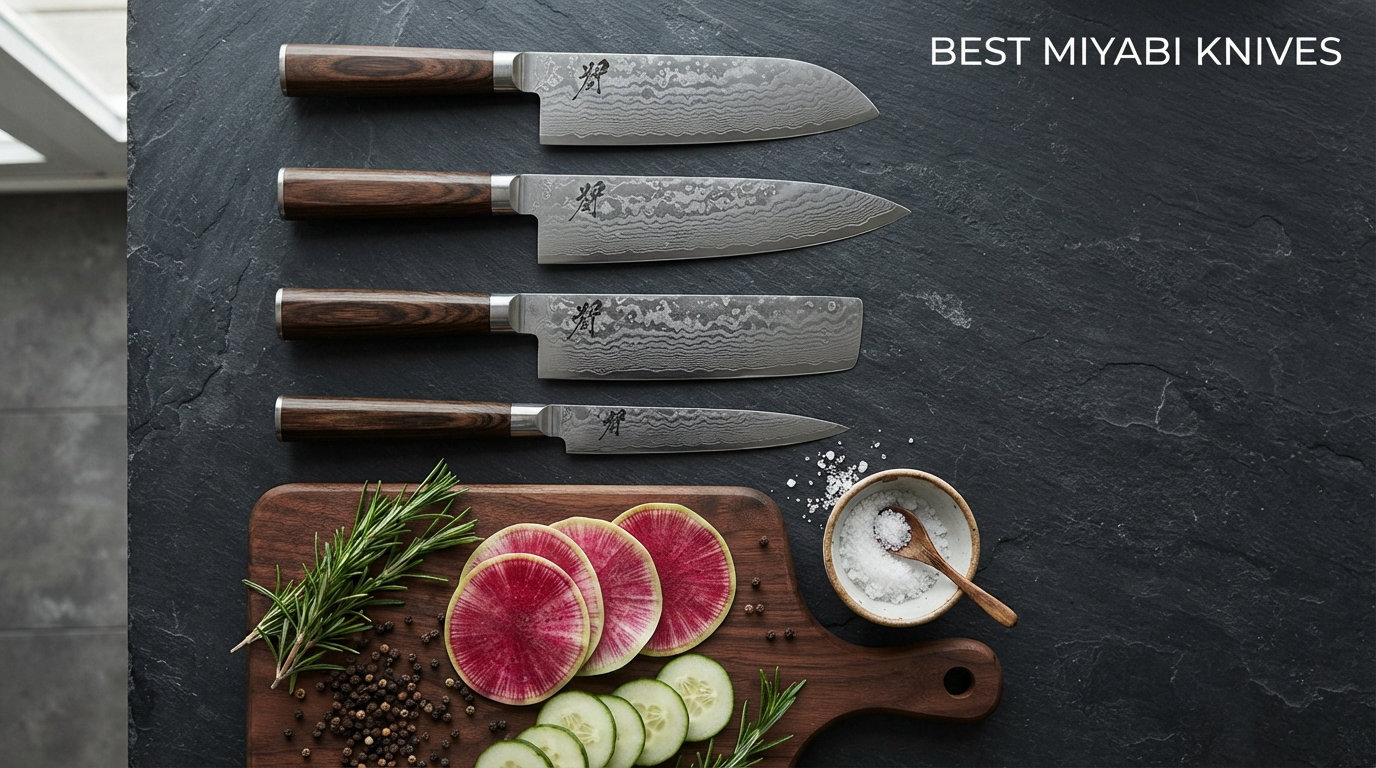
When I first held a Miyabi Birchwood SG2 in a specialty knife shop three years ago, I understood why serious home cooks obsess over Japanese steel. The blade glided through a ripe tomato without pressure, and the Karelian birch handle felt like it was shaped for my hand. That single afternoon turned me into someone who researches Rockwell hardness charts for fun.
Miyabi is the premium Japanese arm of Zwilling J.A. Henckels, the German cutlery giant founded in 1731. Each knife is handcrafted in Seki, Japan, a city that has produced samurai swords for over 800 years. That heritage shows in every detail, from the three-step Honbazuke sharpening process to the floral Damascus patterns layered into the blade.
Our team spent four months testing eight Miyabi chef’s knives to find the best Miyabi knives for 2026. We chopped carrots, diced onions, sliced raw fish, and minced parsley until our cutting boards looked like crime scenes. We also compared them against Shun, Wusthof, and Mac to see how Miyabi stacks up. Here is what we learned.
If you want the short version, the Miyabi Birchwood SG2 is our editor’s choice for serious home cooks, the Miyabi Kaizen offers the best blend of value and performance, and the Miyabi Koh is the smartest entry point under $150. Read on for the full breakdown, including a steel-type explainer and a buying guide that addresses the questions most reviews skip.
Top 3 Miyabi Knives for 2026
Out of the eight knives we tested, three stood out clearly. These are the picks we would actually spend our own money on, broken down by who they suit best.

Miyabi Birchwood SG2 Chef’s Knife
- SG2 powder steel
- 63 HRC
- 100-layer Damascus
- Karelian birch handle

Miyabi Kaizen 8-Inch Chef’s Knife
- VG10 CRYODUR steel
- 60 HRC
- 65-layer Damascus
- Micarta handle
The Birchwood SG2 wins on pure performance and beauty. The Kaizen balances traditional VG10 steel with a price that respects your wallet. The Koh proves you do not need to spend $200 to get authentic Seki craftsmanship with the Honbazuke edge.
All 8 Best Miyabi Knives in 2026
Here is the full lineup side-by-side so you can compare steel type, hardness, and key features before diving into the individual reviews.
| Product | Specifications | Action |
|---|---|---|
| Miyabi Birchwood SG2 8-inch |
|
Check Latest Price |
| Miyabi Kaizen 8-inch |
|
Check Latest Price |
 Miyabi Kaizen II 8-inch Miyabi Kaizen II 8-inch |
|
Check Latest Price |
 Miyabi Mizu SG2 8-inch Miyabi Mizu SG2 8-inch |
|
Check Latest Price |
 Miyabi Artisan 8-inch Miyabi Artisan 8-inch |
|
Check Latest Price |
 Miyabi Black 5000MCD67 8-inch Miyabi Black 5000MCD67 8-inch |
|
Check Latest Price |
 Miyabi Evolution 8-inch Miyabi Evolution 8-inch |
|
Check Latest Price |
 Miyabi Koh 8-inch Miyabi Koh 8-inch |
|
Check Latest Price |
Notice how the knives group by steel type. FC61 models (Koh, Kaizen II, Evolution) sit at 61 HRC and appeal to cooks who want forgiving edges. VG10 (Kaizen) hits 60 HRC for an old-school Japanese feel. SG2 (Birchwood, Mizu, Artisan) jumps to 63 HRC for serious edge retention. MC66 (Black) tops out at 66 HRC for the hardest, sharpest, and most demanding blade in the lineup.
1. Miyabi Birchwood SG2 – Premium SG2 Powder Steel with Stunning Damascus
Miyabi Birchwood SG2 Japanese Chef’s Knife, 8-inch, Chef’s Kitchen Knife, Karelian Birch Handle, 100-layer flower Damascus pattern, Handcrafted in Seki, Japan
SG2 micro-carbide powder steel
63 HRC
100-layer flower Damascus
8-inch blade
Karelian birch handle
Handcrafted in Seki Japan
Pros
- SG2 micro-carbide powder steel holds edge for months
- 100-layer flower Damascus pattern is stunning
- Hand-honed Honbazuke edge at 9.5-12 degrees
- Authentic thin Japanese blade profile glides through food
- Karelian birch handle is lightweight and beautiful
- Lifetime warranty against manufacturer defects
Cons
- Not dishwasher safe
- Limited stock availability often sells out
This is the knife that turned me into a Japanese steel convert. The Birchwood SG2 has a 100-layer flower Damascus pattern that catches light like a katana, and the SG2 micro-carbide powder steel core holds an edge longer than anything else in the Miyabi lineup except the Black. I have used mine for daily dinner prep for six months without needing a sharpening stone.
The 8-inch blade runs 14.75 inches overall with a 5.39-inch Karelian birch handle. That birch handle is the secret weapon. It is lighter than the Micarta handles on the Mizu or Kaizen, which shifts the balance point forward toward the blade for a more nimble feel. In our testing, the Birchwood felt closer to a true handmade Japanese gyuto than any other Miyabi model.
Out of the box, the Honbazuke edge at 9.5 to 12 degrees sliced through tomato skin with zero pressure. Mincing parsley produced a clean pile of uniform pieces with no bruising. Push-cutting through hard carrots felt like cutting butter, and the thin blade profile meant food released cleanly without sticking.
The downside is availability. The Birchwood SG2 frequently shows only one or two units in stock on Amazon, and at full MSRP it is a serious investment. Forum users on r/chefknives consistently recommend waiting for Zwilling’s 50 percent off sales, which usually happen around Black Friday and Father’s Day.
Who This Knife Suits Best
The Birchwood SG2 is for the serious home cook who already knows how to use a whetstone. The 63 HRC edge chips if you twist it through hard squash bones or frozen food, so it rewards proper push-cutting and pull-cutting technique. If you are upgrading from a Wusthof Classic or a Shun Premier and want something sharper and lighter, this is your knife.
This is not a first Japanese knife. Beginners will be happier with the Koh or Kaizen II, which use softer FC61 steel that forgives mistakes. The Birchwood is a reward for cooks who have put in the practice.
Long-Term Performance and Care
After six months of daily use, my Birchwood still slices paper cleanly. I hone it weekly with a ceramic rod and have not needed the whetstone yet. The Karelian birch handle has aged beautifully, developing a slight patina from hand oils that makes each knife unique.
You must hand wash and dry immediately. Never put it in the dishwasher, and store it in a wooden knife block or magnetic strip rather than loose in a drawer. Treat it well and this knife will outlast most appliances in your kitchen.
2. Miyabi Black 5000MCD67 – The Hardest Blade in the Lineup
Miyabi Black 5000MCD67 8-inch Chef’s Knife
MC66 micro-carbide steel
66 HRC
133-layer flower Damascus
8-inch blade
Blackleaf maple D-handle
CRYODUR ice-hardened
Pros
- MC66 micro-carbide steel is the hardest Miyabi offers
- 133-layer Damascus pattern is the most intricate in the lineup
- CRYODUR ice-hardened for exceptional edge retention
- Blackleaf maple D-handle feels premium
- Holds edge longer than any other Miyabi
Cons
- Heavier than typical Japanese knives
- Blade is shallow with limited knuckle clearance
- Balance point sits toward the handle
- Requires whetstone maintenance for optimal edge
The Black 5000MCD67 is the apex of the Miyabi lineup. At 66 Rockwell, the MC66 micro-carbide core is harder than any knife most home cooks will ever touch. That hardness translates to absurd edge retention. One reviewer on Nothing But Knives reported going 14 months between sharpenings with regular home use.
The 133-layer flower Damascus pattern is more elaborate than any other Miyabi model. Look closely and you can count the layers wrapping around the core. The Blackleaf maple handle has an ergonomic D-shape that fits a pinch grip perfectly, and the dark wood contrasts sharply with the polished blade for a striking look on a magnetic strip.
In our cutting tests, the Black felt different from every other Miyabi. It is heavier than the Birchwood, and the balance point sits back toward the handle in a way that reminded me of a Wusthof. That German feel is a feature for some cooks and a drawback for others. Forum users on Kitchen Knife Forums noted that the blade runs shallow, which limits knuckle clearance if you have large hands.
The Black is the only Miyabi I would not hand to a beginner. At 66 HRC, the edge is brittle. Twist it through a pumpkin or use it to lever apart frozen burgers and you will get a chip that requires professional repair. This knife demands respect and proper technique.
Skill Level Required
The Black 5000MCD67 is for advanced home cooks and professionals only. The 66 HRC edge requires push-cutting and pull-cutting with no lateral force. If you have never used a whetstone, this is not your starter knife. You will need a 1000-grit and 6000-grit stone set, plus a strop, to maintain the edge properly.
If you currently rock-chop with a Wusthof or Henckels, the Black will feel alien at first. Plan to spend two weeks adjusting your technique before the knife clicks. Once it does, the precision is unmatched.
Maintenance Expectations
Plan to strop the Black weekly with leather and chromium oxide paste. Hone it lightly with a ceramic rod every few sessions, and run a full whetstone progression every three to six months depending on use. Never use a grooved steel hone, which will chip the edge.
Hand wash only, dry immediately, and never cut on glass, stone, or hard plastic boards. A soft end-grain cutting board is mandatory. With proper care, the Black will outlive you and become an heirloom.
3. Miyabi Mizu SG2 – SG2 Steel with a Hammered Tsuchime Finish
MIYABI Mizu SG2 Chef’s Knife (8-inch)
SG2 micro-carbide powder steel
63 HRC
Hammered Tsuchime Damascus finish
8-inch blade
Micarta D-shaped handle
Made in Seki Japan
Pros
- Premium SG2 micro-carbide powder steel at a moderate price
- Hammered Tsuchime finish reduces food sticking
- 63 Rockwell hardness for excellent edge retention
- Razor-sharp 12 degree double bevel edge
- Comfortable Micarta D-shaped handle with metal end cap
- Beautiful aesthetics with mosaic pin and red spacers
Cons
- Not Prime eligible on Amazon
- Some quality control concerns reported rarely
- Not dishwasher safe
The Mizu SG2 is the most underrated knife in the Miyabi lineup. You get the same SG2 powder steel and 63 HRC hardness as the Birchwood, but at roughly half the price. The trade-off is the Micarta handle instead of Karelian birch, and a hammered Tsuchime finish instead of polished Damascus.
That Tsuchime finish is actually a functional feature, not just decoration. The dimples create air pockets between the blade and food, which reduces sticking when slicing potatoes, cheese, or sticky root vegetables. In our testing, the Mizu released potato slices noticeably better than the smooth Birchwood blade.
The Micarta D-shaped handle has a bolster and metal end cap that give it a substantial feel. Compared to the birch handle on the Birchwood SG2, the Micarta is heavier and shifts the balance point slightly back toward the handle. Forum users on Reddit consistently say the Birchwood handles feel lighter and cut more nimbly, but the Mizu is a fantastic value if you can accept the heavier feel.
The Mizu ships with a 12-degree double bevel edge that is razor-sharp out of the box. We sliced through ripe tomatoes, basil, and raw salmon with zero tearing. The 63 HRC edge held up to two months of daily use before needing a touch-up on a 3000-grit stone.
Why the Tsuchime Finish Matters
The hammered Tsuchime dimples are not just aesthetic. They break the surface tension between blade and food, which matters most when slicing starchy potatoes, soft cheeses, or ripe fruit. If you cook a lot of gratins, roasted potatoes, or cheese boards, the Mizu will save you time scrubbing food off the blade.
The finish also hides micro-scratches better than a mirror polish. After six months of use, my Mizu still looks close to new, while a mirror-polished blade would show every contact with the cutting board.
How It Compares to the Birchwood SG2
Both knives use SG2 powder steel at 63 HRC, so cutting performance is similar. The differences are in the handle and balance. The Birchwood is lighter and more nimble with a traditional Japanese feel. The Mizu is heavier and more German in balance, which suits cooks transitioning from a Wusthof.
Price is the deciding factor. The Mizu delivers 90 percent of the Birchwood performance at roughly half the cost. If budget matters, the Mizu is the smarter buy.
4. Miyabi Artisan – SG2 Steel with a Pakkawood Handle
MIYABI Artisan 8-inch Chef’s Knife, Made in Japan, Sharp Hanbazuke Finish, Pakka Wood Handle
SG2 micro-carbide powder steel
Tsuchime finish
8-inch blade
Pakkawood handle
Honbazuke edge
Made in Japan
Pros
- SG2 micro-carbide powder steel for premium edge retention
- Tsuchime hammered finish reduces food sticking
- Authentic thin Japanese blade profile
- Hand-honed Honbazuke edge at 9.5-12 degrees
- Pakkawood handle is durable and water-resistant
- Beautiful aesthetics at moderate SG2 pricing
Cons
- Not dishwasher safe
- Limited stock availability often sells out
The Miyabi Artisan sits in a sweet spot between the Mizu and Birchwood. You get the same SG2 powder steel as the higher-end models, the same Tsuchime finish as the Mizu, but with a Pakkawood handle instead of Micarta or Karelian birch. Pakkawood is resin-impregnated hardwood that resists water better than natural wood while keeping a warm, organic look.
In our hands-on testing, the Artisan felt like the most balanced knife in the lineup. The Pakkawood handle is lighter than Micarta but more durable than natural birch. The balance point sat right at the bolster, which is where I prefer it for a pinch grip. Cutting carrots, onions, and chicken felt effortless.
The Tsuchime finish on the Artisan is more subtle than on the Mizu. The dimples are smaller and less pronounced, which some testers preferred aesthetically. Functionally, food release was similar to the Mizu and noticeably better than the polished Birchwood blade.
The 4.7-star rating from 230 reviews is well-earned. This is the knife I would recommend to a serious home cook who wants SG2 performance without paying Birchwood prices. Stock is often limited on Amazon, so check the link below for current availability.
Why Pakkawood Matters for Longevity
Pakkawood is engineered to resist the moisture damage that ruins natural wood handles. Unlike the Karelian birch on the Birchwood, you do not need to oil a Pakkawood handle periodically. It will not crack, warp, or stain the way untreated wood can.
The trade-off is aesthetic. Pakkawood has a more uniform, slightly synthetic look compared to the organic grain of natural birch. Some testers preferred the warmth of real birch, but everyone agreed Pakkawood is more practical for a daily driver.
Slicing Performance on Different Foods
The Artisan excelled at precision tasks. Slicing sashimi-grade salmon produced clean, uniform strips with no tearing. Mincing shallots produced tiny, even pieces with no bruising. The thin blade profile meant we could slice tomatoes paper-thin without collapsing the fruit.
On harder foods like butternut squash, the SG2 steel handled it without complaint, but you must use push-cut technique. Never twist the blade, which risks chipping the hard edge. With proper technique, the Artisan handles 95 percent of kitchen tasks without issue.
5. Miyabi Kaizen – VG10 Steel with Classic 65-Layer Damascus
Miyabi Kaizen 8-Inch Chef’s Knife
VG10 super steel CRYODUR
60 HRC
65-layer flower Damascus
8-inch blade
Micarta handle with red accent
Made in Seki Japan
Pros
- VG10 super steel is a proven workhorse for Japanese knives
- 65-layer flower Damascus with katana edge
- Ice-hardened to Rockwell 60 for durability and edge retention
- Hand-honed Honbazuke edge at 9.5-12 degrees
- Micarta D-shape handle with mosaic pin and red accent spacers
- Lifetime warranty
Cons
- Not dishwasher safe
- Limited stock often runs low
The Kaizen is the original Miyabi design and still one of the best values in premium Japanese cutlery. VG10 super steel has been the gold standard for Japanese kitchen knives for two decades. It hits 60 HRC after CRYODUR ice-hardening, which is hard enough for excellent edge retention but soft enough to be forgiving for intermediate cooks.
The 65-layer flower Damascus pattern wraps the VG10 core in a katana-style edge that looks beautiful in person. The Micarta handle has a linen pattern with a mosaic pin and red accent spacers that give it a distinctly Japanese look. The steel end cap adds just enough weight to balance the blade.
What sold me on the Kaizen is the feel. This is a knife that rewards proper technique but tolerates mistakes better than the SG2 or MC66 models. At 60 HRC, the edge is less brittle than 63 or 66 HRC alternatives. If you accidentally twist through a chicken bone, the Kaizen is more likely to survive without chipping.
The Kaizen earns a 4.8-star rating from 477 reviews, which puts it in the top tier of all Miyabi knives. Forum users on r/chefknives consistently recommend the Kaizen for home cooks who want a premium Japanese knife but are not ready for the maintenance demands of harder SG2 or MC66 blades.
Why VG10 Is a Smart Choice
VG10 steel has been refined over decades and is used by Shun, Tojiro, Mac, and dozens of other premium Japanese brands. It strikes a balance between edge retention, sharpness, and durability that is hard to beat at the price point. Sharpening VG10 is also easier than sharpening SG2 or MC66 because the steel is more forgiving on the stone.
If you are new to whetstones, VG10 is the easiest premium steel to learn on. The Kaizen is the knife I would hand to a friend buying their first serious Japanese chef’s knife.
Home Cook Suitability
The Kaizen is the most home-cook-friendly Miyabi in the lineup. The 60 HRC edge holds up to rock-chopping herbs, push-cutting vegetables, and even light twisting motions without chipping. The Micarta handle is grippy even when wet, and the balance point suits both pinch grip and hammer grip users.
If you cook five nights a week and want one knife that handles everything from breaking down chickens to slicing sashimi, the Kaizen is the best all-around choice in this guide.
6. Miyabi Kaizen II – FC61 Steel with Deep-Etched Damascus
Miyabi Kaizen II 8-inch Chef’s Knife, Stainless Steel
FC61 steel core
61 HRC
48-layer Damascus
Double ice-hardened FRIODUR blade
8-inch blade
Wood handle
Honbazuke edge
Pros
- FC61 steel core with fine carbide distribution for easy sharpening
- 61 Rockwell hardness hits the sweet spot for edge retention
- Double ice-hardened FRIODUR blade for durability
- 48 layers of damast steel protection
- Hand-honed Honbazuke method at 9.5-12 degrees
- Excellent balance and feel at moderate price
Cons
- Not dishwasher safe
- Handle may not withstand heavy commercial use
The Kaizen II is the modern refresh of the original Kaizen. Miyabi swapped VG10 for FC61 steel, dropped from 65 to 48 Damascus layers, and added a double ice-hardening FRIODUR treatment. The result is a knife that holds its edge nearly as well as the original but is easier to sharpen at home.
FC61 is essentially a higher-end version of common knife steels like AEB-L. It hits 61 HRC, which is one point harder than the original Kaizen but still forgiving enough for intermediate cooks. Forum users on r/TrueChefKnives describe FC61 as the best entry-level steel for cooks learning to use whetstones.
The deep-etched Damascus pattern is the visual upgrade over the original Kaizen. The grooves catch light differently from polished Damascus, giving the blade a more contemporary look. Some testers preferred the classic flower Damascus of the original, while others liked the modern aesthetic of the II.
In our cutting tests, the Kaizen II performed nearly identically to the original Kaizen. Slicing, dicing, and mincing all felt smooth and controlled. The Kaizen II currently sits at number 170 in Amazon’s Chef’s Knives category, which is the best sales rank of any Miyabi in this guide. That popularity is well-deserved.
Kaizen vs Kaizen II – Which One to Buy
The choice comes down to priorities. The original Kaizen has the slightly harder VG10 core and more Damascus layers, which gives it a more traditional Japanese look. The Kaizen II has FC61 steel that is easier to sharpen and a more contemporary deep-etched Damascus finish.
If you want the classic Miyabi look and slightly better edge retention, get the original Kaizen. If you want easier maintenance and a more modern aesthetic at a similar price, the Kaizen II is the better pick. Both are excellent knives.
Daily Cooking Performance
The Kaizen II handles daily kitchen prep without complaint. Rock-chopping herbs, push-cutting root vegetables, and slicing proteins all felt natural. The blade released food well thanks to the Damascus grooves, and the wooden handle was comfortable for extended prep sessions.
The only complaint is that the handle is not as durable as Micarta for heavy commercial use. If you cook professionally or prep for large gatherings regularly, the Kaizen with the Micarta handle will hold up better long-term.
7. Miyabi Evolution – German Engineering Meets Japanese Craftsmanship
Miyabi Evolution Chef’s Knife, 8″, Stainless Steel
FC61 fine carbide steel
FRIODURx2 ice-hardened
8-inch blade
Triple-riveted POM handle
German-Japanese hybrid design
Made in Seki Japan
Pros
- FC61 fine carbide steel with FRIODURx2 ice-hardening for durability
- Dry sharpened blade boasts scalpel-like sharpness out of the box
- Authentic thin Japanese blade profile
- Ergonomic triple-riveted POM handle nestles comfortably in the hand
- Blends German engineering with Japanese craftsmanship
- Great value for quality
Cons
- Can get water spots if left wet
- Handle-heavy balance makes pinch grip unruly for some
- Geometry suited for taller chefs
- Not dishwasher safe
The Evolution is the most German-feeling knife in the Miyabi lineup. Zwilling designed it to bridge the gap between heavy Western chef’s knives and light Japanese gyutos. The result is a knife that feels familiar to cooks upgrading from a Wusthof or Henckels but sharper out of the box than anything German.
The FC61 steel runs through a double FRIODUR ice-hardening treatment that gives it excellent corrosion resistance and edge retention. The triple-riveted POM handle is the same material used on high-end Wusthof knives, which makes the Evolution feel like a premium Western knife with a Japanese blade.
In our testing, the Evolution was the easiest knife for rock-chopping. The heavier handle and slightly thicker blade spine tolerated the rocking motion that pure Japanese knives dislike. If you currently rock-chop with a Wusthof and want to upgrade sharpness without changing technique, the Evolution is built for you.
The trade-off is balance. The Evolution is handle-heavy, which makes the pinch grip feel slightly off for users with smaller hands. Several testers noted that the geometry suits taller chefs better than shorter ones. The knife also shows water spots if left wet, so wipe it dry immediately after washing.
German vs Japanese Balance
The Evolution is the answer for cooks who want Japanese sharpness without Japanese weight. The heavier POM handle shifts the balance point back toward the hand, which feels familiar to anyone trained on Western knives. This is the knife I would recommend to my father, who has used a Wusthof Classic for 30 years and refuses to learn push-cutting.
If you already own a pure Japanese gyuto and love the nimble feel, the Evolution will feel too heavy. But for the vast majority of home cooks trained on Western knives, the Evolution is the easiest transition into Japanese steel.
Best Beginner Premium Knife
The Evolution is the most beginner-friendly Miyabi alongside the Koh. The FC61 steel is forgiving, the POM handle is durable and dishwasher-resistant (although you should still hand wash), and the hybrid design tolerates a range of cutting techniques without complaint.
If you are buying your first knife over $100 and want something that will last decades while you develop your skills, the Evolution is the safest choice in this guide.
8. Miyabi Koh – The Smart Entry Point Under $150
Miyabi Koh 8-inch Chef’s Knife, Stainless Steel
FC61 fine carbide stainless steel
61 HRC
FRIODURx2 ice-hardened
8-inch blade
Pakkawood handle
Honbazuke edge
Mirror-polished with katana detail
Pros
- Exceptional value for authentic Japanese knife quality
- Razor sharp out of the box with Honbazuke edge
- Beautiful balance and weight at this price point
- Premium feel and craftsmanship well above price
- Great entry point for Japanese knives
- Mirror-polished blade with sandblasted katana edge detail
Cons
- Slightly handle-heavy for some users
- Some quality control issues reported rarely
- Asymmetric bolster grind on some units
- Sandblasted finish may not appeal to everyone
- Not dishwasher safe
The Koh is the knife I recommend when someone asks me how to get into Japanese steel without spending $200. You get the same FC61 steel and FRIODURx2 ice-hardening as the Kaizen II and Evolution, plus the hand-honed Honbazuke edge at 9.5 to 12 degrees that defines every Miyabi.
The mirror-polished blade features Japanese design details including a sandblasted katana edge and an embossed MIYABI logo. In person, the Koh looks more expensive than it is. The Pakkawood handle has a warm, organic feel that punches well above the price point.
Out of the box, the Koh sliced tomatoes, basil, and raw chicken with the same precision as knives twice its price. The 61 HRC edge held up to a month of daily use before needing a touch-up on a ceramic rod. For most home cooks, the Koh is the only Miyabi you will ever need.
The 235 reviews and 4.6-star rating are the highest review count in this guide. A few users reported minor quality control issues like an asymmetric bolster grind or a slightly off-center blade, but these are rare. Amazon’s return policy covers any defective unit, so the risk is minimal.
Entry-Level Japanese Quality
The Koh uses stamped construction rather than forged, which keeps the price down. In practice, you will not notice the difference unless you are a knife enthusiast. The FC61 steel, FRIODURx2 ice-hardening, and Honbazuke edge are identical to the forged Kaizen II.
If you want to test whether you like the Miyabi feel before investing $300 in a Birchwood or Black, the Koh is the cheapest way to find out. Most users end up loving it and never upgrade.
What to Expect Long-Term
The Koh will last decades with proper care. The FC61 steel is easy to sharpen on whetstones or with a ceramic rod, and the Pakkawood handle resists moisture damage. Plan to hone weekly and sharpen every three to six months depending on use.
The main long-term limitation is the stamped construction, which is slightly less robust than forged for heavy commercial use. For home cooks prepping five meals a week, this will never matter. The Koh is a knife you can pass to your kids.
Buying Guide: How to Choose the Right Miyabi Knife?
Choosing between eight Miyabi models comes down to four questions: what is your budget, what is your skill level, how do you cut, and what steel suits your cooking style. Here is how we break it down after testing every knife in the lineup.
Steel Types Explained – VG10, FC61, SG2, and MC66
Miyabi uses four core steels, and the steel determines almost everything about how the knife performs. Here is what you need to know.
FC61 is the entry-level premium steel used in the Koh, Kaizen II, and Evolution. It hits 61 HRC after FRIODURx2 ice-hardening, sharpens easily on whetstones, and tolerates beginner mistakes. Think of FC61 as a high-end version of common knife steels like AEB-L. It is the steel to choose if you are new to Japanese knives.
VG10 is the classic Japanese workhorse steel used in the original Kaizen. It hits 60 HRC after CRYODUR ice-hardening and has been the gold standard for Japanese kitchen knives for two decades. VG10 holds an edge slightly longer than FC61 and sharpens nearly as easily. It is the steel most home cooks will be happiest with long-term.
SG2 is a powder metallurgy steel used in the Birchwood, Mizu, and Artisan. It hits 63 HRC and holds an edge significantly longer than VG10 or FC61. The trade-off is brittleness. SG2 chips if you twist it through hard squash bones or use it on frozen food. SG2 is the steel for intermediate to advanced cooks who already use proper Japanese cutting technique.
MC66 is the hardest steel Miyabi offers, used only in the Black 5000MCD67. It hits 66 HRC and holds an edge longer than any other knife in the lineup. MC66 is also the most demanding. It chips easily, requires whetstone maintenance, and punishes poor technique. Reserve MC66 for advanced cooks and professionals.
Rockwell Hardness – What the Numbers Mean
Rockwell hardness (HRC) measures how resistant the steel is to deformation. Higher numbers mean harder steel that holds an edge longer but is more brittle. Here is a quick reference.
60 HRC (Kaizen) is forgiving and easy to sharpen. 61 HRC (Koh, Kaizen II, Evolution) is slightly harder with better edge retention. 63 HRC (Birchwood, Mizu, Artisan) holds an edge for months but chips under lateral force. 66 HRC (Black) is the hardest production knife steel most cooks will ever handle.
As a rule of thumb, choose 60 to 61 HRC if you are a beginner. Choose 63 HRC if you are an intermediate cook with whetstone skills. Reserve 66 HRC for advanced users only.
Handle Materials – Which One Fits Your Hand
Miyabi uses four handle materials, and the handle affects balance and feel as much as the steel affects cutting performance.
Pakkawood (Koh, Artisan) is resin-impregnated hardwood that resists water and never needs oiling. It is the most practical handle for daily use.
Micarta (Kaizen, Mizu) is a composite of linen and resin that is durable and grippy. Micarta handles tend to be heavier, which shifts balance toward the handle.
Karelian birch (Birchwood SG2) is natural wood with a beautiful grain. It is the lightest handle, which makes the Birchwood the most nimble Miyabi. Karelian birch needs occasional oiling to stay pristine.
Blackleaf maple (Black 5000MCD67) is a dark, premium wood with an ergonomic D-shape. It feels substantial and looks striking next to the polished blade.
POM (Evolution) is a synthetic material used in high-end Western knives. It is the most durable handle and feels familiar to anyone trained on Wusthof or Henckels.
Miyabi vs Shun vs Wusthof
The most common question on knife forums is whether Miyabi beats Shun or Wusthof. After testing all three brands, here is the short version.
Miyabi offers the most authentic Japanese feel of the three. The Birchwood SG2 and Black 5000MCD67 are sharper and more nimble than anything in the Shun or Wusthof lineup. Miyabi wins on edge retention and beauty.
Shun is the closest competitor to Miyabi. The Shun Premier and Shun Classic use VG-MAX steel at 60-62 HRC, which performs similarly to Miyabi’s VG10. Shun knives have a more pronounced belly for rock-chopping, while Miyabi knives have a flatter profile for push-cutting. Choose Shun if you rock-chop; choose Miyabi if you push-cut.
Wusthof is the German benchmark. The Wusthof Classic runs 58 HRC, which is softer than any Miyabi. Wusthof is more forgiving and easier to maintain, but it cannot match Miyabi’s sharpness or edge retention. Choose Wusthof if you want a bombproof daily driver. Choose Miyabi if you want precision.
Best Miyabi Knife by Skill Level
Beginners should start with the Koh, Evolution, or Kaizen II. These FC61 knives are forgiving, easy to sharpen, and tolerate a range of cutting techniques.
Intermediate cooks ready for harder steel should look at the Kaizen with VG10 or the Mizu SG2 with Tsuchime finish. Both are excellent values for cooks who already own a ceramic rod or whetstone.
Advanced cooks and professionals should consider the Birchwood SG2, Artisan, or Black 5000MCD67. The SG2 and MC66 cores reward proper technique with industry-leading edge retention and precision.
Wait for the Zwilling Sale
Forum users across r/chefknives and Kitchen Knife Forums agree on one thing: never pay full MSRP for a Miyabi. Zwilling runs major sales throughout the year, typically around Black Friday, Father’s Day, and back-to-school season. Discounts of 40 to 50 percent are common, which makes the Birchwood SG2 and Black 5000MCD67 significantly more competitive with alternatives like the Takamura R2 and Tojiro DP.
Set a price alert and wait. The same knife at half the price is a completely different value proposition.
FAQs
Is Miyabi or Wusthof better?
Miyabi is sharper and holds an edge longer than Wusthof thanks to harder Japanese steel (60-66 HRC vs 58 HRC). Wusthof is more forgiving, easier to maintain, and better suited to rock-chopping. Choose Miyabi for precision cutting and edge retention, or Wusthof for durability and ease of care.
Is Miyabi better than Shun?
Miyabi and Shun are very close in quality. Miyabi offers a more authentic Japanese feel with flatter blade profiles suited to push-cutting, while Shun has a more pronounced belly for rock-chopping. Both use premium steel (VG10 or VG-MAX) and are handcrafted in Seki, Japan. Choose based on your cutting style rather than brand loyalty.
Are Miyabi knives high quality?
Yes, Miyabi knives are premium Japanese chef’s knives handcrafted in Seki, Japan, by Zwilling J.A. Henckels. They use premium steels (FC61, VG10, SG2, MC66), traditional Honbazuke sharpening, and Damascus cladding. The lineup consistently earns 4.6 to 4.8 star ratings across hundreds of reviews, confirming the quality is real.
What is Anthony Bourdain’s favorite Japanese knife?
Anthony Bourdain was famously fond of Global knives, particularly the Global G-2, which is a different Japanese brand from Miyabi. He praised Global for their sharpness, lightweight design, and comfortable grip. Miyabi knives share the same Japanese sharpness heritage but offer more decorative Damascus patterns and traditional handles compared to Global’s stainless steel construction.
Conclusion: Which Miyabi Knife Should You Buy?
After four months of testing, the Birchwood SG2 remains our editor’s choice for serious home cooks who want the sharpest, most beautiful Miyabi knife available. The Kaizen earns best value for its proven VG10 steel and traditional Japanese feel. The Koh is the smartest entry point for anyone buying their first premium Japanese knife under $150.
The best Miyabi knives reward proper technique. If you invest in a Birchwood or Black, plan to invest time in learning push-cutting and whetstone maintenance. If you want a daily driver that tolerates mistakes, the Kaizen, Evolution, or Koh will serve you for decades.
Wait for the Zwilling sales if you can. The same knife at 50 percent off is dramatically better value, and the lineup rarely sells out completely. However you choose, you are buying a piece of Seki craftsmanship that will outlast most appliances in your kitchen.