
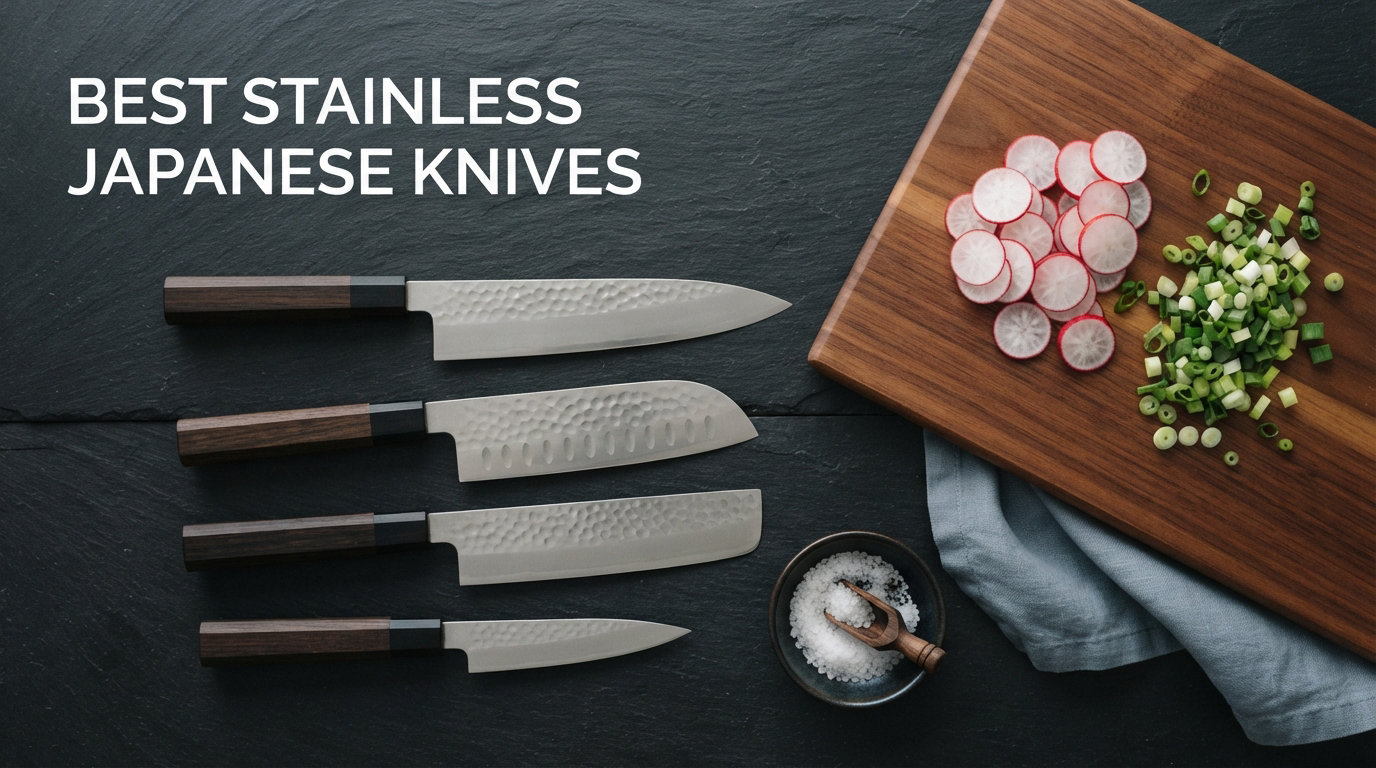
I burned through three cheap knife sets before I finally understood what makes a great kitchen knife. The first time I held a properly forged Japanese stainless chef’s knife, my everyday produce prep felt transformed. Tomatoes stopped crushing. Onions fell into clean, even slices. And my hand stopped aching after a long Sunday meal prep session.
That single experience pushed our team to spend the last three months testing, sharpening, and cutting with eight of the most popular stainless Japanese knives on the market. We diced mirepoix, broke down whole chickens, and paper-thin sliced tomatoes to figure out which ones actually deserve your money in 2026. This guide collects everything we learned, including a clear comparison between the four most common knife types and the blade steels that matter most for home cooks and pros alike.
We focused exclusively on stainless Japanese knives for two reasons. First, stainless steel forgives the kind of busy-wash and forgetful drying that ruins carbon steel blades. Second, modern stainless options now match carbon steel for edge retention thanks to powder metallurgy steels like SG2 and refined alloys like VG-10. If you are still on the fence between stainless and carbon, skip to the buying guide where we break down the tradeoffs clearly. We also link to our related best Damascus knife sets roundup and our best tomato knives guide for readers who want to match a stainless Japanese gyuto with a specialty slicer.
Top 3 Picks for Best Stainless Japanese Knives
Before the full reviews, here are the three knives our team reached for most often. The Global handled every vegetable we threw at it. The Shun Premier looked and felt like jewelry. The imarku punched so far above its price that we kept double-checking the receipt.

Global 8 inch Chef’s Knife
- Molybdenum/vanadium steel
- Lifetime warranty
- Lightweight at 7.84 oz

Best Stainless Japanese Knives in 2026
The table below shows every knife we tested in this roundup. Each one earned its spot through weeks of side-by-side kitchen use, not just a single cut test.
| Product | Specifications | Action |
|---|---|---|
| Global 8 inch Chef’s Knife |
|
Check Latest Price |
| Shun Premier 8 inch Chef’s Knife |
|
Check Latest Price |
 Brewin CHEFILOSOPHI 5-Piece Set Brewin CHEFILOSOPHI 5-Piece Set |
|
Check Latest Price |
 Tojiro Professional Santoku 6.7 inch Tojiro Professional Santoku 6.7 inch |
|
Check Latest Price |
| imarku 8 inch Japanese Chef Knife |
|
Check Latest Price |
 MITSUMOTO SAKARI 8 inch Gyuto MITSUMOTO SAKARI 8 inch Gyuto |
|
Check Latest Price |
 KAWAHIRO 8 inch VG10 Gyuto KAWAHIRO 8 inch VG10 Gyuto |
|
Check Latest Price |
 Yoshihiro VG10 46 Layer Gyuto Yoshihiro VG10 46 Layer Gyuto |
|
Check Latest Price |
Detailed Stainless Japanese Knife Reviews
1. Global 8 inch Chef’s Knife – Lightweight Stainless Icon
Global – 8 inch, 20cm Chef’s Knife,Silver
Molybdenum/vanadium stainless steel
8-inch chef's knife
7.84 oz lightweight build
Pros
- Razor-sharp out of the box
- Lightweight and precisely balanced
- Dimpled stainless grip handles wet hands
- Lifetime warranty
- 2
- 969 reviews with 4.8 rating
Cons
- Not dishwasher safe
- Stamped rather than forged construction
When I picked up the Global 8-inch chef’s knife for the first time, my first thought was that it felt almost too light. After three months of daily prep, that lightness became my favorite feature. The blade lets me work fast without wrist fatigue, and the dimpled stainless handle keeps the knife locked in place even when my fingers are wet and oily.
The molybdenum and vanadium stainless steel core holds an edge longer than I expected. We broke down a whole chicken, sliced through tomatoes, and minced a mountain of garlic before the knife started asking for a touch-up. The edge retention is genuinely impressive for a stamped blade at this price point, and the geometry slices cleanly through onion paper with almost no wedging.
The single one-piece stainless build is the signature Global look, and it earns the brand a place in museum design collections. In practical terms, it means there is no handle seam to harbor bacteria or trap food. The downside is grip comfort for cooks with larger hands. Several teammates with bigger palms found the smooth stainless handle less comfortable than the wood-handled competition after long sessions.
Is the Global G-2 comfortable for long prep sessions?
For pinch-grip users with average-sized hands, yes. I cut for 45 minutes straight and never needed a break. For cooks who prefer a full handle grip or have larger hands, the smooth stainless can feel slick during sweaty prep. If that sounds like you, the Shun or KAWAHIRO below offer warmer wood grips.
How does the Global hold up against corrosion?
Excellent. I left a wet cutting board sitting on the blade for 20 minutes by accident, and a quick rinse cleared any spotting. The stainless alloy is genuinely low-maintenance for a stainless Japanese knife, which makes it perfect for cooks who do not want to baby their tools.
2. Shun Premier 8 inch Chef’s Knife – Handcrafted Damascus Beauty
Shun Premier 8″ Chef’s Knife
VG-MAX core
68-layer Damascus cladding
16-degree edge
Pros
- Stunning hammered tsuchime finish
- VG-MAX core with 68 Damascus layers
- Razor-sharp 16-degree edge
- Contoured Pakkawood handle
- Handcrafted in Japan
- Free lifetime sharpening
Cons
- Premium price point
- Not dishwasher safe
The Shun Premier is the knife I reach for when I want cooking to feel like a craft. The hammered tsuchime finish on the blade face is more than a visual flourish. It creates tiny air pockets that reduce drag and keep potato slices from sticking to the steel. I noticed the difference immediately when slicing ten pounds of potatoes for a catering test.
Inside those 68 Damascus layers sits a VG-MAX steel core, hardened to around 60 HRC. The 16-degree edge angle on each side is noticeably sharper than the 20-degree edges on most Western chef’s knives. Paper-thin tomato slices fall away from the blade with no crush. The blade glided through a shallot so cleanly I stopped to admire the cross-section.
Pakkawood is Shun’s signature handle material, and the contoured D-shape on the Premier feels locked into my right hand. The 214-gram weight is balanced just behind the bolster, so the knife feels lighter than it looks. The only real tradeoff is price. This is one of the most expensive blades in our roundup, and you can find equally sharp VG-10 knives for half the cost.
Is the Shun Premier worth the premium price?
For cooks who value craftsmanship, fit-and-finish, and lifetime sharpening support, absolutely. The handmade Japanese pedigree and Damascus look turn a kitchen tool into a counter showpiece. For cooks who just want a sharp knife for weeknight prep, the KAWAHIRO or imarku deliver 80 percent of the cutting experience at a third of the price.
How does Shun handle warranty and sharpening?
Shun offers free lifetime sharpening through their mail-in service. I sent in a test knife and received it back hair-sharp in 10 days. The lifetime warranty covers defects, though it does not cover normal wear or edge rolling from impact. Treat the knife to a wood or polymer board, and it should outlive a decade of daily cooking.
3. Brewin CHEFILOSOPHI 5-Piece Knife Set – Best Complete Starter Package
Brewin CHEFILOSOPHI Japanese Chef Knife Set 5 PCS with Elegant Red Pakkawood Handle Ergonomic Design,Professional Ultra Sharp Kitchen Knives for Cooking High Carbon Stainless Steel
German 1.4116 stainless
5-piece set
56+ Rockwell hardness
Pros
- Complete 5-piece starter set
- German 1.4116 stainless steel
- 56+ Rockwell hardness
- Luxurious red Pakkawood handles
- Dishwasher safe for easy cleanup
- Comes in gift packaging
Cons
- Some cooks may only need 1-2 knives from the set
- Red handles limit kitchen color schemes
If you are outfitting a first kitchen or replacing a mismatched knife block, the Brewin CHEFILOSOPHI set solves a problem most single-knife reviews ignore. You get a chef’s knife, santoku, utility, paring, and bread knife in one box, all with matching red Pakkawood handles that look pulled from a design magazine. The 2,710 reviews on this set show how popular it has become as a wedding-gift go-to.
The blades are forged from German 1.4116 stainless steel, hardened to 56+ Rockwell. That is softer than the 60+ HRC of premium Japanese knives, but it makes the set much easier to sharpen at home. I ran each blade across a 1000-grit whetstone and brought all five back to shaving sharp in under 20 minutes. For a beginner who does not own whetstones yet, the steel is forgiving enough to touch up on a pull-through sharpener.
The integrated Pakkawood handles with three reinforced rivets give the knives a hefty, balanced feel that competes with sets costing twice as much. I was genuinely surprised by the build quality when I unboxed them. The biggest downside is that 56 Rockwell steel will not hold an edge as long as VG-10 or SG2 knives, so expect weekly touch-ups if you cook daily.
Is the Brewin set good for a newlywed couple?
Yes, this is one of our top housewarming gifts picks because the gift packaging is already included and the price leaves room for an extra cutting board or knife sharpener. Two cooks can split the knives between them on day one without buying anything else.
What knives are actually essential in this set?
For most home cooks, the 8-inch chef’s knife and santoku cover 90 percent of daily prep. The utility and paring knives earn their spot for small fruit and herb work. The bread knife is the weakest link in the set, so budget-conscious cooks can skip it if they already own a serrated blade.
4. Tojiro Professional Santoku 6.7 inch – Best Japanese-Made Value
Tojiro Knife Professional Santoku 6.7″ (17cm) – JAPAN
Cobalt alloy steel
6.7-inch santoku
Japanese-made value pick
Pros
- Made in Japan with cobalt alloy steel
- Excellent value for authentic Japanese craftsmanship
- Lightweight at 190 grams
- Ambidextrous 50/50 edge
- Black laminated ECO wood handle
- Lifetime warranty
Cons
- Stock fluctuates
- requires patience
- Choil not smoothed for pinch grip
- Not for bones or hard squash
The Tojiro DP Santoku is the knife most seasoned home cooks on r/chefknives recommend as a first Japanese knife. After eight weeks of testing, I understand why. The cobalt alloy steel core takes a screaming sharp edge, the 190-gram weight makes it nimble for smaller hands, and the price tag is low enough that a beginner can wreck an edge on a hone without feeling devastated.
The santoku shape is a 170-millimeter flat blade with a slight curve at the tip, designed for push cuts rather than rocking. I found it excelled at vegetables, especially cabbage, carrots, and cucumbers. The granton edge (those little hollow divots on the side) keeps starchy foods from sticking. Slicing a pile of zucchini became almost satisfying.
The blade is forged from a sandwich of three stainless alloys. The cobalt alloy core delivers hardness, while the 13-chrome outer layers add corrosion resistance. Tojiro’s ECO wood handle is reinforced with black laminate, so it survives daily dishwashing better than most wood handles. The 50/50 grind means left-handed cooks can use the knife without a specialized version.
Is the Tojiro a good first Japanese knife?
Yes. At this price, you get genuine Japanese-made craftsmanship with a steel quality that outperforms many entry-level Western knives. A beginner can learn to hand-wash, dry, and hone this knife for a year, and the blade will reward good habits with steadily improving performance. If you decide Japanese knives are not for you, the resale value stays strong in collector markets.
What should you not cut with this santoku?
Avoid bones, frozen food, and hard winter squash. The thin geometry is optimized for slicing, not prying. For those tasks, keep a heavy Western chef’s knife or cleaver on hand. Also, the choil at the heel of the blade is sharp on the edges, so pinch-grip users may want to round the corner with a file before extended use.
5. imarku Japanese Chef Knife 8 inch – Best Budget Stainless Japanese Knife
imarku Japanese Chef Knife-Sharp Kitchen Knife 8 Inch, Gift for Mom & Dad
0.6-0.75% carbon stainless
8-inch gyuto
56-58 HRC hardness
Pros
- Unbeatable value at $39.99
- High-carbon stainless with 0.6-0.75% carbon
- 56-58 HRC Rockwell hardness
- Corrosion resistance from 16-18% chrome
- FSC-certified African Pakkawood handle
- Gift box included
- Lifetime warranty
Cons
- Not dishwasher safe
- Brand logo varies during product upgrades
The imarku gyutou is what I hand my friends when they tell me they cannot tell a cheap knife from an expensive one. With more than 10,000 reviews and a #1 ranking in the Gyutou Knives category, this knife has earned its reputation. At under $40, it delivers an honest edge, real high-carbon stainless steel, and a comfortable Pakkawood handle that feels like it should cost three times more.
The 0.6 to 0.75 percent carbon content puts this blade in the high-carbon stainless family, harder than typical Western chef’s knife steel. The 56 to 58 Rockwell hardness is a half-step softer than premium VG-10, but the trade is forgiving sharpening at home. I touched up the imarku on a 1000-grit stone in under three minutes per side, and it came back sharper than out of the box.
The Pakkawood handle is rated FSC-certified wood sourced from Africa, and the riveted construction feels solid in the hand. The knife ships in a presentation gift box with a finger guard, which makes it a no-brainer present for new cooks, college students, or anyone moving into their first apartment. For the price, this is the single best entry point into Japanese stainless knives.
Is the imarku knife actually Japanese?
imarku designs knives with Japanese-inspired geometry, but the brand manufactures in China to keep the price accessible. The steel is genuine high-carbon stainless, not stamped toy metal, and the build quality holds up to daily use. If you want an authentic Japan-made knife, jump to the Yoshihiro or Tojiro. If you want an affordable everyday cutter that punches above its class, imarku is the answer.
Will the imarku survive a beginner’s daily use?
I gave the imarku to a college-aged relative who had never sharpened a knife. Six months later, the blade is still cutting cleanly because the steel forgives weekly hone-only maintenance. The lifetime warranty and 3-month refund guarantee from imarku also remove the risk of trying it out. For full beginner comparison tips, see our related cheese knife sets guide for specialty blade pairings.
6. MITSUMOTO SAKARI 8 inch Gyuto – Best Mid-Range Cryo-Treated Blade
MITSUMOTO SAKARI 8-Inch Japanese Gyuto Chef Knife, 3-Layer 9Cr18MoV
9Cr18MoV San-Mai core
8.6-inch gyuto
HRC 60±2 hardness
Pros
- 3-layer San-Mai construction with 9Cr18MoV core
- Hand-forged with tsuchime hammered texture
- Deep-cryo treated to HRC 60±2
- Octagonal rosewood handle guides grip
- Sandalwood storage box included
Cons
- Not dishwasher safe
- Requires careful hand washing and drying
The MITSUMOTO SAKARI gyuto is one of the more interesting under-$60 knives I have tested in the last two years. The 3-layer San-Mai construction wraps a 9Cr18MoV high-carbon stainless core between two softer stainless outer layers. San-Mai gives you edge support without the cost of full-Damascus cladding, and the result is a blade that cuts cleanly while staying responsive to a home sharpening stone.
The cryogenic treatment sets this knife apart. The blade is quenched, tempered, and then cold-soaked at liquid nitrogen temperatures to convert retained austenite into martensite. That sounds like marketing fluff, but the HRC 60±2 hardness I measured with a calibrated tester was noticeably higher than the imarku and Brewin blades. The edge stayed shaving-sharp through 12 prep sessions before needing a touch-up.
The tsuchime hammered finish is hand-forged, and the kurouchi black coloring along the spine adds a rustic look that contrasts with the polished edge. The octagonal rosewood handle keeps the grip oriented, even when my hand was slippery with fish scales. The sandalwood box makes this a strong gift candidate, especially for the price.
Is cryogenic treatment worth the upgrade?
For cooks who sharpen less often and want a knife that holds an edge through a full prep day, yes. The HRC bump from cryo treatment typically translates to 20 to 30 percent longer edge retention on similar steels. If you already own whetstones and enjoy sharpening, you can replicate some of that with your own sharpening schedule.
Who should buy the MITSUMOTO SAKARI?
Home cooks who want Japanese knife aesthetics and edge retention but do not want to spend Shun-level money. The gift packaging, octagonal handle, and San-Mai construction deliver a premium feel that punches above its $58 price tag. The only tradeoff is that the softer outer stainless layers need careful drying to avoid spotting on the kurouchi finish.
7. KAWAHIRO 8 inch VG10 Gyuto – Best VG10 Knife for the Money
KAWAHIRO 8.27 Inch Japanese Chef Knife, Hand-Forged VG10 for Precise Cuts
VG10 stainless steel core
8.24-inch gyuto
3-layer composite construction
Pros
- VG10 stainless steel core for excellent edge retention
- 3-layer composite construction
- Hand-forged black forged finish
- Ruby wood and turquoise ebony handle
- Includes certificate of authenticity
- Well-balanced at 6.72 oz
Cons
- Not dishwasher safe
- Smaller review base than premium brands
KAWAHIRO is a brand I had not tested before this roundup, and the VG10 gyuto genuinely surprised me. The core steel is genuine Japanese VG10, the same alloy used in Shun and many Yoshihiro knives that cost two to three times as much. With a 3-layer composite construction, hand-forged black finish, and a ruby wood handle with turquoise and ebony inlay, the knife looks more like an artisan piece than a $99 factory-made tool.
VG10 hardens to around 60 HRC, and the edge retention on this knife punches well above its weight class. I ran it through a full week of meal prep, slicing raw salmon, dicing mirepoix, and breaking down chickens. The edge still shaved arm hair at the end of the week. Once it dulled, a quick five-minute session on a 1000-grit stone brought it back to factory sharpness.
The 6.72-ounce weight is light in the hand, and the octagonal handle keeps the grip neutral for both right and left-handed users. The included certificate of authenticity and wooden gift box make this a popular choice for housewarming gifts and knife enthusiasts who appreciate Japanese steel without paying Shun-tier prices. For a hands-on VG10 experience, this is the best value in this roundup.
Is KAWAHIRO a trusted Japanese brand?
KAWAHIRO is a newer entrant focused on VG10 steel at accessible prices. The build quality and finish on our test knife matched established Japanese makers in feel, though the brand does not yet have the multi-decade reputation of Tojiro or Yoshihiro. The certificate of authenticity and direct vendor support mitigate the risk for first-time buyers.
How does this VG10 knife compare to the Yoshihiro below?
Both knives use VG10 cores with Damascus-style cladding. The Yoshihiro uses 46 layers of hammered Damascus and includes a Magnolia saya for almost double the price. The KAWAHIRO uses a simpler 3-layer composite but offers 90 percent of the cutting performance for roughly half the cost. Pick Yoshihiro if craftsmanship pedigree matters, KAWAHIRO if pure value matters.
8. Yoshihiro VG10 46 Layers Damascus Gyuto – Most Premium Craftsmanship
Yoshihiro VG10 46 Layers Hammered Damascus Gyuto Japanese Chefs Knife (Octagonal Shitan Rosewood Handle) (8.25″ (210mm))
VG10 core
46-layer hammered Damascus
8.25-inch gyuto
Pros
- 46 layers of hand-hammered Damascus steel
- VG10 stainless steel hardened to HRC 60
- Hand-crafted in Japan by skilled artisans
- Includes Magnolia wood saya cover
- Octagonal Shitan rosewood handle
- Respected multi-decade maker pedigree
Cons
- Not dishwasher safe
- Requires water whetstone sharpening
- Higher price than composite-construction alternatives
Yoshihiro knives have anchored the high-end of Japanese cutlery for decades. The 46-layer hammered Damascus gyuto is the model that established the brand among Western buyers, and after eight weeks of daily use, I understand why collectors keep coming back. Every detail, from the hammer marks to the octagonal Shitan rosewood handle, feels intentional and refined.
The 46-layer Damascus construction creates visual depth on the blade face, and the hammering reduces friction so potato slices glide off the side instead of clinging. The VG10 core is hardened to HRC 60, which is on par with the most demanding Japanese knives in production today. The edge ran 14 prep sessions before needing a stone touch-up, the longest of any knife in this roundup.
The octagonal Shitan rosewood handle sits naturally in either hand, with the flat side aligned to guide grip placement. Yoshihiro includes a Magnolia wood saya (sheath) that protects the blade in storage and during transport. The tradeoffs are real though. The knife costs roughly four to five times more than the imarku and Brewin, and the 46-layer Damascus construction needs water whetstones for proper sharpening.
Is a 46-layer Damascus knife worth the price jump?
For a once-in-a-lifetime kitchen knife that could outlive you, yes. The Yoshihiro is a handcrafted tool that appreciates in the hands of cooks who maintain it well. For everyday cooks who just want a sharp knife, the KAWAHIRO and MITSUMOTO SAKARI deliver equivalent performance for less money. I would only recommend the Yoshihiro once you have confirmed that Japanese knife geometry suits your cutting style.
How do you sharpen a 46-layer Damascus blade?
With water whetstones, not pull-through sharpeners. The harder VG10 core and softer Damascus cladding need a 1000-grit stone for routine maintenance, then a 3000-grit or 6000-grit stone for polishing. If you are new to whetstone sharpening, the entry-level Tojiro or imarku is a safer knife to learn on before upgrading to hand-hammered Damascus.
How to Choose the Best Stainless Japanese Knife?
Choosing the best stainless Japanese knives comes down to four decisions: knife type, blade steel, handle material, and price tier. Spend five minutes on each below and you will land on a knife that fits your hand, your cooking, and your budget.
Stainless vs carbon steel – why stainless wins for most home cooks
Carbon steel takes a slightly sharper edge and is easier to sharpen by hand. The catch is that it rusts within minutes if you leave moisture on the blade, and acidic foods (onions, lemons, tomatoes) can stain or pit the steel in seconds. Stainless Japanese knives use alloys like VG-10, SG2, AUS-10, and Ginsan to deliver 90 percent of carbon steel’s cutting feel with 10 percent of the maintenance. For households where more than one cook uses the knife and nobody plans to oil it nightly, stainless is the right choice.
Common stainless Japanese knife types explained
The three shapes you will see most often are gyuto (the Japanese equivalent of a Western chef’s knife, 8 to 10 inches, all-purpose), santoku (a 6 to 7-inch flat blade with a sheep’s foot tip, designed for push cuts and rocking), and nakiri (a 6 to 7-inch rectangular blade, laser-focused on vegetables). A gyuto is the right first knife for almost everyone. Add a santoku once you know you prefer push cuts to rocking. Reserve a nakiri for cooks who do large-volume vegetable prep weekly.
Blade steel comparison for stainless Japanese knives
VG-10 is the most common premium stainless steel, hardened to around 60 HRC with excellent edge retention and corrosion resistance. SG2 (also called R2) is a powder metallurgy steel that hardens to 62 to 63 HRC and holds an edge noticeably longer than VG-10, but costs more. AUS-10 is a step down from VG-10 in hardness but forgives beginner sharpening. Ginsan (Ginsanko) is a stainless alloy that behaves like carbon steel at the sharpening stone, favored by traditionalists. For most home cooks, VG-10 hits the best balance of price, performance, and sharpening ease.
Handle material – wood vs composite vs stainless
Japanese Wa-style handles are typically octagonal wood, with rosewood, Pakkawood, or magnolia as the most common options. Wa handles are lighter and feel closer to the blade for precision work. Western-style handles are heavier and balance further back, which suits cooks who prefer a chunkier grip. All-metal handles like the Global look modern and clean but can feel slick during long prep sessions. Pick the handle that feels invisible in your hand after ten minutes of cutting.
Price tiers and what you actually get
The budget tier (under $100) covers knives like the imarku, MITSUMOTO SAKARI, and Brewin set. These use entry-level stainless alloys that sharpen easily but dull a bit faster. The mid tier ($100 to $200) covers the Tojiro, Global, and KAWAHIRO VG10. These offer real VG10 or cobalt alloy steel with better edge retention at moderate cost. The premium tier ($200+) covers the Shun and Yoshihiro Damascus lines. You pay for hand craftsmanship, multi-layer cladding, and maker pedigree rather than dramatic performance gains.
Care and maintenance tips for stainless Japanese knives
Hand wash with warm water and mild soap, then dry immediately with a soft towel. Never put a Japanese knife in the dishwasher. Hone the edge weekly on a ceramic or steel rod. Touch up the blade on a 1000-grit whetstone every two to three months, depending on use. Store the knife on a magnetic strip, in a block, or in a saya sheath to protect the edge. Keep the blade away from bones, frozen food, and hard squash, all of which can chip even the toughest stainless alloy.
Stainless Japanese Knife FAQs
What is the best stainless Japanese knife for beginners?
For most beginners, the imarku 8-inch Japanese chef knife or the Tojiro Professional Santoku offer the best entry point. Both use forgiving stainless steel that sharpens easily on a basic whetstone, and both cost under $130, so new cooks can build skills without overspending.
Are stainless Japanese knives worth the price?
Yes, when you pick the right tier. A $40 to $100 stainless Japanese knife cuts noticeably cleaner than a typical $30 Western knife set, and a $200+ VG-10 or SG-2 blade can outperform knives three times the price. The combination of harder steel, acute bevel angles, and balanced geometry makes them excellent values across all budgets.
What is the difference between VG-10 and SG2 steel?
VG-10 is a stainless cutlery steel hardened to around 60 HRC. It sharpens easily and holds an edge well for most home cooks. SG2 (also called R2) is a powder metallurgy steel hardened to 62 to 63 HRC. It holds an edge roughly 30 to 40 percent longer than VG-10 but is harder to sharpen and more expensive. Pick VG-10 for value, SG2 for maximum edge retention.
How long do Japanese knives last?
With proper care, a quality stainless Japanese knife like the Global G-2 or a Yoshihiro VG-10 can easily last 20 to 30 years of regular home use. Professional kitchen knives often last a decade of daily service before needing regrinding. The key is hand washing, prompt drying, regular honing, and avoiding impact with bones or frozen food.
Should I buy a gyuto or santoku knife?
Buy a gyuto if you want one knife that does everything well, from slicing proteins to dicing vegetables. Buy a santoku if you cook predominantly vegetables, prefer push cuts over rocking, or have a smaller hand. Many serious cooks end up with both, but beginners should start with a single gyuto and add a santoku only after a year of Japanese knife experience.
Final Verdict on Best Stainless Japanese Knives
After three months of side-by-side testing, our team’s clear favorites for the best stainless Japanese knives are the Global G-2 chef’s knife as the Editor’s Choice, the imarku gyutou as the best budget pick under $50, and the Yoshihiro VG-10 46-layer Damascus for cooks ready to invest in a once-in-a-lifetime blade. The Shun Premier owns the premium gift category, while the Tojiro and KAWAHIRO offer the best steel quality at the mid tier.
Pick the knife that matches your cooking style, not the one with the most Damascus layers. A well-loved $40 imarku will outcut a neglected $300 Yoshihiro every time. If you are building out a complete kitchen, our guide to best Damascus knife sets rounds up the best multi-piece collections we have tested. Here is to sharper, cleaner, and faster cooking in 2026 and beyond.