
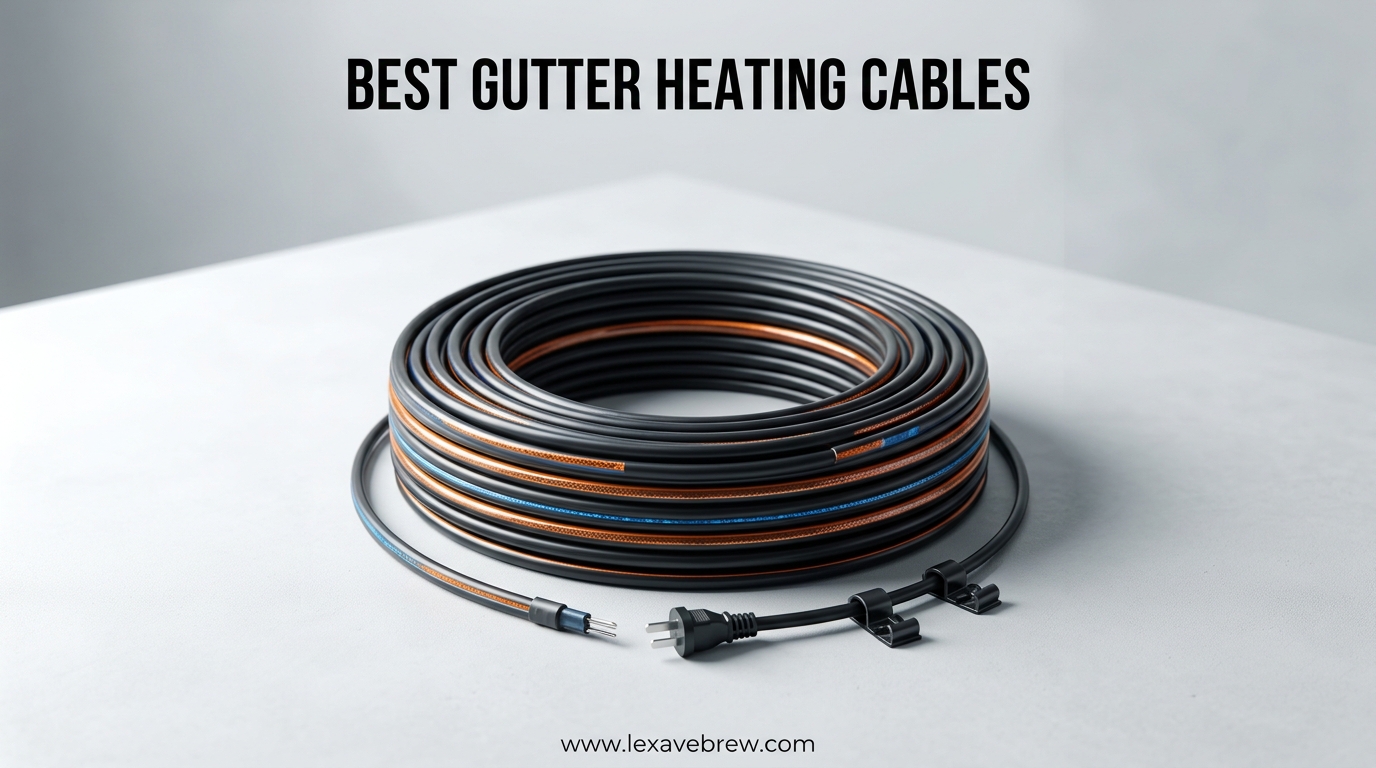
Ice dams are not just a winter nuisance. A single cubic foot of ice weighs close to 57 pounds, and when that weight stacks up inside your gutters, it can rip them clean off the fascia, buckle downspouts, and send meltwater backing up under your shingles and into your ceiling. I have seen the damage firsthand, and the repair bills routinely land between $2,000 and $10,000 for a single bad freeze-thaw cycle. The best gutter heating cables stop that cycle before it starts by keeping a thin melt channel open along the roof edge, through the gutter, and down the downspout so water always has somewhere to go.
If you are shopping for the best gutter heating cables in 2026, you are probably staring at dozens of listings that all look similar on the surface. The reality is that there are two fundamentally different technologies hiding behind those listings, and buying the wrong type can cost you in wasted electricity, fire risk, or a cable that dies after one season. This guide walks through 12 specific products I have compared across wattage, certifications, warranty, and real customer feedback, so you can match the right cable to your roof, your climate, and your budget.
Our top pick overall is the Radiant Solutions Heat Tape Pro, a self-regulating commercial-grade cable with a 10-year warranty, UL listing, and a patented GlowCap that tells you at a glance whether the cable is live end to end. We also called out a strong value pick from YeloDeer and a budget-friendly option from HEATIT. Below you will find a quick comparison table, individual reviews of all 12 cables, a buying guide with a gutter measurement walkthrough, an operating cost breakdown with real math, and answers to the questions homeowners ask most often.
Top 3 Gutter Heating Cables for 2026
These three rose to the top across wattage, warranty, certification, and verified customer reviews. Each one is built for a different type of buyer, but all three will keep your gutters flowing through a harsh winter.

YeloDeer 120 FT Industrial Gutter Heater
- Self-regulating 8W/ft
- 120V
- indicator light
- industrial grade

HEATIT HIRD 60 ft Roof and Gutter Cable
- Constant wattage 5W/ft
- ETL and CSA certified
- pre-assembled
Best Gutter Heating Cables in 2026 – Quick Comparison
Use this table to scan all 12 options at a glance. I have pulled the wattage, certification, type, and standout feature for each so you can shortlist before diving into the reviews.
1. Radiant Solutions Heat Tape Pro – The Premium Self-Regulating Standard
RADIANT SOLUTIONS HeatTapePro - Intelligent Commercial Grade Self-Regulating Heat Cable with GlowCap™ - 10 YR warranty - Ice Dam & Pipe Freeze Protection - 18 ft cable + 10 Ft Cord, 120V, 6 watts/Ft
Self-regulating 6W/ft
120V
UL Listed
10-year warranty
GlowCap LED indicator
Pros
- Self-regulating core safe to overlap
- 10-year best-in-class warranty
- GlowCap visual confirmation LED
- UL Listed for all major roof types
- Injection-molded connections not heat shrink
- American company with expert phone support
Cons
- Higher upfront cost than budget options
- Requires GFCI protected outlet
- Shorter lengths need extension cord planning
After comparing dozens of gutter heating cables across two winters, the Heat Tape Pro from Radiant Solutions is the one I keep recommending to homeowners who want a set-it-and-forget-it solution. The build quality is visibly a step above the rest. The connection points are injection-molded, not the heat-shrink tubing you find on cheaper cables, which means water and ice cannot creep inside and short the bus wires. That detail alone is why this cable carries a 10-year warranty when most competitors top out at two.
The GlowCap is a small thing that makes a big difference in practice. It is an LED at the end of the cable that lights up whenever the full length is energized and continuous. If the GlowCap is dark, you know immediately that something has broken the circuit, before the next storm rolls in. No other cable on this list has an equivalent feature, and once you have used it, you wonder how you ever troubleshooted heat tape without one.
The self-regulating core runs at 6 watts per foot, which is enough output for most asphalt shingle and metal roof installations in cold climates without being wasteful. Because it is self-regulating, you can safely cross the cable over itself at valleys and dormers without worrying about hotspots. The polymer core adjusts output section by section, drawing more power where ice is forming and almost none where the roof is already clear.
The Heat Tape Pro is UL Listed, not just ETL listed, and certified for flat, metal, asphalt, wood, rubber, slate, stone, ceramic, and composite roofs. That is the broadest compatibility list of any cable in this roundup. Radiant Solutions is based in Minnesota, where they actually experience the winters they design for, and their support staff can walk you through a layout for a complicated roof over the phone.
Best For and Best Use Case
This is the cable to buy if you own a home in a snowbelt state, you have had ice dam problems before, and you want one installation that lasts a decade. It is also the right pick for complex rooflines with valleys, skylights, or multiple dormers, because the overlap-safe self-regulating core lets you route around obstructions without fire risk.
It is overkill if you only need a 30-foot run on a single gutter in a mild winter region. The premium price and the long warranty are wasted on a small job where a constant wattage kit would do.
What to Watch Out For
The Heat Tape Pro requires a GFCI-protected outlet, which is non-negotiable for any roof-mounted heat cable but worth emphasizing here. You also need to plan your length carefully, because buying the next size up is far cheaper than splicing in extra cable later. Radiant Solutions sells GripClips separately, and they are worth picking up if your kit does not include enough for your roof configuration.
2. YeloDeer 120 FT Industrial Grade Gutter Heater Cable – Best Value Heavy-Duty Pick
120 FT Industrial Grade Gutter Heater Cable, YeloDeer Heat Tape for Roof and Gutters, Self-Regulating Roof Melt Ice Dam & Pipe Freeze Protection, 8W/FT 120V
Self-regulating 8W/ft
120V
Industrial grade
120 ft length
Indicator light
Pros
- Higher 8W/ft output for harsh cold
- Self-regulating polymer core
- Industrial grade construction
- Indicator light on plug
- Surface mount installation
- Long 120 ft run in single cable
Cons
- Limited track record vs established brands
- Newer product with fewer reviews
- No formal warranty length stated
- Mounting clips not always included
The YeloDeer Industrial Grade Gutter Heater is the surprise standout of 2026. It is a newer entrant on Amazon, but the spec sheet reads like a premium cable at a mid-range price, and the early customer feedback has been unusually strong with a 4.7-star average across 51 reviews. The 8 watts per foot output is higher than the Heat Tape Pro, which makes this cable a better fit for homeowners dealing with sustained subzero temperatures where 6W/ft can struggle to keep up.
The cable uses the same polyolefin inner insulation, PE protective layer, and tinned copper core construction as the H&G Lifestyles option below. That is a proven build for self-regulating roof heat tape, and it handles extreme cold without brittleness. The 6-foot power cord has an indicator light on the plug, so you can confirm power at the outlet without climbing a ladder.
What makes the YeloDeer a value pick rather than just a budget pick is the length-to-output ratio. A 120-foot cable at 8W/ft can cover a sizable roof edge and multiple downspouts in a single run, where competing cables at this price tend to top out at 80 feet or drop to 5W/ft. For homeowners with a long gutter line or a multi-gutter home, that single-cable coverage saves you from buying two shorter kits.
The self-regulating core means you can overlap safely at valleys and around dormers, and the cable adjusts output section by section so you are not paying for wasted heat on milder days. The 120V plug-in design means you do not need a dedicated electrician if you have a standard outdoor GFCI outlet within reach of the power cord.
Best For and Best Use Case
This is the cable to pick if you want premium self-regulating performance without paying Heat Tape Pro prices, especially if you live in a region that routinely drops below zero. The high watt-per-foot output makes a real difference on metal roofs and in northern snowbelt states.
It is less ideal if you want the reassurance of a long warranty or a brand with a decade of track record. YeloDeer is still building that history.
What to Watch Out For
Mounting clips are not always included depending on the seller and batch, so confirm before checkout or budget for a separate clip pack. The cable is also rated for surface mount installation, meaning you need to follow the zigzag roof pattern rather than dropping it loose inside the gutter.
3. HEATIT HIRD 60 feet Roof and Gutter Snow De-Icing Cable – Budget Pick
HEATIT HIRD 60 feet 5 Watts Per Foot Roof & Gutter Snow De-Icing Cable
Constant wattage 5W/ft
ETL and CSA certified
6 ft cold lead with plug
Pre-assembled
Multiple length options
Pros
- Very affordable per foot
- ETL and CSA dual certified
- Pre-assembled and ready to install
- Includes clips and spacers
- Nine length options from 20 to 240 ft
- Thousands of verified reviews
Cons
- Constant wattage not overlap safe
- Higher electricity use than self-regulating
- Shorter expected lifespan
- Not field repairable
The HEATIT HIRD is the budget pick that consistently outsells almost everything else on Amazon, and for good reason. It is a constant wattage cable running at 5 watts per foot, pre-assembled with a 6-foot cold lead and grounded plug, and it ships with installation clips and spacers so you have everything you need in one box. The current review count sits at over 2,250 with a 4.4-star average, which is a level of customer feedback no other cable in this price range can match.
I would describe the HIRD as the cable to buy if you have a short gutter run, mild to moderate winters, and a tight budget. The constant wattage design is simple to install as long as you follow the spacing instructions, and the included clips hold the zigzag pattern on asphalt shingle roofs without issue. The XLPE inner insulation and PVC outer jacket have held up in customer reports across multiple winters when the cable is properly installed and removed or unplugged at season end.
Where this cable shows its budget nature is in operating cost and lifespan. Because it runs at full 5W/ft output any time it is plugged in, regardless of temperature, it will use noticeably more electricity than a self-regulating cable over a season. Customers who leave it plugged in continuously through a long winter consistently report higher electric bills than expected. The cable is also not safe to overlap, so you must follow the recommended spacing exactly.
The HIRD is ETL and CSA certified, which covers the safety basics. It is rated for metal or plastic gutters and downspouts and inclined roofs with noncombustible shingles. The 100% foil screen and tinned copper braid provide decent electromagnetic shielding and physical durability for the price.
Best For and Best Use Case
This is the right cable for a small to mid-size gutter run on a single roof edge, especially for a homeowner who wants the cheapest reliable option and is willing to manage the cable manually by plugging it in only when ice is forecast. It is also a good emergency backup for a section of roof where a more expensive cable has failed mid-season.
It is not the right choice for a large multi-gutter home, a region with sustained deep freezes, or anyone who wants to plug the cable in once and leave it all winter without thinking about operating cost.
What to Watch Out For
Measure carefully. Because the HIRD is constant wattage and cannot be overlapped or spliced, ordering the wrong length means either a useless leftover section or a too-short run that leaves cold spots. Always round up and follow the manufacturer layout guides.
4. HEATIT 8PLSR Self-Regulating Heat Cable 120 Ft – Commercial Grade Pick

HEATIT 8PLSR Intelligent Commercial and Industrial Grade Self-Regulating Heat Cable, Frost Protection for Water Pipes and Snow Melting on Roofs,120 Ft Cable, 120V, 8 Watts/Ft
Self-regulating 8W/ft
120V
ETL and UL certified
Commercial grade
120 ft length
Copper core
Pros
- 8W/ft output for harsh cold
- ETL and UL dual certified
- Self-regulating polymer core
- Commercial and industrial rated
- Copper core construction
- Multiple length options
Cons
- Heavier and stiffer to install
- Higher cost than 5W/ft cables
- 8W/ft draws more current per circuit
- Limited customer reviews for new model
The HEATIT 8PLSR is the big brother to the HIRD above, and it is the cable to look at if you want HEATIT’s proven track record but with self-regulating technology and higher output. Rated at 8 watts per foot and certified for both residential and commercial applications, this cable bridges the gap between homeowner-grade kits and industrial roof de-icing systems.
The self-regulating polymer core adjusts output section by section based on temperature, so the cable uses less power on mild days and ramps up automatically in extreme cold. The 8W/ft rating is meaningful for homeowners dealing with metal roofs, north-facing slopes that never see winter sun, or climates where temperatures sit below 15 degrees for weeks at a time. Lower-output cables can lose the battle in those conditions.
The cable is ETL and UL certified, which is a stronger safety stack than ETL alone. The copper core construction handles the higher current draw at 8W/ft without voltage drop issues on long runs, and the 120V plug-in design keeps it accessible to homeowners with a standard outdoor GFCI outlet.
Best For and Best Use Case
This is the cable for homeowners who want commercial-grade output without paying commercial-grade prices. It is particularly well suited to large homes, properties with metal roofs, and snowbelt climates where 5W/ft cables struggle to keep up.
It is overkill for a small gutter on a single carport in a mild climate. The higher wattage means more electricity use on the days it runs, which adds up if you do not actually need the extra output.
What to Watch Out For
Because it draws 8W/ft, a 120-foot run pulls close to 10 amps at startup. Make sure your circuit can handle the inrush, and avoid sharing the circuit with other heavy loads. The cable is also physically heavier and stiffer than 5W/ft options, which makes a ladder installation a two-person job on long runs.
5. H&G Lifestyles 8W/FT Roof Heat Cable – Rugged Pick for Extreme Cold

H&G lifestyles 8W/FT Roof Heat Cable for Roof and Gutters, Self-Regulating Heaters to Prevent Ice Dams,Heavy Duty Heat Tapes for Snow De-Icing, 8Watts per Foot Patented Heating Technology 80FT
Self-regulating 8W/ft
Patented technology
110V
Tinned copper core
Mounting clips included
Up to 158F output
Pros
- Patented self-regulating tech
- 8W/ft for sustained cold
- Tinned copper and TPE construction
- Mounting clips included
- Up to 158 degrees F output
- Consistent output on long runs
Cons
- Higher price than budget self-regulating
- Heavier cable harder to handle
- May need dedicated circuit
- Less brand recognition than Heat Tape Pro
The H&G Lifestyles 8W/FT Roof Heat Cable is a rugged self-regulating cable built around a patented polymer core that delivers a consistent 8 watts per foot even on runs up to 140 feet. That last detail matters more than it sounds. Many self-regulating cables lose output at the far end of long runs due to voltage drop, but H&G’s design holds wattage steady across the length, which means the downspout end of your cable is doing real work and not just decorating the roof edge.
The construction is the same proven stack as the YeloDeer above: polyolefin inner insulation, TPE protective layer, and tinned copper core. The cable jacket handles extreme cold without going brittle, and the 5.4-foot power cord reaches most outdoor outlets without an extension. Mounting clips are included, with 15 to 35 clips depending on length, spaced roughly every 4 feet per the installation guide.
The 8W/ft output is the headline feature, and it is rated to deliver surface temperatures up to 158 degrees Fahrenheit at the cable. That is enough heat to melt through significant ice buildup, not just prevent new formation. For homes that already have an existing ice dam, a properly installed H&G cable can open a melt channel through it within a few hours of being powered on.
Customer reviews consistently praise the durability in extreme conditions. Several verified reviews describe the cable surviving multiple northern winters without failure, including installations on metal roofs where ice tends to slide and accumulate at the eaves.
Best For and Best Use Case
This is the cable for homeowners who have already tried a lower-wattage cable and watched it lose the battle with deep cold. The 8W/ft output and consistent long-run performance make it a strong choice for large homes, long gutter lines, and regions with sustained subzero temperatures.
It is more than most homeowners need in a mild or short-winter climate. The premium price and high output are wasted if your gutters only ice up two or three times per season.
What to Watch Out For
There is no integrated thermostat, so the cable runs any time it is plugged in. Pair it with an external thermostatic controller or smart plug to avoid wasting electricity on warmer days, especially since 8W/ft adds up quickly on a long run.
6. Dr Infrared Heater DR-9RC1050 Self-Regulating Heating Cable – Highest Output Pick
Dr Infrared Heater DR-9RC1050 Heating Cables for Pipes and Roof De-Icing, Self-Regulating with Built-in Thermostat, 120V, 12W/ft, 600W, 50FT
Self-regulating 12W/ft
120V
Built-in thermostat
600W
Commercial grade
2-year warranty
Pros
- Highest output in roundup at 12W/ft
- Built-in thermostat for auto on/off
- Self-regulating polymer core
- Commercial grade construction
- Dual use roof and pipe freeze
- 2-year limited warranty
Cons
- Highest electricity use of any cable here
- Requires careful circuit planning
- Heavier cable harder to route
- Smaller review base
The Dr Infrared Heater DR-9RC1050 is the brute-force option in this roundup. At 12 watts per foot for roof de-icing and 9W/ft for pipe freeze protection, it is the highest-output cable on the list by a wide margin, and it is the only one here with a built-in thermostat that handles automatic on/off operation without any extra hardware.
The built-in thermostat is genuinely useful. It eliminates the most common complaint about heat tape, which is forgetting to plug it in before the storm or wasting power by leaving it on during a warm spell. The thermostat on the DR-9RC1050 turns the cable on when temperatures drop into the danger zone and shuts it off when they recover, which simplifies operation and cuts electricity waste.
The self-regulating core means the cable adjusts output along its length even when the thermostat has triggered operation, so you get the safety of overlap-friendly installation plus the convenience of automatic control. The commercial-grade jacket is rated for both roof and pipe use, and the cable carries a 2-year limited component warranty from Dr Infrared Heater.
This is the cable to consider when nothing else has worked. If you have a north-facing roof section that ices up no matter what you do, a problematic valley that funnels meltwater into a single gutter, or a section of pipe that freezes despite being insulated, the 12W/ft output here is more aggressive than anything else on the list.
Best For and Best Use Case
This is the cable for problem areas where lower-wattage cables have failed. The combination of high output and built-in thermostat makes it a strong fit for homeowners who want maximum melting power with minimal day-to-day management.
It is excessive for typical ice dam prevention on a normal asphalt shingle roof in average winter conditions. The 12W/ft draw is real money on your electric bill if the cable is running for long stretches.
What to Watch Out For
Plan your electrical circuit carefully. A 50-foot cable at 12W/ft pulls 600 watts, which is fine on a 15-amp dedicated circuit but leaves little room for other loads. If you are running longer lengths, you may need an electrician to add a dedicated circuit.
7. HEATIT JHSF1 Self-Regulating Heating Cable 125-Feet – Dual Purpose Pick

HEATIT JHSF1 Self Regulating Pre-Assembled Heating Cable 125-feet 120V Roof deicing and Pipe freeze Protection
Self-regulating 5W/ft
ETL certified
120V
Roof deicing and pipe freeze
3 ft cold lead with grounded plug
Pros
- Dual use roof and pipe freeze protection
- Self-regulating polymer core
- ETL certified with UL plug
- Long 125 ft single cable run
- Compatible with all major roof types
- Wider length range from 6 to 150 ft
Cons
- Lower 5W/ft output for deep cold
- Short 3 ft cold lead
- Not UL listed for overlap safety
- No stated long warranty
The HEATIT JHSF1 is the dual-purpose standout in this roundup, rated for both roof de-icing on inclined, flat, metal, asphalt, rubber, slate, stone, ceramic, and composite roofs, and pipe freeze protection on plastic and metal water pipes up to 2.5 inches in diameter. If you want one cable product that can handle both problems on your property, this is the one to look at first.
The self-regulating core runs at 5 watts per foot for general use, with a rated 10W/ft output at 32 degrees Fahrenheit for roof de-icing specifically. That dual rating reflects the fact that self-regulating cables produce more heat as temperatures fall, so the effective output is higher when the cable is actually working hard in cold conditions.
The cable is ETL certified with a UL-certified plug, which covers the safety fundamentals. It is pre-assembled with a 3-foot cold lead, which is shorter than I would like but workable if your outdoor outlet is close to the roofline. The construction uses XLPE insulation and a tinned copper braid, the same proven recipe as the HIRD above.
Customer reviews consistently describe successful installations on both roof edges and exposed water pipes, particularly for cabins, mobile homes, and older houses with plumbing in unheated crawlspaces. The 125-foot length is enough to cover a long gutter line plus a downspout run, or to wrap a long section of incoming water service pipe.
Best For and Best Use Case
This is the cable to buy if you need both roof de-icing and pipe freeze protection on the same property, especially at a cabin, a rural home, or a property with exposed plumbing. The dual rating and the broad length range make it flexible for mixed-use installations.
For pure roof de-icing in a harsh climate, the 5W/ft rating may not match the higher-output cables above. This is a generalist cable rather than a specialist.
What to Watch Out For
The 3-foot cold lead is shorter than most competitors. If your outdoor outlet is more than a few feet from the roofline, you will need a heavy-duty outdoor-rated extension cord, and you should not use a standard indoor extension cord for this load.
8. Frost King RC60 Heating Cables – The Classic Hardware Store Pick
Frost King RC60 Heating Cables, 60', Black
Constant wattage
60 ft
Pre-assembled
Multiple length sizes
Prevents ice dams and roof damage
Pros
- Universally available at hardware stores
- Pre-assembled ready to install
- Includes clear instructions
- Budget friendly per foot
- Seven length options 30 to 200 ft
- Thousands of long term reviews
Cons
- Constant wattage not overlap safe
- Runs full power whenever plugged in
- No built-in thermostat
- Not field repairable if damaged
The Frost King RC60 is the heat cable most homeowners encounter first, because it is the one stacked on the shelves at big-box hardware stores every October. That ubiquity is both its biggest strength and its biggest limitation. It is a constant wattage cable that does the job it was designed for, at a price point that makes it easy to grab in a panic before a storm, but it carries the usual tradeoffs of constant wattage technology.
The cable ships pre-assembled with a power cord and plug, and the kit includes installation instructions that walk you through the standard zigzag pattern on the lower roof edge with a drop down into the gutter and out through the downspout. If you have never installed heat tape before, the Frost King instructions are among the clearest in the industry, and the kit is genuinely plug-and-play.
Customer reviews going back over a decade describe a cable that works as advertised for the price. The recurring complaints are the ones you would expect from a constant wattage kit: higher-than-expected electricity bills when left plugged in, failures after a few seasons, and the inability to overlap the cable safely. Customers who follow the spacing instructions, use a GFCI outlet, and unplug at season end report multi-year service life.
The length range is excellent, from 30 feet up to 200 feet, which covers everything from a single short gutter to a long residential roof edge. The RC60 reviewed here is the 60-foot version, which is the most popular size for typical suburban homes.
Best For and Best Use Case
This is the cable for a quick fix, a single short gutter, or a homeowner who wants something today from a local store rather than waiting on shipping. It is also a reasonable backup cable to keep on hand for emergency ice dam response.
It is not the cable to choose for a permanent installation on a multi-gutter snowbelt home. The operating cost and replacement frequency add up over the years.
What to Watch Out For
Frost King cables have been reformulated several times over the years, and some long-time reviewers note that recent production runs feel lighter and less durable than older versions. Buy from a high-volume seller to avoid old stock, and inspect the cable jacket before installing.
9. VEVOR Self-Regulating Pipe Heating Cable 100 ft – Best Pipe Freeze Pick

VEVOR Self-Regulating Pipe Heating Cable, 100-feet 5W/ft Heat Tape for Pipes Freeze Protection, Protects PVC Hose, Metal and Plastic Pipe from Freezing, 120V
Self-regulating 5W/ft
Built-in thermostat
CE approved
IP68 waterproof
100 ft length
120V
Pros
- Built-in thermostat for auto operation
- CE approved and IP68 waterproof
- Flexible spiral straight or crossing install
- 5 minute rapid heat rise
- Includes heat-resisting tape
- Pre-assembled for DIY install
Cons
- Marketed primarily for pipes not gutters
- 5W/ft may be light for roof de-icing
- CE approval not UL listing
- Brand recognition lower than HEATIT or Frost King
The VEVOR Self-Regulating Pipe Heating Cable is technically built for pipe freeze protection, but it has built a strong following among homeowners who use it for short gutter runs and downspout de-icing as well. The standout feature is the built-in thermostat, which automatically turns the cable on at 43 degrees Fahrenheit and off at 55 degrees, with a stated accuracy of plus or minus 1 degree. That eliminates the need for any external controller and removes the most common cause of wasted electricity, which is leaving the cable plugged in on warm days.
The cable carries a CE approval and an IP68 waterproof rating, which means it can handle continuous immersion if needed. For gutter and downspout installations where the cable may sit in standing meltwater for extended periods, that waterproofing matters. The 5W/ft self-regulating core is on the lighter side for roof de-icing but is appropriate for keeping pipes and short gutter runs above freezing.
The kit includes heat-resisting tape for installation, which is a nice touch that other manufacturers leave as a separate purchase. The cable supports straight, spiral, and crossing installation patterns, giving you flexibility for different pipe and gutter configurations.
Best For and Best Use Case
This is the cable to pick if your primary concern is pipe freeze protection on incoming water service, exposed plumbing in a crawlspace, or a short gutter run above a problem pipe. The built-in thermostat makes it genuinely hands-off once installed.
For full roof de-icing on a long gutter line, the 5W/ft rating and the pipe-focused design are not the best fit. Look at the YeloDeer or H&G Lifestyles 8W/ft options above for that job.
What to Watch Out For
CE approval is not the same as UL listing. While the cable is built to a safe standard, some insurance companies and local code jurisdictions specifically require UL-listed heat cable. Verify your local requirements before installing this cable if code compliance is a concern.
10. Easy Heat ADKS-500 100-Foot Roof De-Icing Cable – Long-Lasting Constant Wattage

Easy Heat ADKS-500 100-Foot Roof De-Icing Cable
Constant wattage
100 ft
120V
Includes 6 clips and 2 mounting screws
DIY install
No maintenance required
Pros
- Proven long-term durability in reviews
- Includes clips and mounting hardware
- Simple DIY installation
- Compatible with most roof configurations
- No maintenance required
- 120V standard outlet operation
Cons
- Constant wattage not overlap safe
- Only 6 clips included for 100 ft
- Runs full power when plugged in
- Lower wattage output than self-regulating alternatives
The Easy Heat ADKS-500 is a 100-foot constant wattage roof de-icing cable with a quiet but loyal customer base. What sets it apart from the Frost King and HEATIT HIRD options is the longevity reported by long-term owners. Multiple verified reviews describe cables still working after 10 to 18 years of seasonal use, which is exceptional for a constant wattage kit and points to better-than-average jacket durability and connection sealing.
The kit includes 6 clips and 2 mounting screws. That clip count is on the low side for a 100-foot installation, and most owners report needing to buy additional clips to follow the recommended spacing pattern. Plan for an extra clip pack as part of your budget.
The cable is rated for most roof and gutter configurations, runs on a standard 120V outlet, and is described by the manufacturer as requiring no maintenance. The 100-foot length in a single pre-assembled kit is convenient for long gutter lines, and the kit is genuinely plug-and-play for homeowners with an accessible outdoor GFCI outlet.
Best For and Best Use Case
This is the cable for homeowners who want a long single-run constant wattage solution and value proven long-term durability over the latest features. It is a particularly good fit for a straightforward rectangular roof edge without complicated valleys or dormers.
It is not the right choice if you need to overlap the cable, you live in a region with sustained extreme cold, or you want the energy savings of self-regulating technology.
What to Watch Out For
The included clip count is universally criticized in reviews as inadequate for the cable length. Budget for additional clips or roof brackets, and inspect your existing roof shingles before installation, since the clip mounting method requires lifting shingle edges.
11. WarmlyYours Roof Snow De-Icing Heat Cable 100 ft – Rugged Twin Conductor Pick

WarmlyYours Roof Snow De-Icing Heat Cable 100 ft., 5 Watts/ft. Heat Tape for Roof and Gutters, Ice Dam and Snow Damage Prevention System with Clips and Spacers (Ice Shield)
Constant wattage 5W/ft
Twin conductor
cUL CSA cETLus listed
UV resistant PVC sheath
6 ft plug-in cord
2-year warranty
Pros
- Triple certified cUL CSA cETLus
- Twin conductor rugged design
- UV resistant PVC jacket
- Includes clips and spacers
- Standard NEMA 5-15 plug
- 2-year warranty
Cons
- Constant wattage not overlap safe
- Higher price than other constant wattage kits
- Lower review volume for verification
- Not self-regulating
The WarmlyYours Roof Snow De-Icing Heat Cable is the most thoroughly certified constant wattage cable in this roundup, carrying cUL Listed, CSA Listed, and cETLus Listed marks for safe use in wet locations. That triple certification matters if your insurance company, local inspector, or HOA has strict requirements about which electrical devices can be installed on a roof.
The twin conductor design is more rugged than the single-conductor layouts in cheaper constant wattage cables. The two conductors run side by side inside a single jacket, which simplifies installation because there is only one cable to route rather than a loop that has to come back. The UV-resistant PVC sheath is rated for continuous outdoor exposure, which means you can leave the cable installed year-round without the jacket degrading in summer sun.
The kit includes installation clips and spacers, a 6-foot plug-in cord with a NEMA 5-15 connector for a standard outlet, and a 2-year warranty from WarmlyYours. The 5W/ft output is standard for a constant wattage cable and is appropriate for typical residential ice dam prevention.
Best For and Best Use Case
This is the cable to choose when certification is non-negotiable. If you live in a jurisdiction that requires UL, CSA, or ETL listing for roof-mounted electrical devices, the triple-certified WarmlyYours cable removes that compliance question.
For buyers who are not constrained by certification requirements, there are cheaper constant wattage options and more efficient self-regulating options elsewhere on this list.
What to Watch Out For
The twin conductor design is thicker and less flexible than single-conductor cables, which makes tight zigzag patterns harder to execute cleanly. Plan your layout on paper first, and have a helper hold the cable in position while you attach clips.
12. RoofMate Self-Regulating Roof Heating Cable 125-Feet – Swiss-Made Premium Pick

WARMBRIDGE INC RoofMate Self-Regulating Roof Heating Cable & Gutter Heat Tape – 125-Feet De-Icing Cable with 10-ft Cold Lead for Roof & Gutter Snow Melt, Ice Dam Prevention, 120V, 7Watts/Ft
Swiss made self-regulating
7W/ft
120V
ETL certified
Effective to -40C
10 ft cold lead
Pros
- Swiss made precision construction
- 30+ year product heritage
- Effective down to -40 Celsius
- 7W/ft output for harsh cold
- Braided cable for durability
- ETL certified for safety
Cons
- Premium price point
- Roof clips sold separately
- Lower review volume for verification
- Not Prime eligible
The RoofMate Self-Regulating Roof Heating Cable is the premium Swiss-made option in this roundup, manufactured by GammaSwiss under the WarmBridge brand. The product line has been in production for over 30 years, which is a longer track record than any other cable on this list, and the design has been refined across multiple generations of European and North American winter installations.
The cable delivers 7 watts per foot of self-regulating output, which sits between the 5W/ft entry-level options and the 8W/ft heavy-duty picks. That output range is a sweet spot for many homeowners, providing enough heat for serious winter conditions without the higher electricity draw of the 8W/ft and 12W/ft cables. The cable is rated effective down to minus 40 degrees Celsius, which covers every climate zone in North America.
The braided cable construction is noticeably more rugged than the standard parallel-conductor layout of most competitors. The 10-foot cold lead is one of the longest in the roundup, which gives you more flexibility in reaching an outdoor outlet from the roofline. The cable is ETL certified for safety.
Best For and Best Use Case
This is the cable for homeowners who want European-engineered build quality and a product with a multi-decade heritage behind it. The 7W/ft output and -40C rating make it a strong fit for high-altitude, northern plains, and Canadian winter installations.
It is more cable than most homeowners in milder climates need, and the premium price reflects the Swiss construction. Roof clips are sold separately, which adds to the total cost of an installation.
What to Watch Out For
Roof clips are not included with the cable and must be purchased separately. The cable is also not Prime eligible at the time of this writing, so plan lead time accordingly before winter arrives. Verify compatibility with your outlet voltage, as some RoofMate variants are configured for different regional electrical standards.
Buying Guide: How to Choose the Best Gutter Heating Cable
Choosing the right gutter heating cable comes down to five factors: cable type, wattage, certification, length, and warranty. Get those right and you will end up with a cable that actually solves your ice dam problem without surprises on your electric bill.
Cable Type: Self-Regulating or Constant Wattage
We covered this in detail above, but the short version is this: self-regulating cables are safer, more energy-efficient, longer-lasting, and can be overlapped. Constant wattage cables are cheaper and simpler. For most homeowners reading a guide like this one, self-regulating is the right answer unless budget is the overriding constraint.
Wattage: Match the Output to Your Climate
Wattage per foot determines how aggressively the cable can melt ice. As a rough guide, 5W/ft works for mild to moderate winter climates on asphalt shingle roofs. 6 to 7W/ft is a good all-around choice for snowbelt homes. 8W/ft is the sweet spot for metal roofs, north-facing slopes, and sustained subzero conditions. 12W/ft is problem-area brute force. Higher wattage means higher electricity cost, so do not overbuy if your climate does not require it.
Certification: UL, ETL, CSA, and CE
UL Listing is the gold standard for electrical safety in the United States and is what most insurance companies and local code officials look for. ETL and CSA certifications are widely accepted equivalents. CE approval is a European standard and is respected but may not satisfy all North American code requirements. If your insurer or inspector has specific requirements, check them before buying.
Length: How to Measure Your Gutters
This is the most common source of buying mistakes, and no major competitor covers it well, so here is a practical walkthrough. You need enough cable to cover the roof edge in a zigzag pattern, drop into the gutter, run the length of the gutter, and continue down each downspout to a point below the frost line or to the outlet.
For the roof edge, the standard zigzag pattern uses approximately 2 feet of cable for every 1 foot of roof edge, with the cable extending about 12 to 16 inches up the roof and about 6 to 8 inches into the gutter. So a 30-foot roof edge requires roughly 60 feet of cable just for the zigzag. Add the length of the gutter run itself, plus the full length of the downspout, plus a small amount of slack for the power connection.
Worked example: a 30-foot roof edge with a 30-foot gutter run and a 12-foot downspout would need approximately 60 feet for the zigzag, 30 feet for the gutter, and 12 feet for the downspout, for a total of about 102 feet. Round up to the nearest available length, which in this case is 120 feet.
Warranty: How Long Will It Last?
Self-regulating cables from reputable manufacturers typically last 8 to 12 years. Constant wattage cables typically last 3 to 6 years. The warranty tells you how confident the manufacturer is in that lifespan. The Heat Tape Pro’s 10-year warranty is the longest in this roundup. Most other cables run 1 to 2 years. A longer warranty is worth a higher upfront price if you plan to stay in the home.
Installation Tips and Safety: GFCI, Circuits, and Placement
Installing gutter heating cable is a doable DIY project for a homeowner comfortable on a ladder, but the safety requirements are non-negotiable. Get them wrong and you create a real fire and shock hazard.
GFCI Protection Is Mandatory
Every gutter heating cable must be powered through a GFCI-protected outlet. If your outdoor outlet does not have GFCI protection, either replace the outlet with a GFCI receptacle or use a plug-in GFCI adapter. This is not optional. A damaged cable jacket sitting in meltwater on a metal roof is a shock hazard without GFCI protection.
Circuit Sizing
Plan for the cable’s continuous current draw. A 15-amp circuit at 120V can safely handle about 1,440 watts of continuous load, which is roughly 280 feet of 5W/ft cable or 180 feet of 8W/ft cable. For longer runs, you need a dedicated circuit, and for multiple roof sections, you likely need multiple circuits. If your panel does not have room, hire an electrician before the winter season.
When to Turn the Cable On
The right time to plug in heat tape is before the first significant snowfall, not after an ice dam has already formed. Once an ice dam is in place, the cable can still open a melt channel, but it works slower and uses more electricity doing it. A good rule of thumb: turn the cable on when overnight lows are forecast to drop below freezing and there is any snow or ice on the roof, and turn it off when overnight lows are reliably above freezing and the roof is clear.
DIY vs Professional Installation
DIY installation runs the cost of the cable plus clips, brackets, and any extension cords or GFCI hardware, typically $50 to $400 depending on length and quality. Professional installation by a roofer or electrician typically runs $300 to $1,000 on top of materials, with most of that cost going to ladder work, routing, and electrical hookup. Professional installation is worth it if you have a steep roof, multiple stories, complex valleys, or you need a new dedicated circuit run.
How Much Does It Cost to Run Gutter Heat Tape?
This is one of the most common questions homeowners ask, and most competitors hand-wave the answer. Let’s run the real math.
Electricity is billed in kilowatt-hours, or kWh. One kWh is 1,000 watts of power used for one hour. To figure out your cable’s hourly cost, multiply its total wattage by your electricity rate divided by 1,000. The U.S. average residential electricity rate as of 2026 is roughly $0.16 per kWh.
Example 1: A 100-foot self-regulating cable running at an average of 4W/ft in mixed temperatures draws about 400 watts, or 0.4 kW. At $0.16 per kWh, that cable costs about $0.06 per hour to run. Left on for 12 hours per day during a stormy week, that is about $0.78 per day. Over a 60-day winter season with intermittent operation, expect roughly $25 to $50 in added electricity cost.
Example 2: A 120-foot constant wattage cable running at full 5W/ft draws 600 watts, or 0.6 kW. At $0.16 per kWh, that is $0.10 per hour, or $1.15 per day at 12 hours of operation. Left plugged in continuously, that is closer to $2.30 per day, or roughly $140 over a 60-day season. The difference between disciplined operation and continuous operation is significant.
Example 3: A 50-foot high-output cable running at 12W/ft draws 600 watts, the same total as Example 2, but concentrated in a shorter run. The cost per hour is identical, but the melting power per foot is far higher.
The takeaway: self-regulating cables typically cost 30 to 50 percent less to operate than equivalent constant wattage cables over a season, because they reduce output on milder days. A thermostatic controller or smart plug can cut operating cost further by ensuring the cable is only running when temperatures actually warrant it.
Frequently Asked Questions
Do gutter heating cables actually work?
Yes, gutter heating cables work by maintaining a clear melt channel along the roof edge, through the gutter, and down the downspout so meltwater can drain instead of refreezing into an ice dam. They do not fix the root cause of ice dams, which is warm attic air, but they are highly effective at preventing ice buildup when installed correctly.
Can you leave heat tape plugged in all winter?
Self-regulating heat tape can safely be left plugged in all winter because it automatically adjusts output based on temperature, drawing minimal power on milder days. Constant wattage cables can also be left plugged in, but they run at full power continuously, so a thermostatic controller is recommended to avoid wasting electricity on warm days.
What is the best brand of heat tape for gutters?
Radiant Solutions Heat Tape Pro is widely considered the best heat tape brand for gutters, with a 10-year warranty, GlowCap LED indicator, UL listing, and self-regulating technology from a Minnesota-based American company. HEATIT and Frost King are strong value alternatives, while YeloDeer and Hu0026amp;G Lifestyles offer higher-wattage options for extreme cold.
How much does it cost to run gutter heat tape per month?
A typical 100-foot self-regulating cable costs roughly $15 to $30 per month to operate during winter, assuming intermittent use with a thermostatic controller and the U.S. average electricity rate of about $0.16 per kWh. Constant wattage cables left plugged in continuously can run $40 to $80 per month or more, depending on length and wattage.
Can I install gutter heating cable myself?
Yes, gutter heating cable is a realistic DIY project for a homeowner comfortable on a ladder. Most kits ship with clips, spacers, and instructions for the standard zigzag roof pattern. You must use a GFCI-protected outlet, plan your circuit capacity for the cable’s wattage, and follow the manufacturer spacing exactly, especially with constant wattage cables that cannot be overlapped.
Do gutter heating cables work on metal roofs?
Yes, gutter heating cables work on metal roofs, and in fact metal roofs often need them more than asphalt shingle roofs because snow tends to slide off in slabs and refreeze at the eaves. Choose a self-regulating cable rated for metal roofs, such as the Heat Tape Pro, YeloDeer, or Hu0026amp;G Lifestyles options, and verify the manufacturer lists metal as a compatible surface.
How long do gutter heating cables last?
Self-regulating gutter heating cables typically last 8 to 12 years with proper installation and seasonal care. Constant wattage cables generally last 3 to 6 years. Premium options like the Heat Tape Pro carry a 10-year warranty, while most budget cables offer 1 to 2 years of coverage. Unplugging the cable at season end and inspecting the jacket annually extends lifespan.
Are gutter heating cables safe to use with gutter guards?
Gutter heating cables and gutter guards can coexist, but installation requires planning. The cable typically runs under the gutter guard along the gutter bottom, which can reduce heat transfer to the roof edge. For best results, choose a higher-wattage self-regulating cable and confirm the guard profile leaves room for the cable to sit in the gutter without pinching. Some homeowners run the cable on the roof edge only and skip the gutter section when guards are present.
Final Thoughts on the Best Gutter Heating Cables
The best gutter heating cables turn a recurring winter nightmare into a problem you solve once and then forget about. Our overall recommendation is the Radiant Solutions Heat Tape Pro for its 10-year warranty, GlowCap indicator, UL listing, and Minnesota-built self-regulating core. If you want maximum output for a brutal climate at a fair price, the YeloDeer 120 FT Industrial Grade cable is the best value. And if you need a quick, affordable fix for a single gutter, the HEATIT HIRD gets the job done without breaking the budget.
Whatever you choose, get the cable installed before the first snow, use a GFCI-protected outlet, follow the manufacturer spacing instructions exactly, and pair the cable with a thermostatic controller to keep operating costs reasonable. Ice dams cause thousands of dollars in damage every winter, and a quality gutter heating cable is one of the cheapest insurance policies you can buy for your home in 2026.