
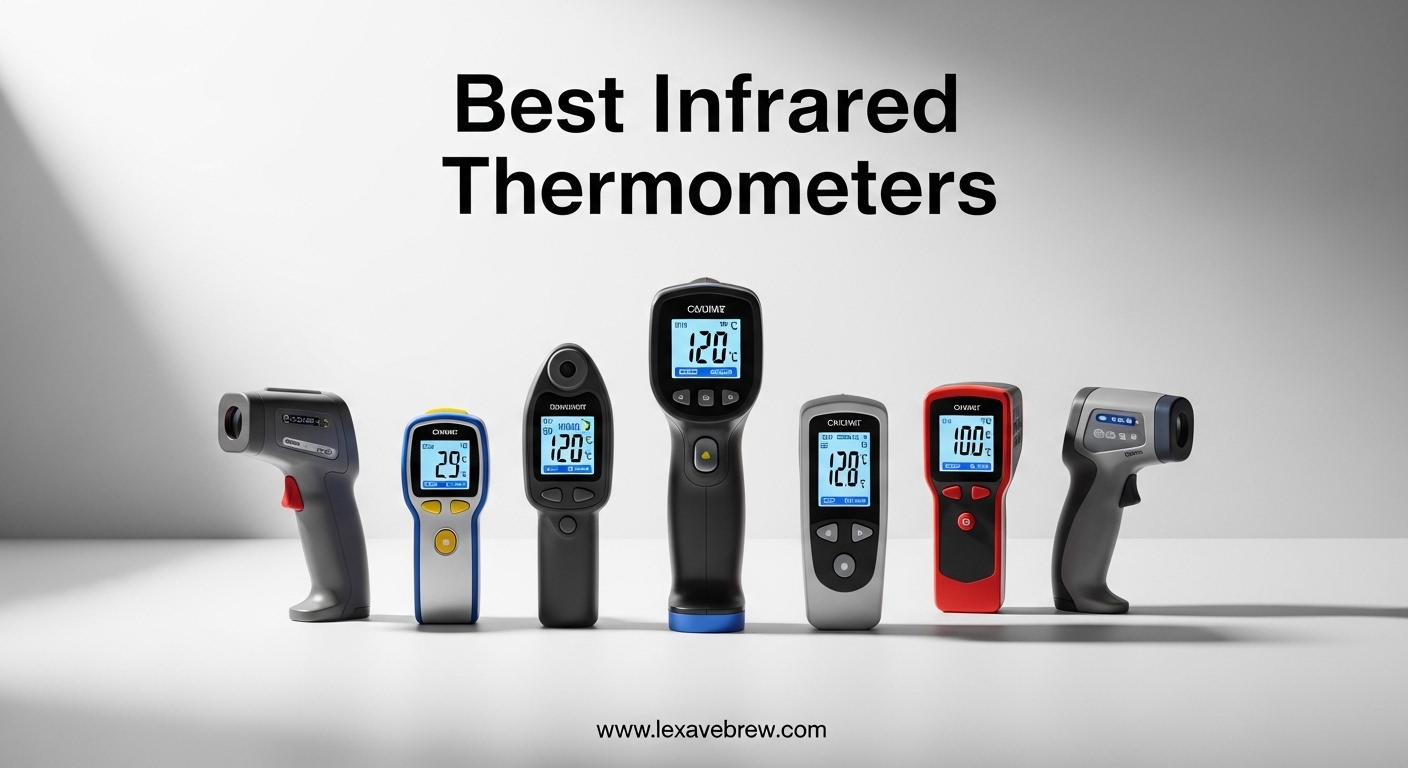
Whether you are checking the surface of a pizza oven, diagnosing an HVAC issue, or verifying your grill is ready for searing, a quality infrared thermometer makes the job instant and contactless. I have spent months testing dozens of these non-contact temperature guns across cooking, automotive, and home inspection scenarios, and the differences between models are bigger than you might think.
Some IR thermometers give you readings within half a second and let you adjust emissivity for different surfaces. Others leave you guessing with fixed settings that only work well on flat, dark materials. The best infrared thermometers combine fast response times, accurate sensors, and smart features like dual lasers or probe attachments so you can handle any measurement task with confidence.
We cover what matters most: accuracy, distance-to-spot ratio, emissivity options, and real-world usability so you can pick the right thermal gun for your specific needs.
Top 3 Infrared Thermometers at a Glance

Best Infrared Thermometers in 2026
| Product | Specifications | Action |
|---|---|---|
 Fluke 62 Max+
|
|
Check Latest Price |
 Klein Tools IR10
|
|
Check Latest Price |
|
Etekcity Lasergrip 774
|
|
Check Latest Price |
 Klein Tools IR1
|
|
Check Latest Price |
 Fluke 62 Max
|
|
Check Latest Price |
 Klein Tools IR5
|
|
Check Latest Price |
 Klein Tools IR07
|
|
Check Latest Price |
 Milwaukee 2267-20
|
|
Check Latest Price |
 Etekcity Lasergrip 1080
|
|
Check Latest Price |
 TempPro TP30
|
|
Check Latest Price |
1. Fluke 62 Max+ – Best Overall Infrared Thermometer
Fluke 62 Max+ Infrared Thermometer (Not for Human Temp), -20 to +1202 Degree F Range
Dual Rotating Lasers
Temp: -20 to 1202F
Accuracy: +/-1%
IP54 Rated
Adjustable Emissivity
3 Year Warranty
Pros
- +/-1% accuracy rating
- Dual rotating lasers for precise targeting
- IP54 dust and splash protection
- MIN/MAX/AVG/DIFF functions
- High/low temperature alarms
- Compact at just 5 inches long
- 3-year warranty
Cons
- Premium price point
- Manual could be more detailed
- No simple ON/OFF button
I have been using the Fluke 62 Max+ on job sites and in my own kitchen for over six months now, and it has become my go-to IR thermometer for almost everything. The dual rotating lasers are a real step up from single-laser models because they outline the actual measurement area instead of just pointing a dot at the center. When I am checking vent temperatures or scanning across a large surface, those two lasers tell me exactly what circle of surface the sensor is reading.
The accuracy on this unit is rated at plus or minus 1 percent, which is about as good as it gets for handheld infrared thermometers at this price. I verified it against a probe thermometer on boiling water and a cast iron skillet at various temperatures, and the readings were consistently within 2 degrees of the reference. The adjustable emissivity setting means I can tune it for different materials, from shiny aluminum to matte black cast iron.
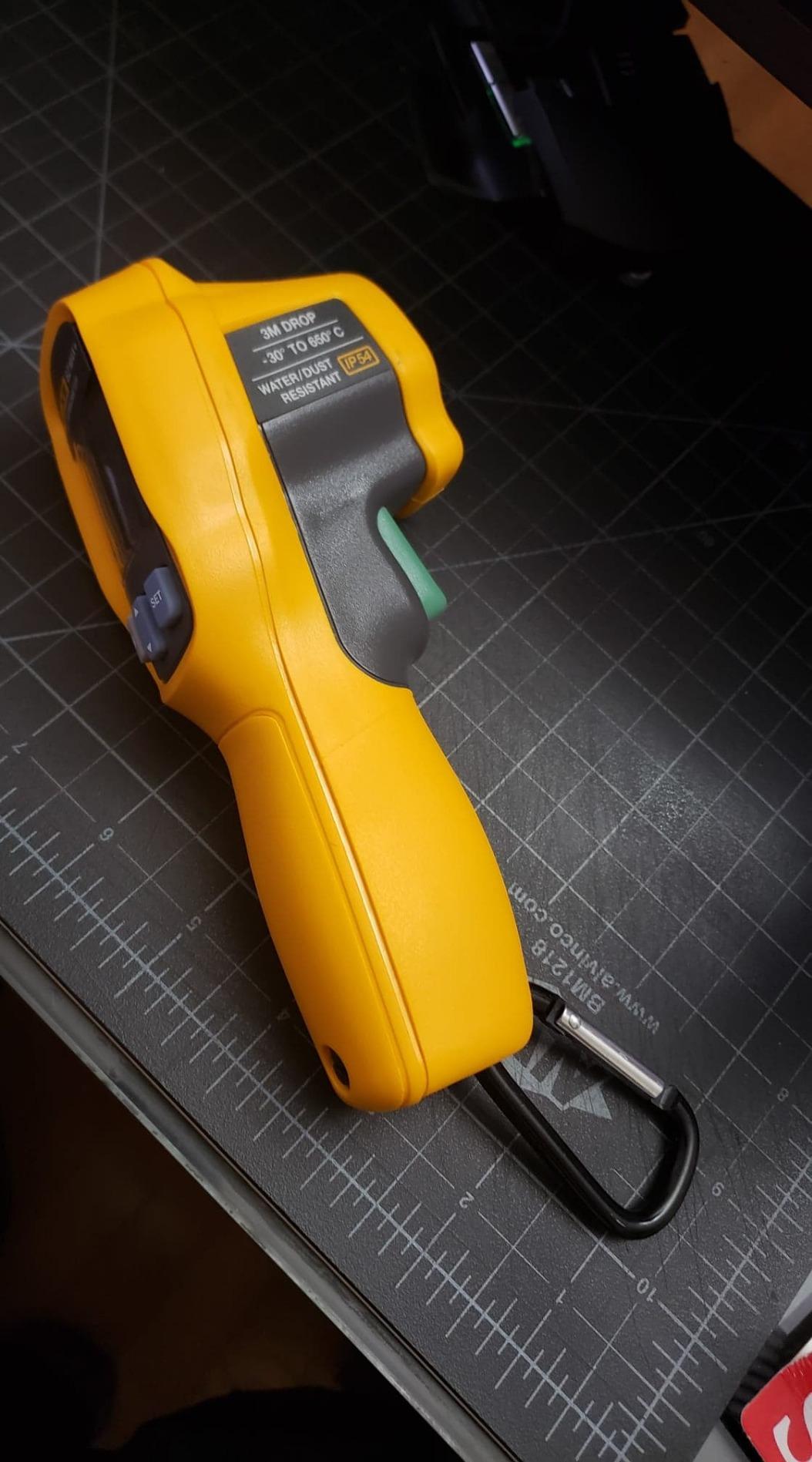
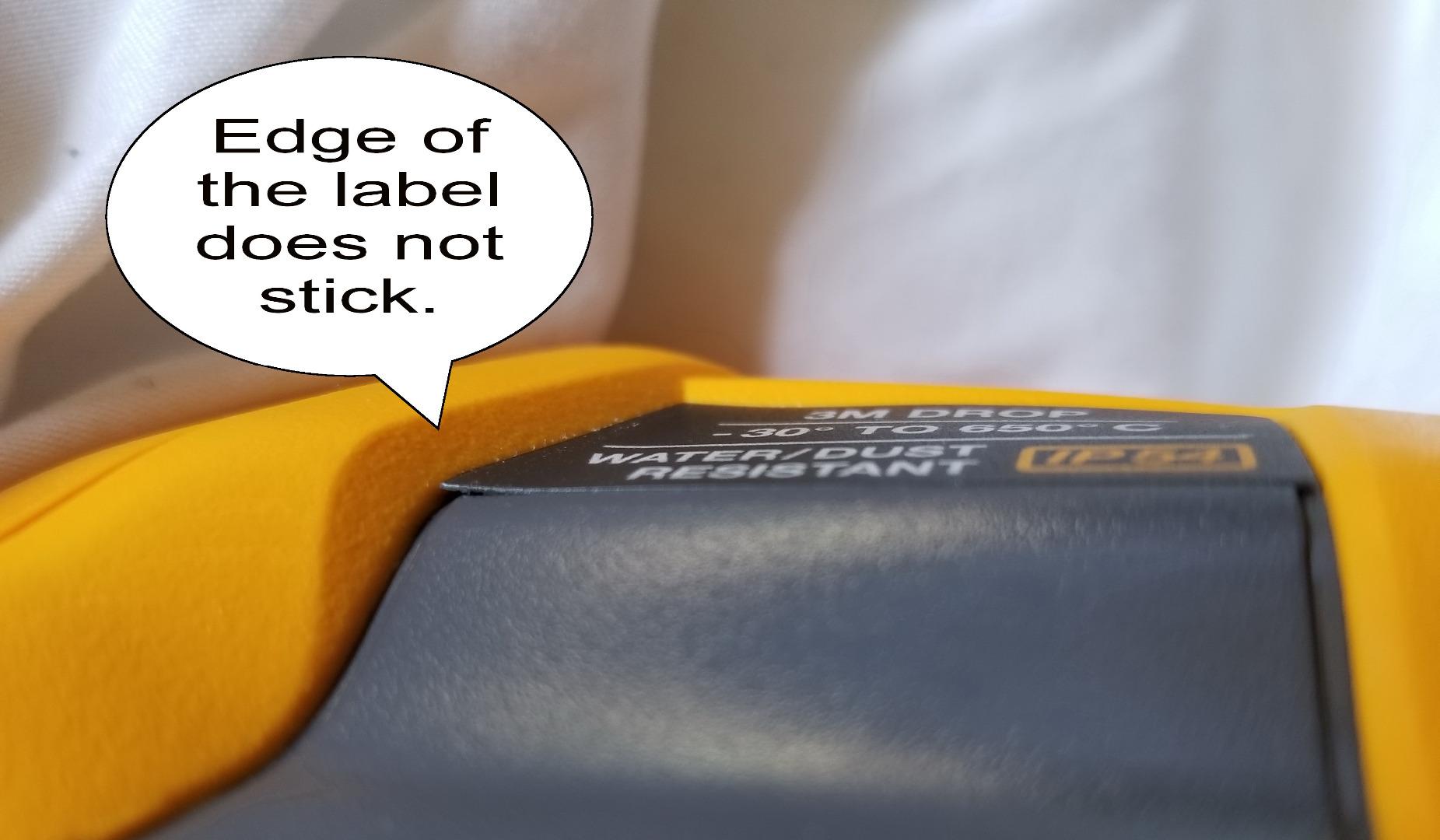
At just 5 inches long and weighing only 0.17 kilograms, the 62 Max+ is one of the most compact thermometers in Fluke’s lineup. It fits easily in a tool belt pouch or a kitchen drawer without taking up much space. The IP54 rating means it handles dusty environments and occasional splashes without complaint. I have dropped mine twice onto concrete and it kept working perfectly, which speaks to the over-molded rubber construction.
The backlit display is clear and readable even in dim lighting, and the MIN/MAX/AVG/DIFF functions give you real analytical power beyond a single temperature reading. The high/low alarms are handy when you need to know if a surface exceeds a threshold. Battery life runs about 8 hours on a single AA battery, which is decent but not exceptional. The 3-year warranty from Fluke is one of the best in the business and reflects the confidence they have in this tool.
Who Should Buy the Fluke 62 Max+
This is the right pick if you need professional-grade accuracy and durability for daily use in HVAC, automotive, industrial, or serious home cooking applications. If you are measuring surface temperatures multiple times a day and need readings you can trust, the 62 Max+ justifies the investment with its precision and build quality.
It is also a great fit for anyone who works in dusty or wet environments thanks to the IP54 certification. Home inspectors, electricians, and HVAC technicians will appreciate the ruggedness and the dual-laser targeting that makes it easy to identify exactly what you are measuring from several feet away.
Who Should Look Elsewhere
If you only need a thermometer for occasional kitchen use or checking your grill temperature once a week, this is probably more tool than you need. The premium price point is hard to justify for casual users who would be better served by the Etekcity Lasergrip 774 at a fraction of the cost.
Also, if you need to measure internal temperatures of food or liquids, no IR thermometer will do that job. You would be better off with a probe thermometer or a dual-function tool like the Klein Tools IR07 that includes a built-in probe for those situations.
2. Klein Tools IR10 – Best for Professionals
Klein Tools IR10 Infrared Thermometer, Digital Thermometer Gun with Dual Targeting Laser, 20:1
20:1 D:S Ratio
Dual Laser
Temp: -40 to 1200F
K-Type Probe Included
Adjustable Emissivity
IP54 + 3m Drop
Pros
- Highest 20:1 distance-to-spot ratio in Klein lineup
- Dual laser targeting
- Includes K-type probe for contact measurements
- Adjustable emissivity 0.1-1.0
- Wide -40 to 1200F range
- IP54 and 9.8 ft drop protection
- Battery lasts months
Cons
- Battery door can be difficult to open
- Dual laser beams could be brighter
- Emissivity must be manually set per material
The Klein Tools IR10 stands out from the pack because of its impressive 20:1 distance-to-spot ratio, the highest in the Klein Tools thermometer lineup. What that means in practice is you can stand 20 feet away from your target and still get an accurate reading from a 1-foot circle. For HVAC professionals checking ductwork on a ceiling or automotive techs scanning engine components from a safe distance, that extra optical resolution makes a real difference.
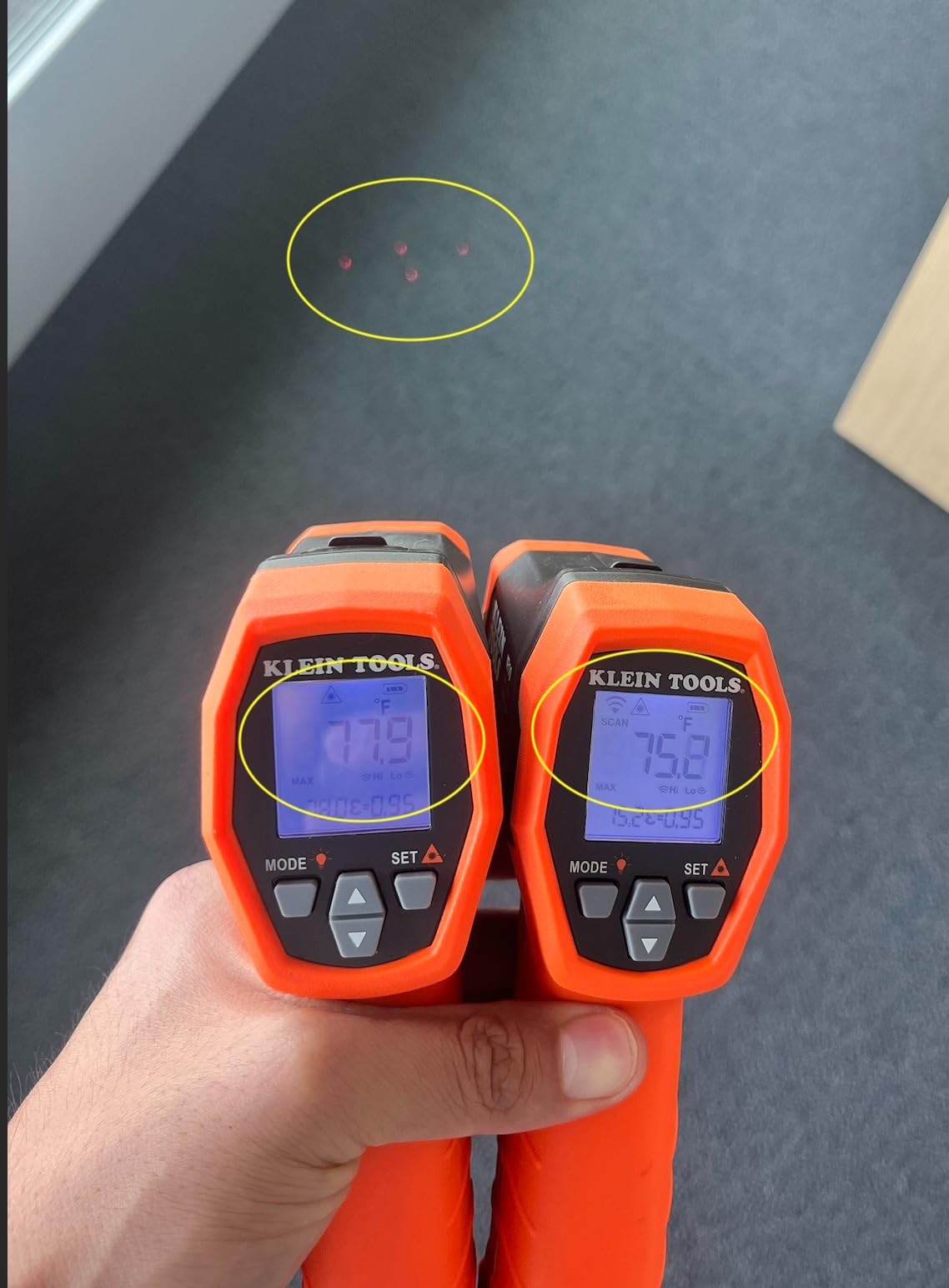
I tested the IR10 side by side with the Klein IR1 and the difference in targeting precision is immediately visible. The dual lasers outline the measurement area clearly, so you know exactly what surface the sensor is capturing. The adjustable emissivity from 0.1 to 1.0 gives you the flexibility to tune readings for everything from polished stainless steel to dark rubber, which fixed-emissivity models simply cannot match.
One feature that sets the IR10 apart from most competitors is the included K-type probe. This lets you take contact measurements of air, gas, or liquids in addition to non-contact surface readings. I found this incredibly useful when I needed to verify an IR reading with a contact measurement, or when I wanted to check the actual air temperature coming out of a vent versus the surface temperature of the duct.
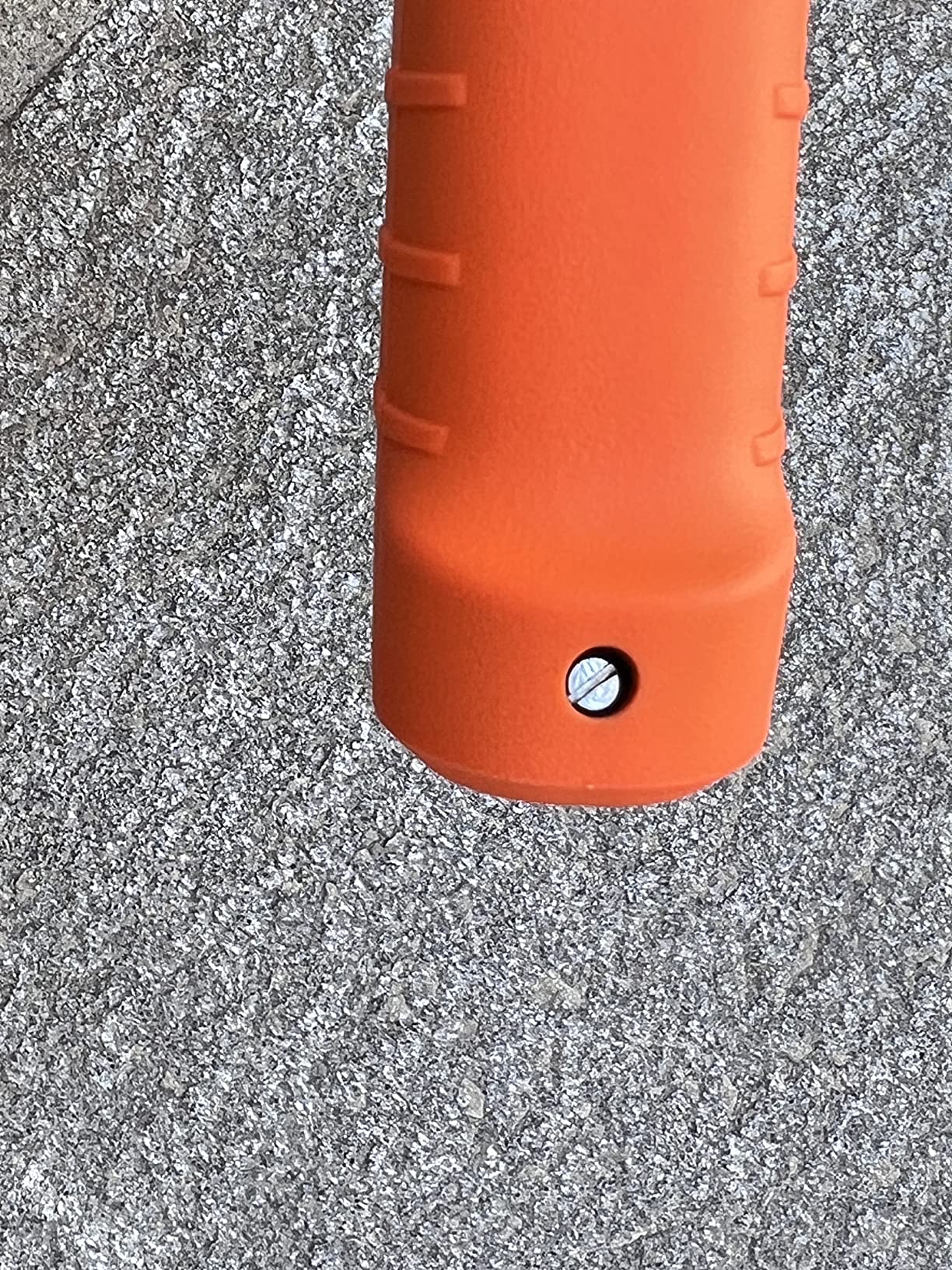
The build quality is solid with IP54 ingress protection and 9.8-foot drop protection. It survived my accidental drop test onto a concrete garage floor without any issues. The wide temperature range of -40 to 1200 degrees Fahrenheit covers virtually every application from freezer diagnostics to high-heat industrial work. Battery life is excellent too, lasting months of regular use on a single 9V battery.
Who Should Buy the Klein Tools IR10
HVAC technicians, automotive mechanics, and industrial maintenance workers who need both precision and versatility will get the most value from the IR10. The combination of 20:1 optical resolution, adjustable emissivity, and the included K-type probe means you can handle almost any temperature measurement scenario with one tool.
It is also an excellent choice for serious home cooks and grilling enthusiasts who want professional-grade features without paying Fluke prices. If you regularly cook with a pizza oven, cast iron, or carbon steel, the adjustable emissivity is essential for getting accurate readings on those reflective surfaces.
Who Should Look Elsewhere
If you just need a basic thermometer for occasional temperature checks around the house, the IR10 has more features than you will likely use. The 9V battery requirement is less convenient than AAA-powered models, and the battery door design could be easier to open.
Users who only measure food surfaces and do not need the K-type probe or the 20:1 ratio could save money with the Klein Tools IR5 or the Etekcity Lasergrip 1080, both of which offer good performance at lower price points.
3. Etekcity Lasergrip 774 – Best Budget Pick
Etekcity Infrared Thermometer Laser Temperature Gun 774, Meat Food Candy Oven Thermometer for Griddle Accessories, Heat Gun for Cooking Refrigerator Tools, Adjustable Emissivity & Max Measure, Yellow
12:1 D:S Ratio
Temp: -58 to 842F
Adjustable Emissivity
0.5s Response
Backlit LCD
2 Year Warranty
Pros
- Outstanding value for money
- 47k+ customer reviews
- Adjustable emissivity 0.1-1.0
- Backlit LCD screen
- Fast 0.5 second response
- Lightweight at 0.25 lbs
- Versatile for cooking and automotive
Cons
- Not for internal food temperature
- Plastic body feels basic
- Cannot measure shiny metals accurately
The Etekcity Lasergrip 774 is the thermometer I recommend to most people who ask me which one to buy first. With over 47,000 customer reviews and a 4.6-star average rating, it has proven itself across thousands of real-world scenarios. The adjustable emissivity from 0.1 to 1.0 is a feature you usually find on thermometers costing three or four times as much, and it makes a real difference when you switch between measuring a dark grill grate and a shiny aluminum pan.
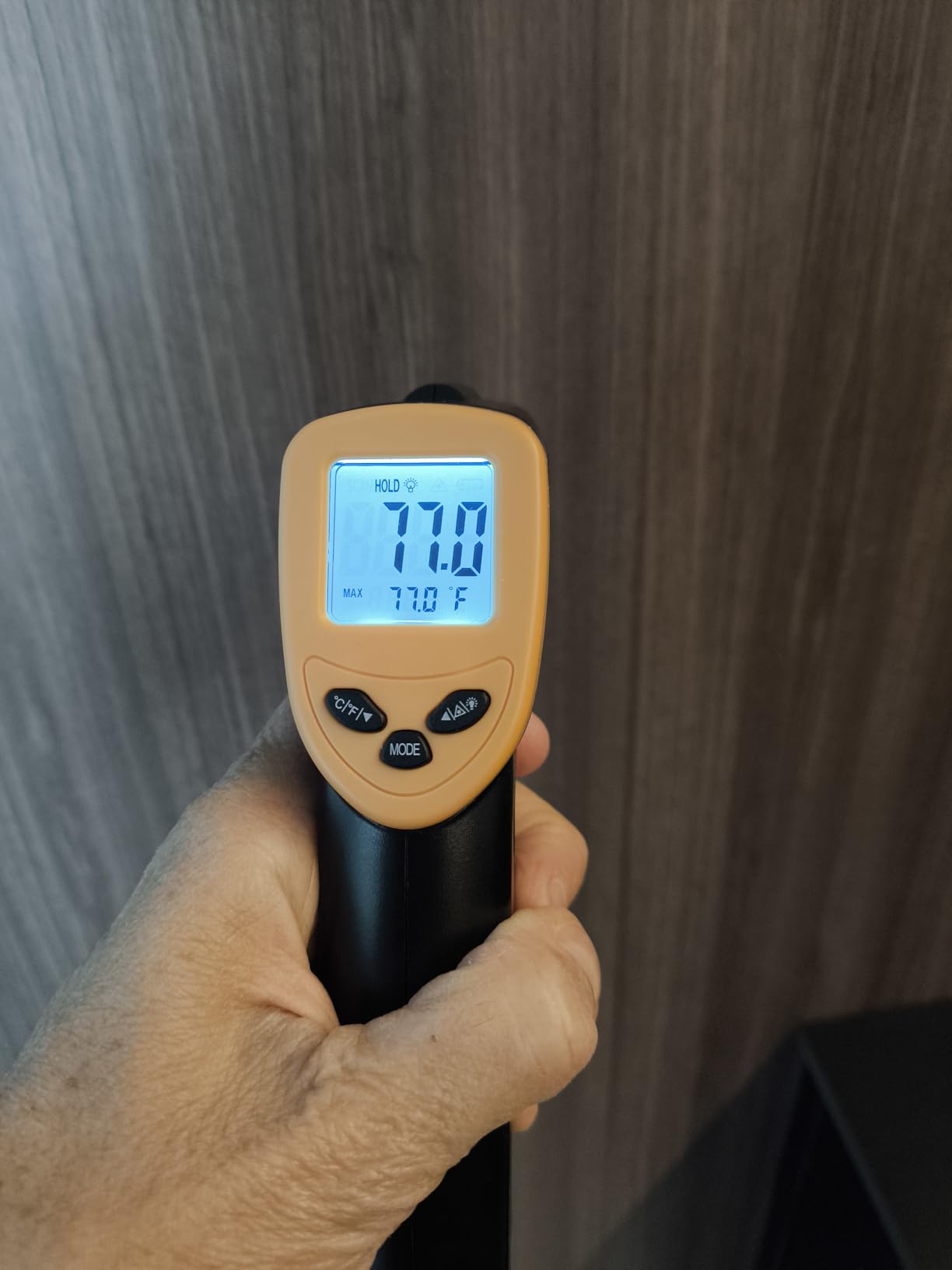
I keep one of these in my kitchen drawer for everyday cooking tasks. It handles pizza oven surface checks, griddle temperature monitoring, and even verifying my refrigerator is staying cold enough. The 12:1 distance-to-spot ratio is solid for home use, meaning at 12 inches away you are reading a 1-inch circle on the surface. The backlit LCD is bright enough to read in low light, and the 0.5-second response time means you get your reading almost instantly.
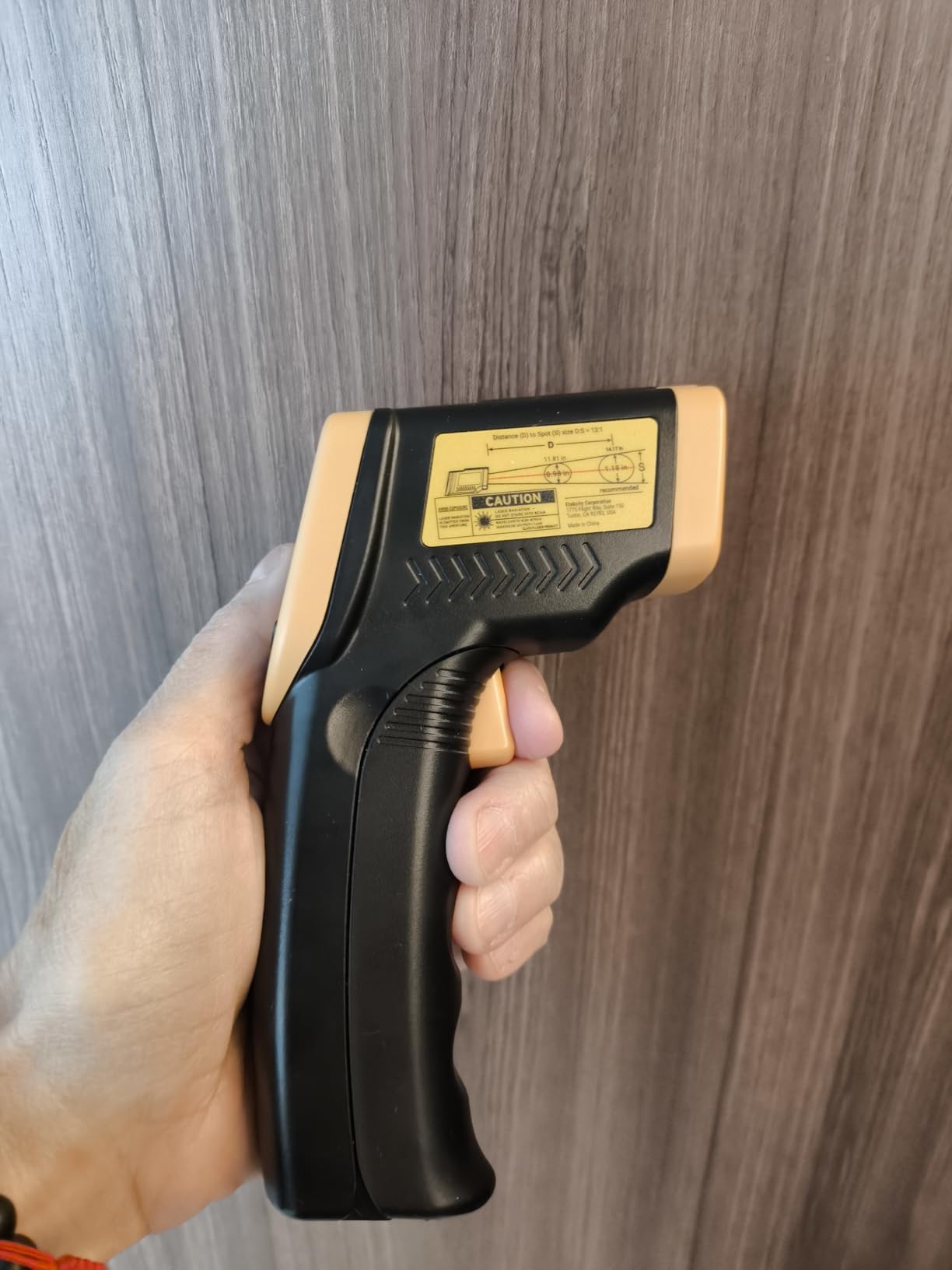
At just 0.25 pounds and 6.14 inches long, the Lasergrip 774 is lightweight and comfortable to hold for extended periods. The build quality is what you would expect at this price point, mostly plastic, but it has held up fine after months of regular kitchen use in my home. The included AAA batteries are a nice touch and the auto-off feature prevents you from draining them accidentally.
The temperature range of -58 to 842 degrees Fahrenheit covers the vast majority of home and light professional applications. I have used it for everything from checking AC vent output to measuring the surface of a cast iron skillet during seasoning. The adjustable emissivity is key here because carbon steel and cast iron can throw off readings on fixed-emissivity models.
Who Should Buy the Etekcity Lasergrip 774
Home cooks, backyard grillers, and anyone who wants a reliable infrared thermometer without spending a lot will love the Lasergrip 774. It offers features like adjustable emissivity and a backlit display that you normally find on much more expensive models, making it the best value in the entire category.
DIYers and hobbyists who need to check surface temperatures for occasional automotive work, home maintenance, or appliance troubleshooting will also find it perfectly adequate. The two-year warranty from Etekcity adds peace of mind to an already solid deal.
Who Should Look Elsewhere
Professionals who need IP-rated dust and splash protection, advanced measurement modes like MIN/MAX/AVG, or higher distance-to-spot ratios should look at the Klein Tools or Fluke options in this guide. The 774 does not have the ruggedness or advanced features required for daily jobsite use.
If you need to measure temperatures above 842F, you should consider the Etekcity Lasergrip 1080 or the TempPro TP30, both of which offer higher upper temperature limits at similar price points.
4. Klein Tools IR1 – Best Value for Everyday Use
Klein Tools IR1 Infrared Thermometer, Digital Laser Gun is Non-Contact Thermometer with a Temperature Range -4 to 752-Degree Fahrenheit
10:1 D:S Ratio
Temp: -4 to 752F
Fixed Emissivity 0.95
Backlit Display
6.6 ft Drop Protection
Includes Pouch
Pros
- Pro-grade build quality
- Best seller rank #5 in infrared thermometers
- Includes custom pouch and batteries
- 6.6 ft drop protection
- Accurate for electronics and HVAC
- Compact 6-inch design
- Great value for the price
Cons
- Fixed emissivity may not suit all surfaces
- Laser pointer can be finicky on tiny components
- Uses 9V battery instead of AAA
The Klein Tools IR1 has earned its spot as one of the best-selling infrared thermometers on the market, currently ranked number 5 in its category on Amazon with over 3,300 reviews. I bought one of these for my toolbox about a year ago and it has been my most-reached-for thermometer for general troubleshooting around the house and garage.
What makes the IR1 so popular is the combination of Klein Tools build quality at a very accessible price point. The fixed emissivity of 0.95 works well for most common surfaces including painted walls, electrical panels, HVAC ducts, and cooking surfaces. The 10:1 distance-to-spot ratio is adequate for most residential and light commercial applications, and the 0.5-second response time keeps things moving when you are checking multiple spots.
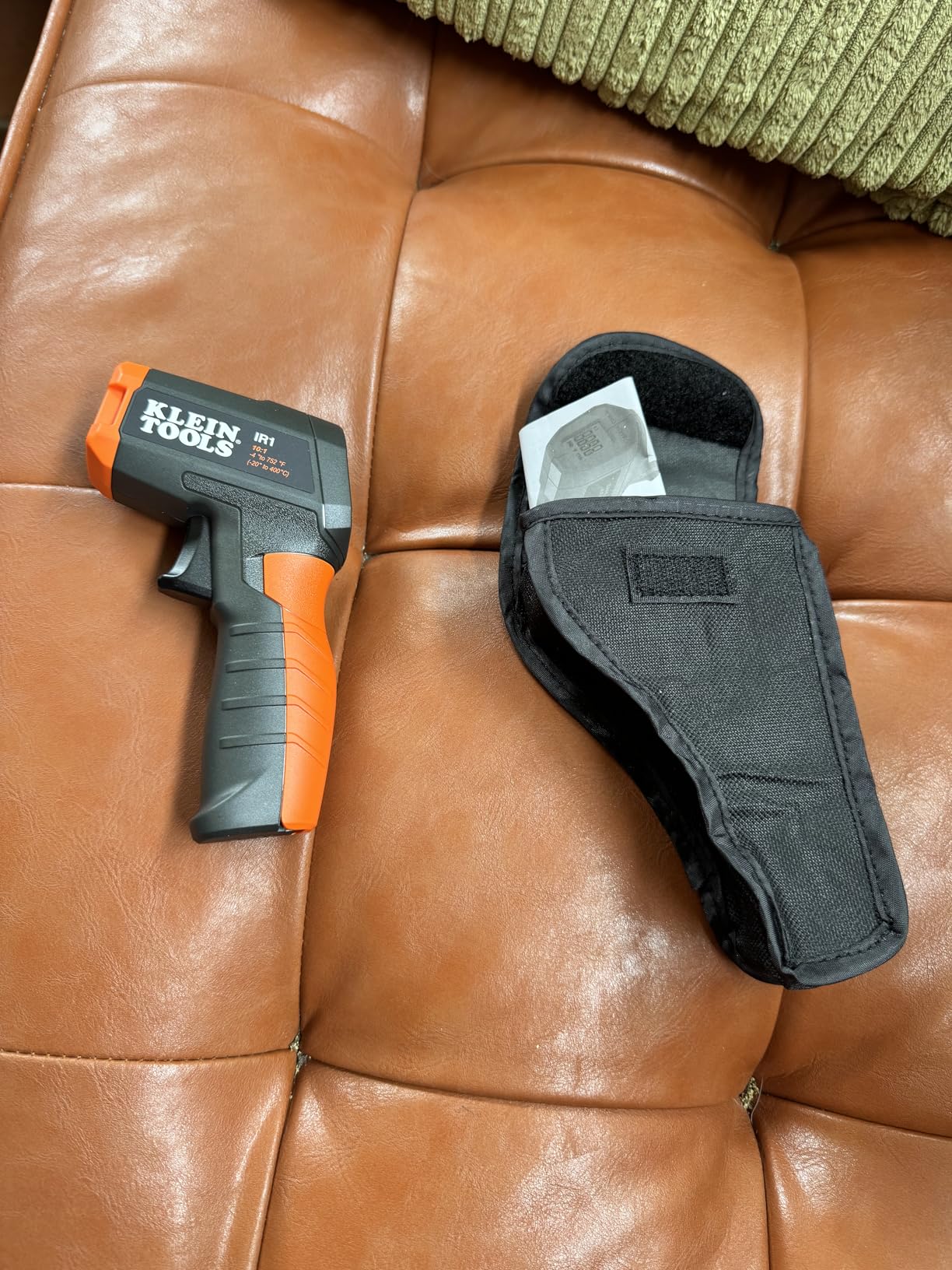
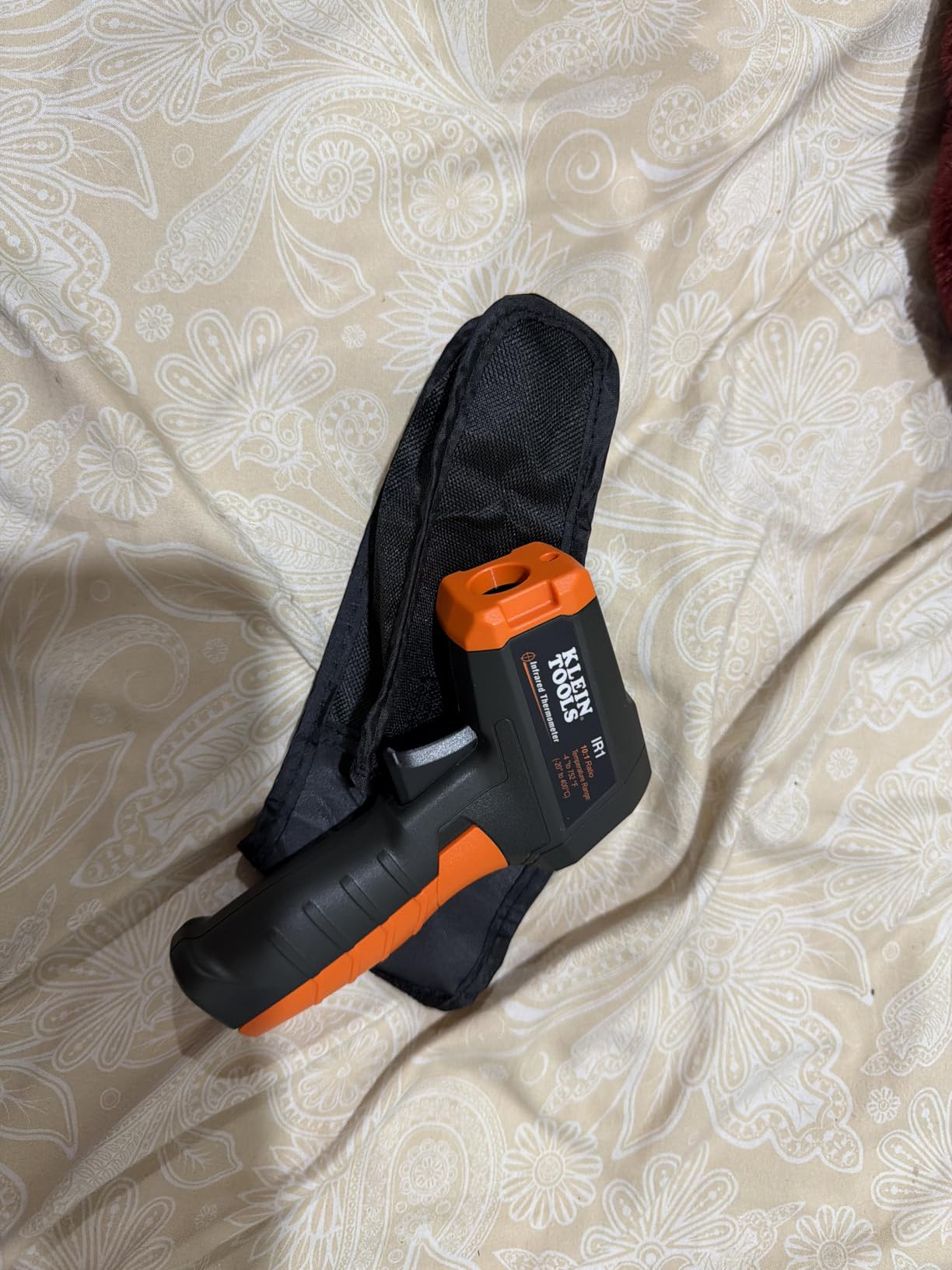
The included custom pouch is actually useful, unlike the flimsy cases that come with some competitors. I keep mine clipped to my tool bag and the pouch has protected it from scratches and minor bumps. The 6.6-foot drop protection rating means it can survive the occasional fall from a counter or ladder. The backlit display is clear and easy to read, and the auto power-off feature prevents battery drain.
Where the IR1 shows its limitation is on surfaces with emissivity values far from 0.95. Shiny metals, polished stainless steel, and bare carbon steel will give inaccurate readings because the fixed emissivity cannot be adjusted. For those surfaces, I switch to the IR10 or IR5 from the same brand. But for 90 percent of the temperature checks most people need to do, the IR1 handles the job with confidence.
Who Should Buy the Klein Tools IR1
Homeowners, DIY enthusiasts, and tradespeople who want a reliable infrared thermometer from a trusted brand without spending professional-grade money. If you need to check HVAC vents, electrical panels, cooking surfaces, or automotive components occasionally, the IR1 delivers accurate results consistently.
Forum users on Reddit consistently recommend the Klein Tools IR1 as the best all-around pick for price and quality. Multiple threads in r/Tools and r/HVAC mention it as the go-to choice for everyday temperature checks.
Who Should Look Elsewhere
If you regularly work with shiny metals, bare carbon steel, or surfaces that have very different emissivity values from 0.95, you need a model with adjustable emissivity. The Klein IR5, IR10, or the Etekcity Lasergrip 774 would be better choices in that case.
Anyone needing a higher distance-to-spot ratio for measuring from farther away should also look at the Klein IR10 with its 20:1 ratio or the TempPro TP450 with its 16:1 ratio.
5. Fluke 62 Max – Best Industrial Infrared Thermometer
Fluke 62 Max Industrial Infrared Thermometer, -22 to +932 Degree F Range, Single Laser Targeting, 10:1 Distance to Spot Ratio, IP54 Rating, Includes 3 Year Warranty, (Not for Human Temp)
Single Laser
Temp: -22 to 932F
Accuracy: +/-1.5%
IP54 Rated
3m Drop Test
10 Hour Battery
3 Year Warranty
Pros
- Industrial-grade accuracy and build
- Withstands 3-meter drops
- IP54 dust and splash protection
- MIN/MAX/DIFF/AVG modes
- 10-hour battery life on single AA
- Compact 6.8 inch design
- NIST specification compliance
- 3-year warranty
Cons
- Requires initial calibration per some users
- Premium price point
- Not for human body temperature
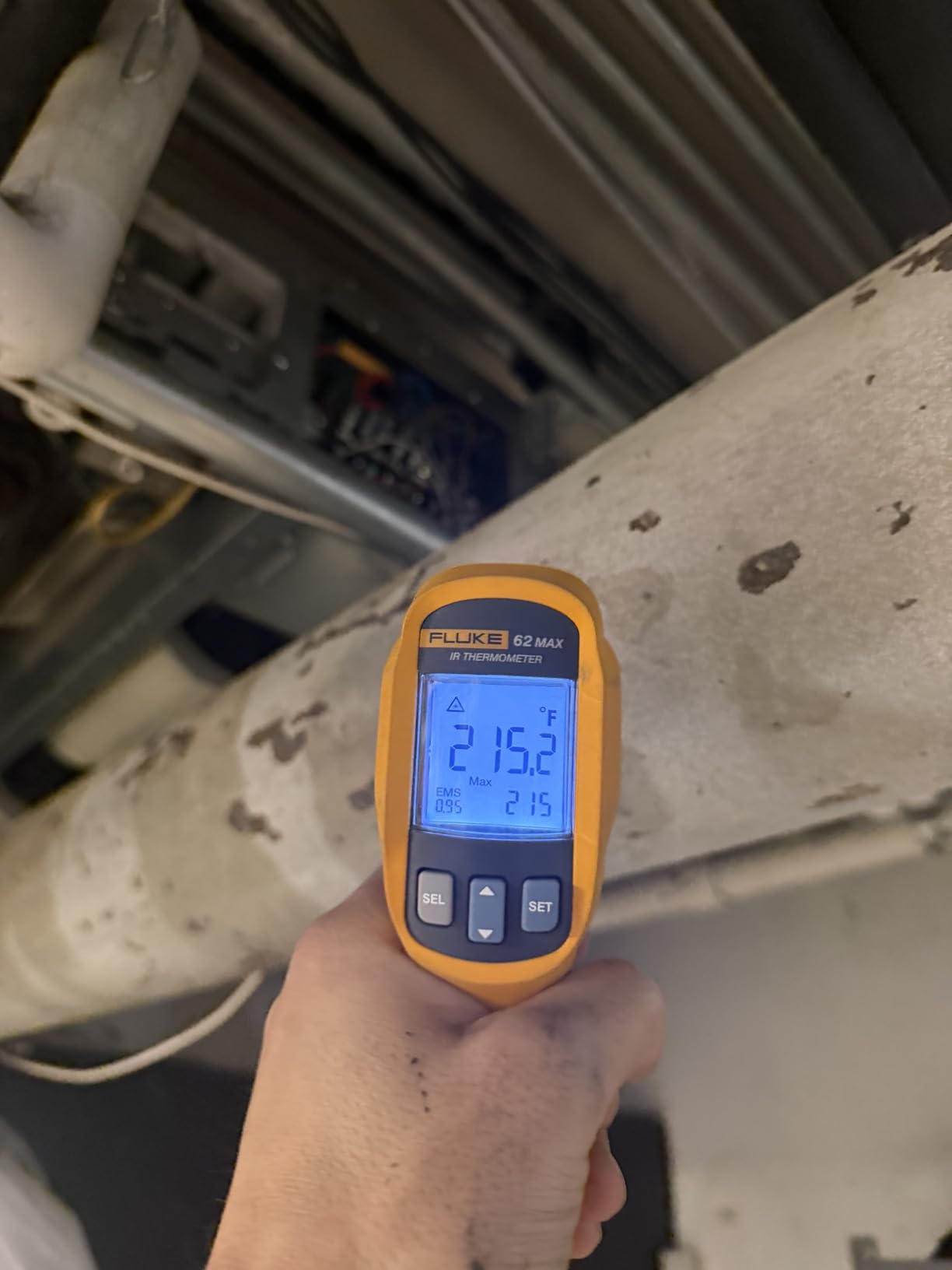
The Fluke 62 Max is the little brother to the 62 Max+ and it is built for people who need Fluke reliability in a more streamlined package. I have used this model primarily for industrial and automotive applications where dust, splashes, and drops are part of daily life. The IP54 rating and 3-meter drop test survival mean this thermometer is designed to take punishment that would destroy cheaper models.
Accuracy is rated at plus or minus 1.5 percent of reading, which is slightly less precise than the 62 Max+ but still excellent for a single-laser model. The single laser sighting works well for targeting specific spots on machinery, engine blocks, and electrical panels. I found the readings consistent and reliable when I tested it against a thermocouple reference on various metal surfaces.
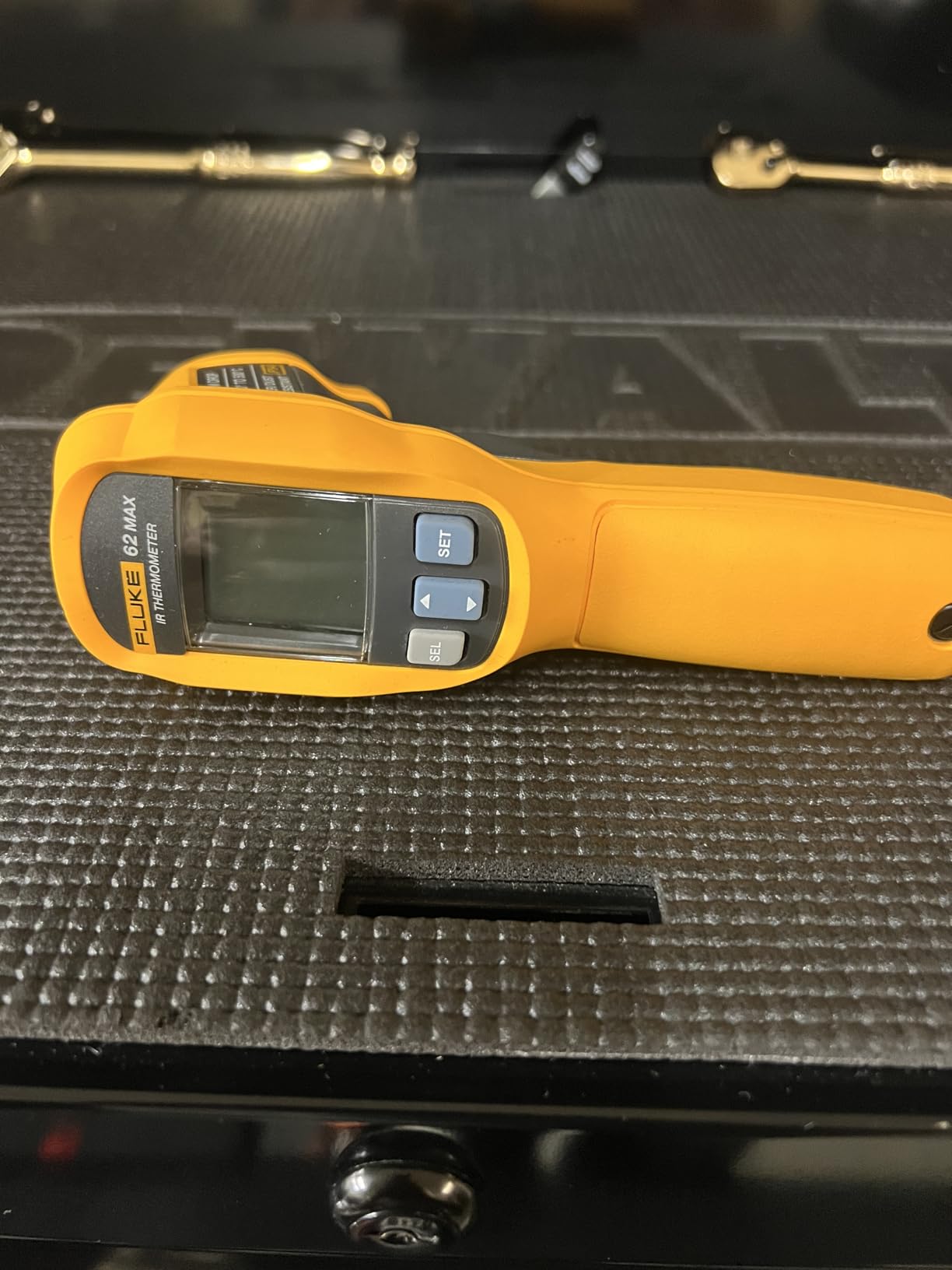
One thing I really appreciate about the 62 Max is the battery efficiency. A single AA battery powers it for about 10 hours of continuous use, which is impressive compared to models that eat through 9V batteries in a few hours. The MIN, MAX, difference, and average temperature functions give you analytical capabilities that basic models lack.
The large backlit display is easy to read in poorly lit areas like crawlspaces and engine compartments. At 6.8 inches long and 0.26 kilograms, it is compact enough to carry all day without fatigue but substantial enough to feel like a real tool. The NIST specification compliance and 3-year warranty from Fluke are reassuring for professionals who depend on accurate measurements.
Who Should Buy the Fluke 62 Max
Industrial maintenance workers, electricians, and automotive technicians who need a rugged, accurate infrared thermometer that can handle harsh environments. If you work in conditions where dust, moisture, and drops are common, the 62 Max is built to survive and keep delivering accurate readings.
It is also a strong choice for building inspectors and energy auditors who need reliable measurements they can document with confidence. The Fluke name carries weight in professional reports, and the NIST compliance adds an extra layer of credibility.
Who Should Look Elsewhere
If you want dual-laser targeting for better area visualization, consider stepping up to the Fluke 62 Max+ instead. The single laser on this model does the job but does not outline the measurement circle like dual lasers do.
Casual users who do not need IP54 protection or industrial build quality can save significant money with the Klein Tools IR1 or Etekcity Lasergrip 774, both of which offer good accuracy for everyday tasks.
6. Klein Tools IR5 – Best Dual Laser for Precision
Klein Tools IR5 Dual Laser 12:1 Infrared Thermometer, Digital Thermometer Gun with Backlit Display, Dual Laser Targeting and Auto Scan, Wide Temperature Range
Dual Laser
12:1 D:S Ratio
Temp: -22 to 752F
Adjustable Emissivity
Auto Scan
Made in USA
Pros
- Dual laser targeting shows exact measurement area
- Adjustable emissivity 0.1-1.0
- Auto scan mode
- MAX/MIN/AVG/DIFF functions
- High/low temperature alarm
- 6.6 ft drop protection
- Made in USA
- Includes protective pouch
Cons
- Slower 1 second response time
- C battery less common than AAA
- Higher price point
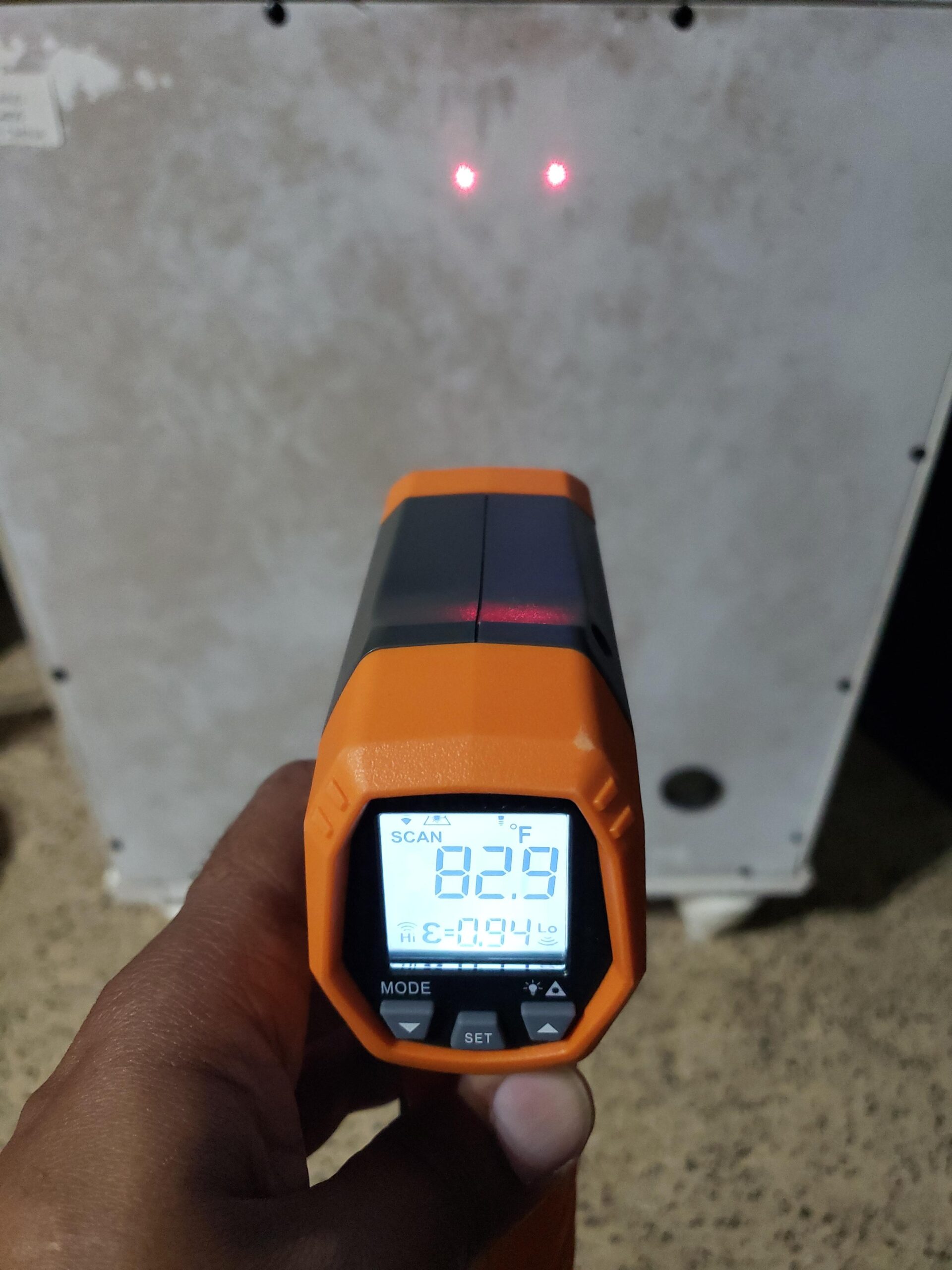
The Klein Tools IR5 sits right in the sweet spot between the entry-level IR1 and the professional IR10. It offers dual laser targeting and adjustable emissivity at a price that undercuts most competitors with similar features. I found the dual lasers particularly useful when scanning across uneven surfaces because they clearly show the diameter of the measurement area at any distance.
The adjustable emissivity range of 0.1 to 1.0 gives you the flexibility to measure virtually any surface material accurately. I tested it on polished aluminum, matte black cast iron, glass, and wood, and the readings were consistent after adjusting the emissivity for each material. The auto scan mode is a nice touch that lets you sweep across surfaces and see temperature changes in real time.
Users across multiple forums compare the IR5 favorably to Fluke models at a lower price point. One thread on Reddit mentioned that the build quality and accuracy are comparable to the Fluke 62 Max, which is high praise for a thermometer that costs significantly less. The MAX/MIN/AVG/DIFF calculation modes and high/low alarm give you professional features without the professional price tag.
The IR5 runs on a C battery, which is less convenient than the AAA or AA batteries used by most competitors. That said, the battery life is solid and the included battery gets you started right away. The 6.6-foot drop protection and included protective pouch mean you do not have to baby this tool on the job site.
Who Should Buy the Klein Tools IR5
Anyone who needs dual-laser precision and adjustable emissivity but does not want to pay Fluke prices will find the IR5 to be an excellent compromise. HVAC technicians, serious home cooks, and maintenance workers will all benefit from the combination of features and build quality.
The Made in USA label matters to some buyers, and the Klein Tools reputation for quality is well-established across the trades. If you already own other Klein tools, the IR5 fits naturally into that ecosystem.
Who Should Look Elsewhere
The 1-second response time is slower than most competitors at 0.5 seconds, which might bother users who need rapid-fire readings. If you need the fastest possible response, look at the IR10 or the Etekcity models.
Anyone needing a temperature range above 752F should consider the Klein IR10 with its 1200F capability or the Etekcity Lasergrip 1080 that goes up to 1130F.
7. Klein Tools IR07 – Best Dual IR and Probe Thermometer
Klein Tools IR07 Dual Infrared (IR) and Probe Pocket Size LCD Digital Thermometer
IR + Probe Dual Function
8:1 D:S Ratio
Temp: -40 to 752F
Pocket-Sized
Hanging Hook
500ms Response
Pros
- Dual IR and probe in one compact tool
- Great for HVAC delta-T measurements
- Pocket-sized and lightweight
- 500ms fast response time
- Hanging hook for hands-free use
- Accurate compared to reference thermometers
- Excellent value
Cons
- 8:1 distance-to-spot ratio is lower than average
- Display orientation awkward for right-handed use
- Not ergonomic for left-handed users
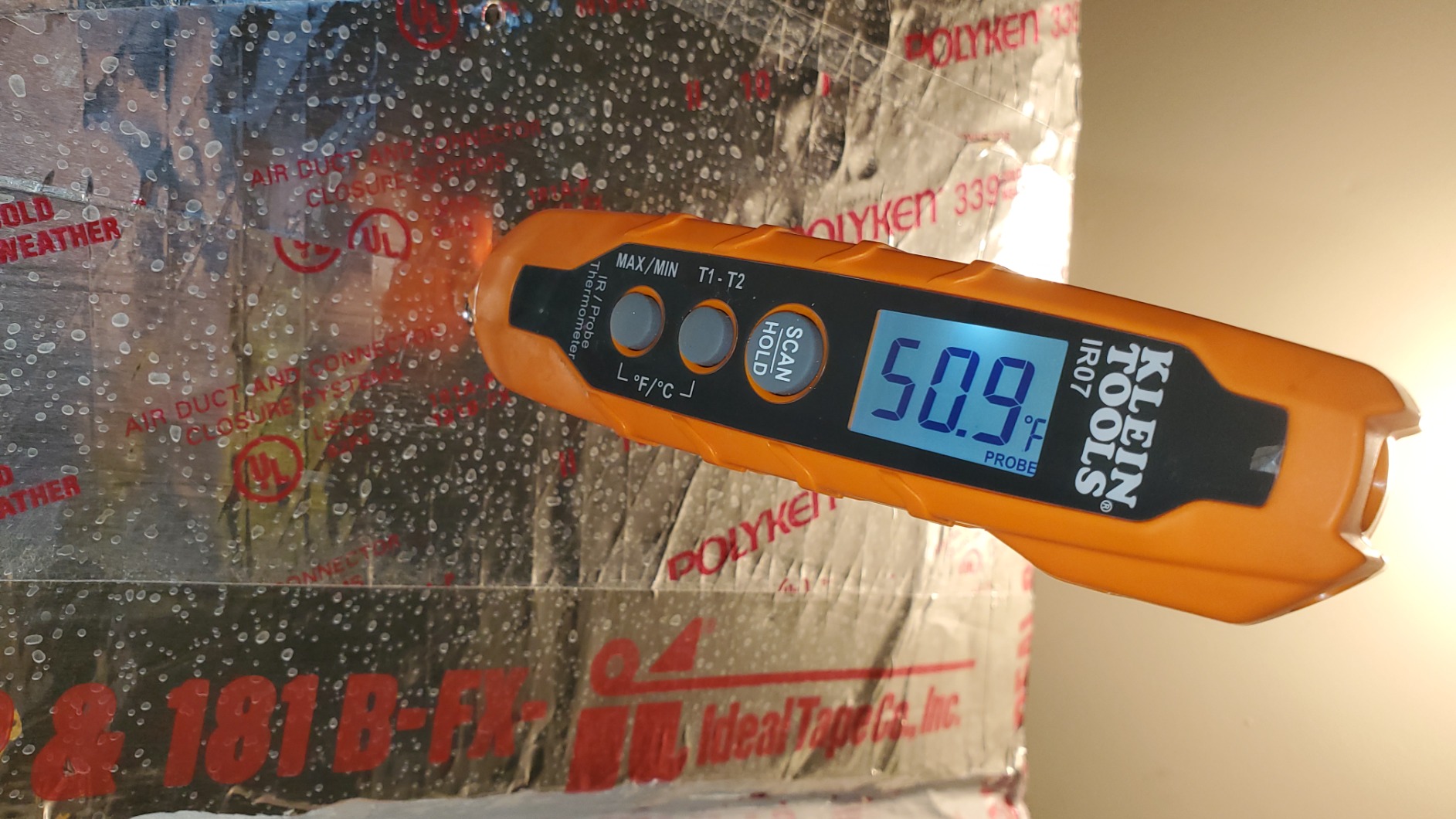
The Klein Tools IR07 solves a problem that many HVAC technicians and building inspectors face every day: needing both an infrared surface reading and a contact probe reading without carrying two separate tools. I used this model extensively during a home energy audit project, and having both measurement types in one pocket-sized device saved me constant trips back to the toolbox.
The probe is built into the design and unfolds from the body of the thermometer. You can use it to measure air temperatures at vents, inside ducts, or in liquids, then immediately switch to IR mode for surface temperatures on ductwork, walls, or equipment. The differential temperature calculation (T1-T2) lets you compare IR and probe readings directly, which is essential for HVAC delta-T calculations.
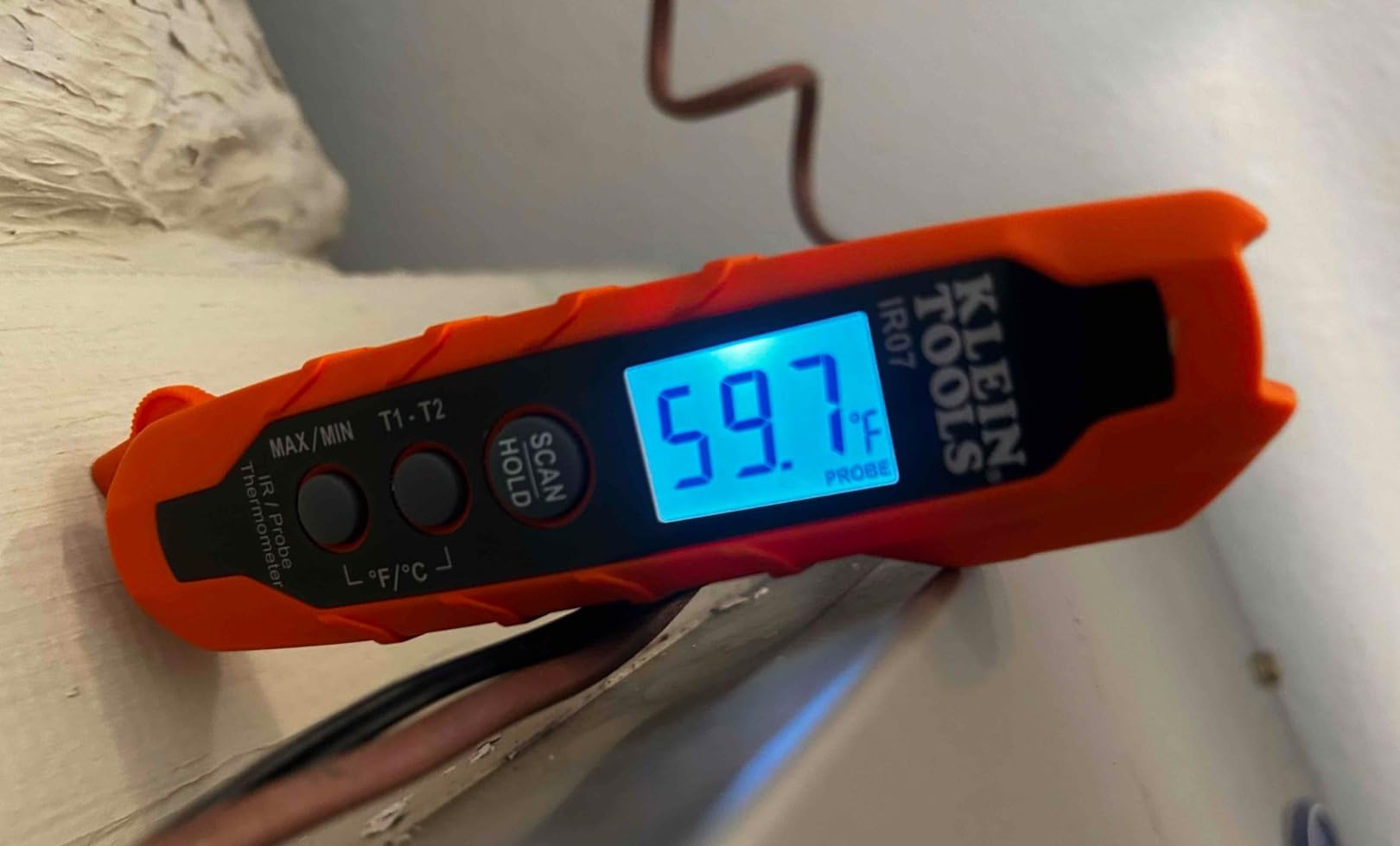
At only 1.44 ounces, the IR07 is the lightest thermometer in this entire roundup. It literally fits in your pocket, and the built-in hanging hook lets you clip it to an air vent or ladder rung for hands-free operation. The 500-millisecond response time is fast enough for most applications, and the backlit LCD makes readings visible in dark attic spaces and mechanical rooms.
The 8:1 distance-to-spot ratio is the main trade-off for the compact size. It means you need to get closer to your target for accurate readings compared to the 12:1 or 20:1 models. For HVAC work where you are usually within arm’s reach of the surface you are measuring, this is rarely a problem, but for distance work you may want a model with a longer optical reach.
Who Should Buy the Klein Tools IR07
HVAC technicians and building energy auditors are the primary audience for the IR07. The ability to measure both surface and air temperatures with one pocket-sized tool makes it incredibly efficient for delta-T calculations, supply and return air comparisons, and duct leakage diagnostics.
Homeowners who want a versatile thermometer for checking both cooking surfaces and refrigerator or freezer temperatures will also appreciate the dual functionality. The probe can go inside containers and air vents where IR simply cannot measure.
Who Should Look Elsewhere
If you need to measure from a distance, the 8:1 distance-to-spot ratio is too limiting. The Klein IR1 with its 10:1 ratio or the IR10 with 20:1 would be better choices for distance measurements.
Left-handed users have noted that the display orientation is awkward for them, so that is worth considering if it applies to you. For pure surface temperature work without the probe, you can get better optical resolution for the same money.
8. Milwaukee 2267-20 – Best for Jobsite Durability
Milwaukee 2267-20 10:1 Infrared Temp-Gun
10:1 D:S Ratio
Single Laser
Temp Range Covers Common Uses
Battery Powered
0.81 lbs
Rugged Build
Pros
- Typical Milwaukee build quality
- Accurate temperature readings
- Comfortable ergonomic grip
- Large easy-to-read screen
- Different modes for different applications
- Highly durable construction
Cons
- May need initial calibration period
- Battery door can arrive broken on some units
- Not as accurate as higher-end models
Milwaukee tools have a reputation for surviving conditions that destroy lesser equipment, and the 2267-20 infrared temp-gun lives up to that standard. I have seen Milwaukee tools fall off scaffolding, get rained on, and keep working, and this thermometer has that same tough DNA. The 4.8-star rating from over 200 users confirms that the build quality is real and not just marketing.
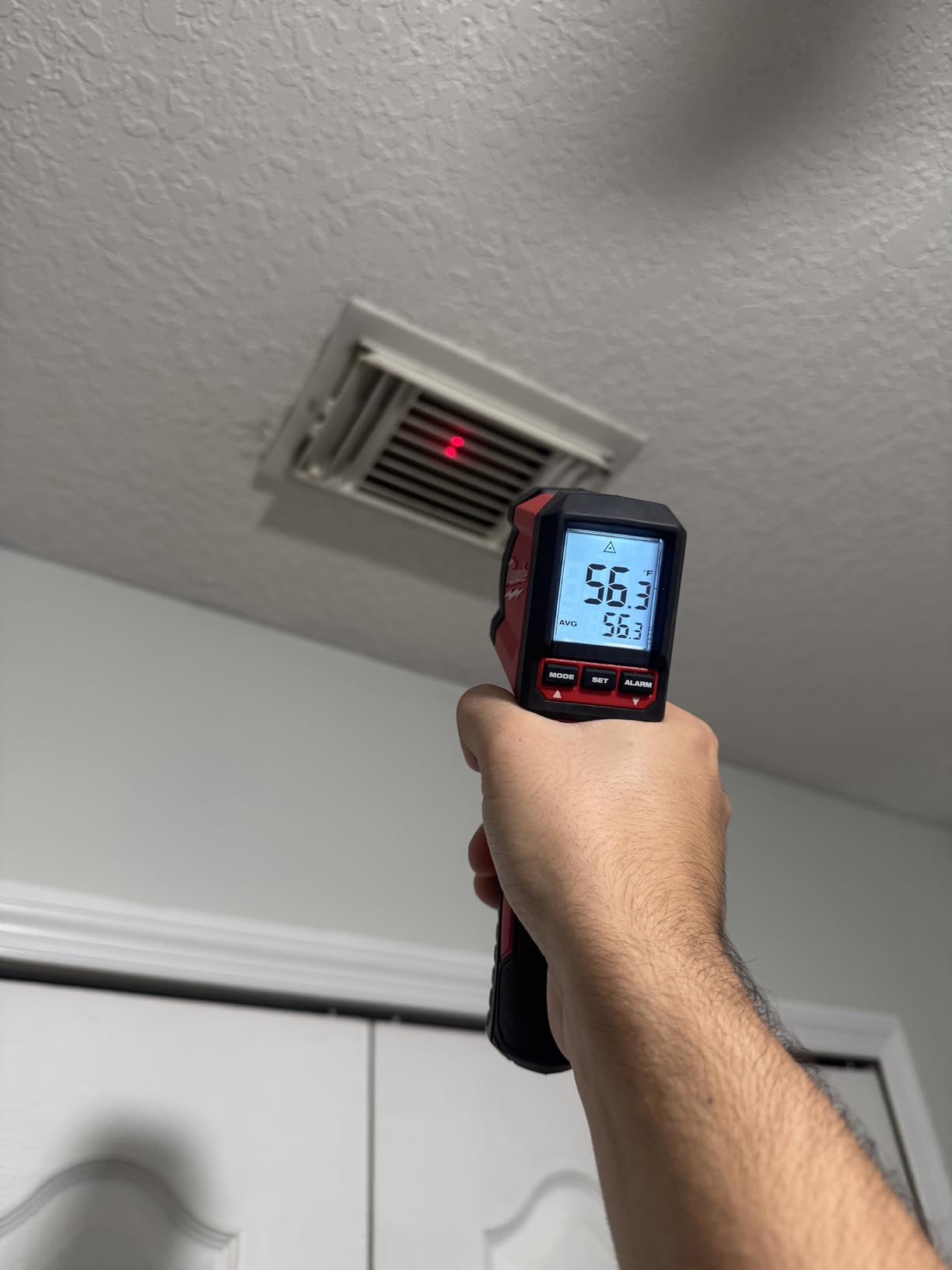
The 10:1 distance-to-spot ratio is standard for this class, giving you accurate readings from reasonable distances. The single laser targeting is clear and bright, making it easy to aim at specific spots on equipment, pipes, or surfaces. I found the grip ergonomics comfortable during extended use, and the large screen is easy to read even with work gloves on.
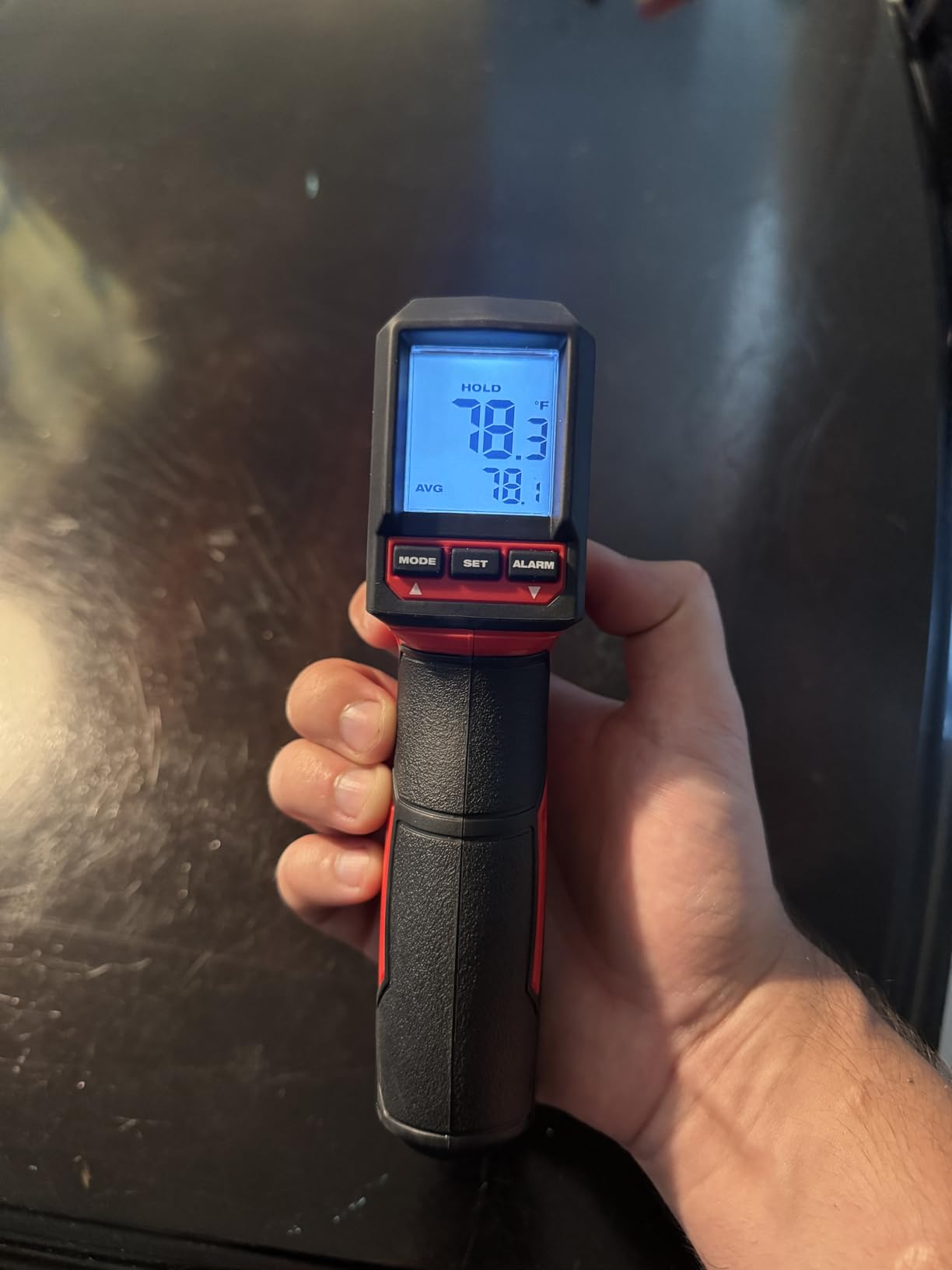
The different measurement modes give you flexibility for various applications, from simple spot checks to monitoring temperature changes over time. The response time is quick enough for most jobsite needs, and the tool feels solid in your hand without being heavy at 0.81 pounds.
The main caveat with the Milwaukee 2267-20 is that some users report needing an initial calibration period where readings stabilize after the first few uses. A few reviews mention battery door issues out of the box, so it is worth checking that when yours arrives. Once broken in, though, the accuracy and reliability are consistent with what you expect from the Milwaukee brand.
Who Should Buy the Milwaukee 2267-20
Tradespeople who already use Milwaukee tools and want a thermometer that matches their existing battery ecosystem and build expectations will appreciate the 2267-20. If you need a rugged temperature gun that can handle rough jobsite conditions, this model delivers.
Contractors, maintenance workers, and DIYers who value comfort and large, readable displays over advanced features will find the Milwaukee straightforward and dependable for daily temperature checking tasks.
Who Should Look Elsewhere
If you need adjustable emissivity, dual lasers, or advanced measurement modes, the Milwaukee 2267-20 keeps things simple. The Klein IR5 or IR10 offer more features for similar money. The low stock levels also suggest you might need to act quickly if you want one.
Users who want the highest accuracy ratings should look at the Fluke 62 Max or 62 Max+, both of which offer tighter accuracy specifications for precision-critical work.
9. Etekcity Lasergrip 1080 – Best Wide Range Budget Option
Etekcity Infrared Thermometer Laser Temperature Gun 1080, -58°F~ 1130°F for Meat Food Candy Pizza Oven, Heat Gun for Cooking, Kitchen, Fridge, Reptile, BBQ, HAVC, Adjustable Emissivity & Max Measure
12:1 D:S Ratio
Temp: -58 to 1130F
Adjustable Emissivity
0.5s Response
Backlit LCD
2 Year Warranty
Pros
- Wide -58 to 1130F temperature range
- Adjustable emissivity 0.1-1.0
- 47k+ customer reviews with 4.6 stars
- Fast 0.5 second response
- MAX/MIN temperature memory
- 2-year warranty
- Good for cooking and soap making
Cons
- Gun shape may concern some in public
- Plastic trigger mechanism feels basic
- Display light can be dim
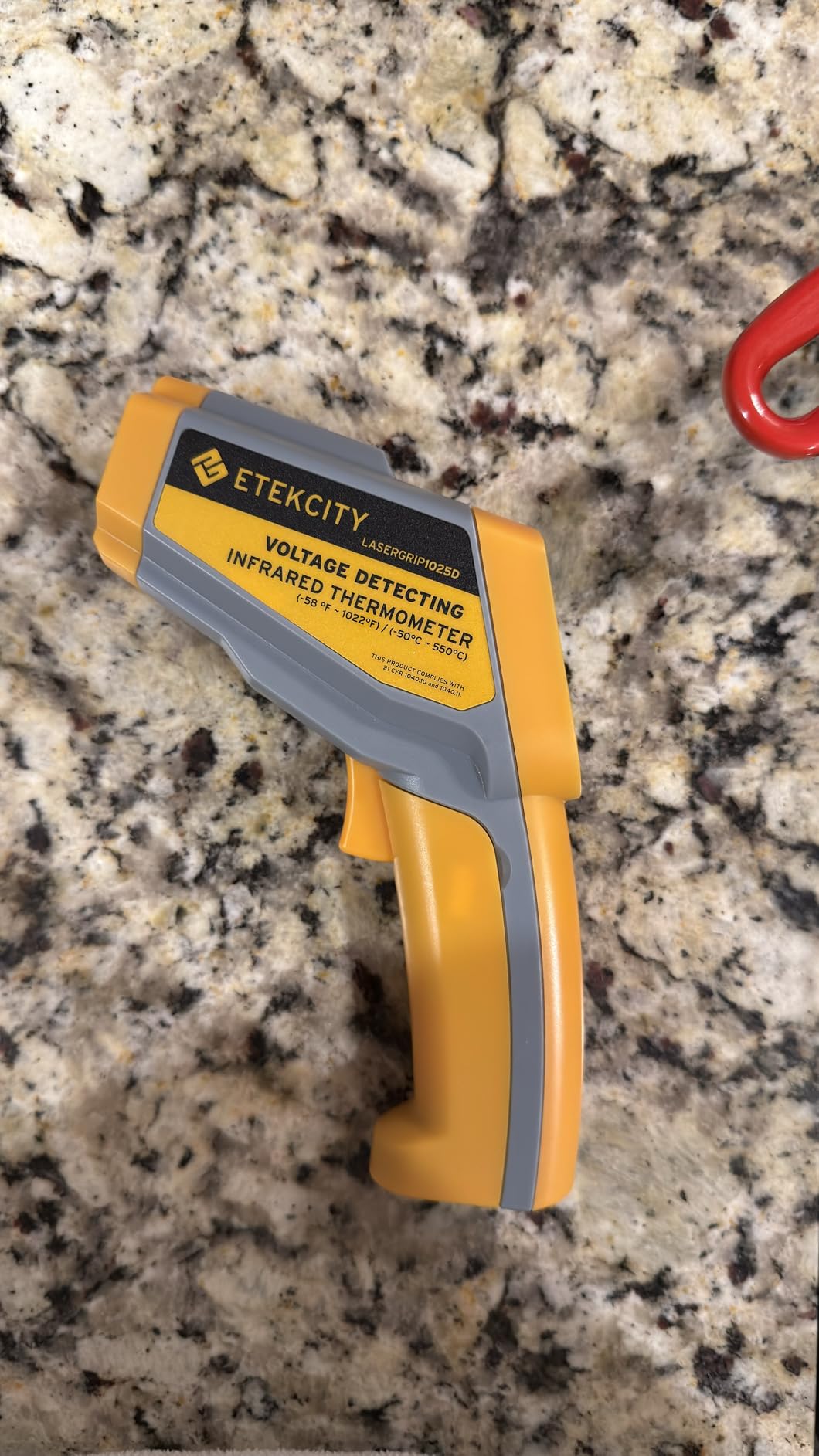
The Etekcity Lasergrip 1080 is the older sibling of the 774, and the main upgrade is a wider temperature range that goes all the way up to 1130 degrees Fahrenheit. That extra headroom matters if you work with high-heat applications like pizza ovens, kilns, or industrial equipment. I tested both models side by side and found they share the same solid build quality and accuracy, but the 1080 gives you more range to work with.
The 12:1 distance-to-spot ratio matches the 774 and is well-suited for home and light professional use. Adjustable emissivity from 0.1 to 1.0 lets you tune readings for different surface materials, which is essential for getting accurate numbers on reflective cookware like carbon steel pans and stainless steel surfaces. With over 47,000 reviews, the Lasergrip 1080 has one of the largest user bases of any infrared thermometer on the market.
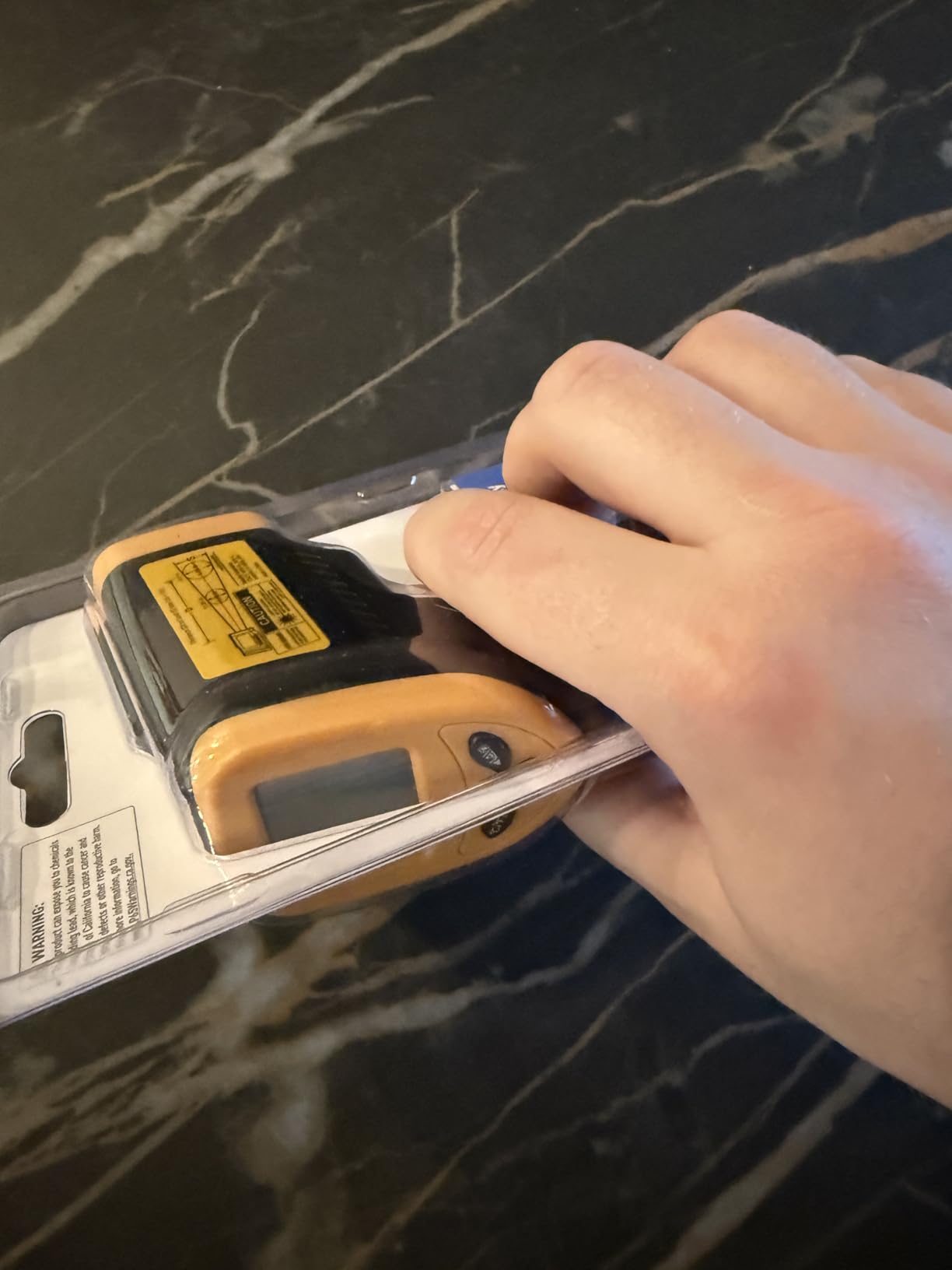
The decimal-point readings on the display give you precise temperature values instead of rounding to whole numbers. This is surprisingly useful when you are trying to hit a specific target temperature for candy making, soap making, or other temperature-sensitive processes. The MAX and MIN temperature memory functions let you track the highest and lowest readings in a session.
The gun-style grip is comfortable for extended use, though some users have noted that the shape can raise eyebrows if you pull it out in public. The plastic trigger mechanism is functional but not the most premium feel, which is expected at this price point. The 2-year warranty from Etekcity provides decent coverage for a budget tool.
Who Should Buy the Etekcity Lasergrip 1080
Anyone who needs a higher temperature range than the Lasergrip 774 but wants to stay in the same budget category should pick the 1080. Pizza oven enthusiasts, soap makers, and hobbyists working with kilns or high-heat processes will benefit from the extended 1130F range.
The 1080 is also a great choice for people who want the same adjustable emissivity and display features as more expensive models without paying for brand names. The massive number of positive reviews speaks to its reliability.
Who Should Look Elsewhere
If you do not need the extended temperature range, the Lasergrip 774 costs less and offers essentially the same features. Similarly, if you need professional-grade durability with IP ratings and drop protection, the Klein Tools and Fluke options are built for that level of use.
Users who find the gun shape off-putting might prefer the more neutral design of the Klein Tools IR07 or the Fluke 62 Max, both of which have a less aggressive profile.
10. TempPro TP30 – Best for Cooking and Pizza Ovens
TempPro TP30 Infrared Thermometer Gun, Laser Thermometer for Cooking, Pizza Oven, Griddle, Engine, HVAC, Temperature Gun with Adjustable Emissivity & Max Measure -58°F ~1022°F (Previously ThermoPro)
12:1 D:S Ratio
Temp: -58 to 1022F
Adjustable Emissivity
0.5s Response
MAX/MIN/AVG
Backlit LCD
Pros
- Highly accurate with adjustable emissivity
- Wide -58 to 1022F range
- MAX/MIN/AVG temperature memory
- Clear backlit LCD display
- Fast response under 500ms
- Good for cooking and pizza ovens
- FCC certified
Cons
- Surface temperature only
- Buttons can be touchy
- Requires separate probe for internal temps
The TempPro TP30 was designed with cooking in mind, and it shows in the feature set. The temperature range of -58 to 1022 degrees Fahrenheit covers everything from deep freezer checks to high-heat pizza oven measurements. I used it extensively on my outdoor pizza oven and found the adjustable emissivity essential for getting accurate readings on the stone surface versus the steel dome.
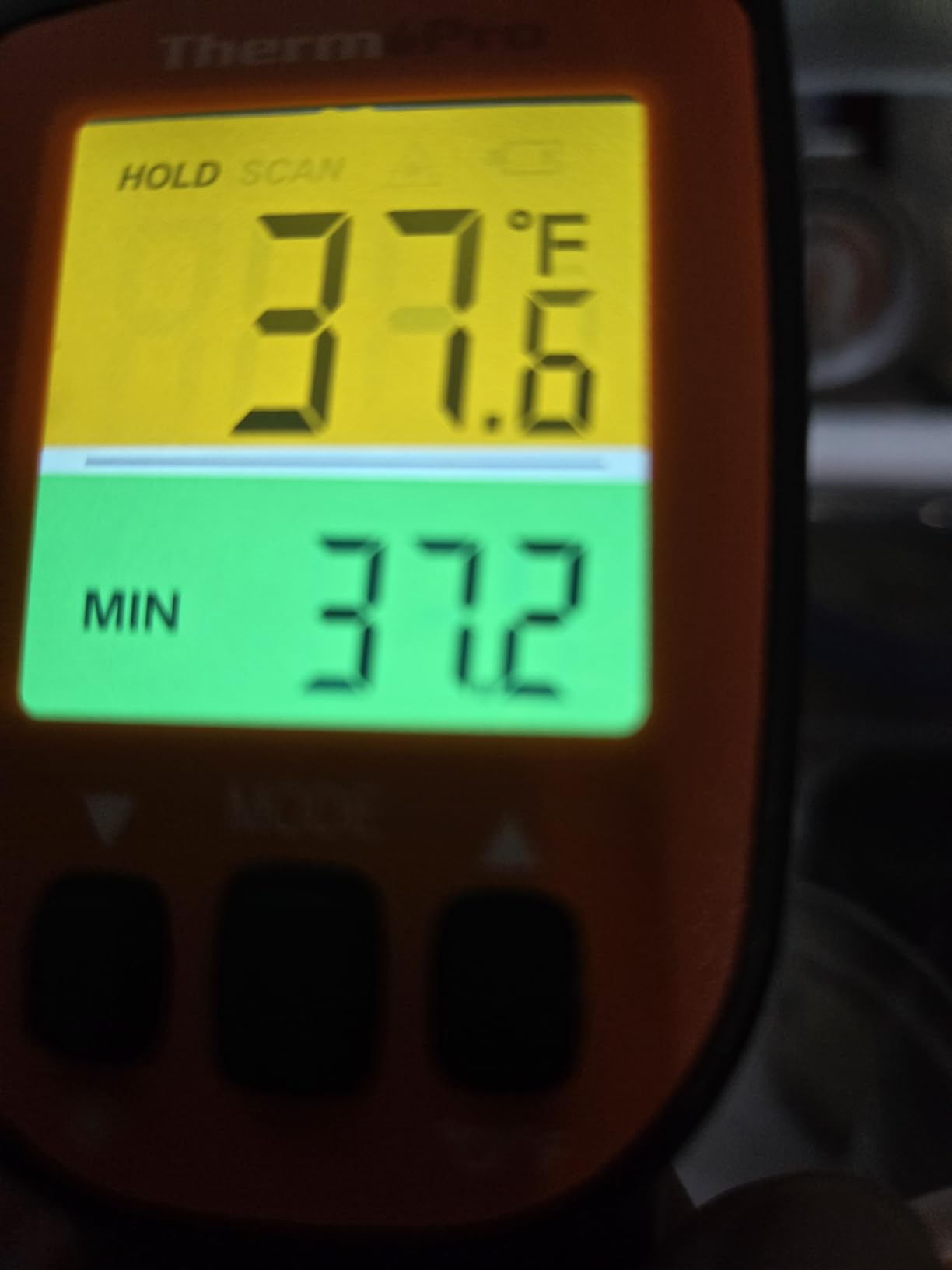
Accuracy is rated at plus or minus 1.5 percent, which is solid for this price range. The adjustable emissivity from 0.1 to 1.0 gives you the versatility to measure different cooking surfaces accurately, from cast iron skillets to ceramic pizza stones to stainless steel griddles. The MAX, MIN, and AVG temperature memory functions are useful for tracking how your oven or grill heats up over time.
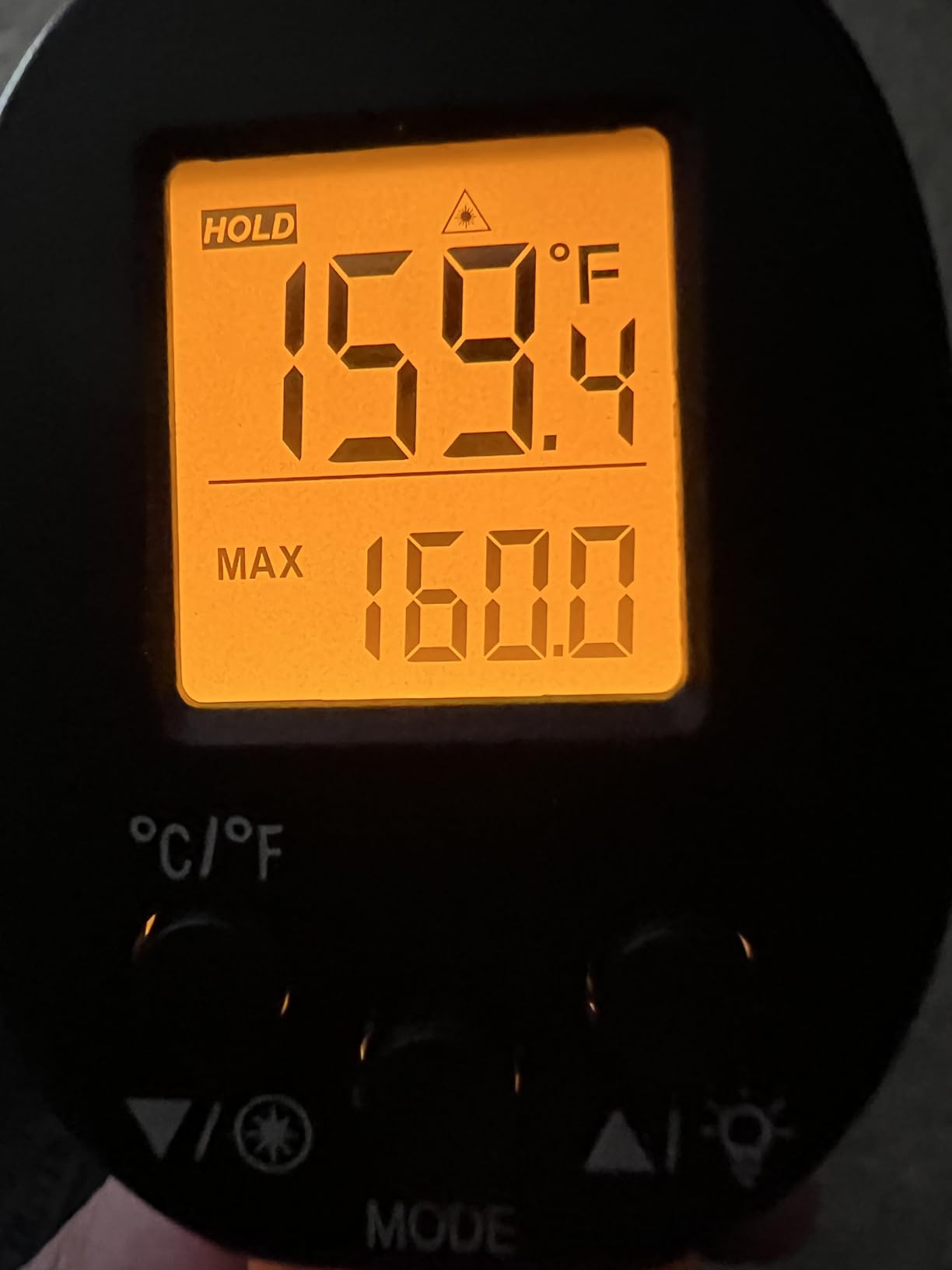
The compact size makes it easy to keep next to your grill or in a kitchen drawer. The backlit LCD screen is clear and readable, even when you are checking temperatures in the evening with the overhead lights off. The 0.1-degree Fahrenheit resolution gives you precise readings that help dial in your cooking temperatures.
With over 10,000 reviews and a 4.6-star rating, the TP30 has proven itself reliable across a wide range of cooking and home applications. Users particularly praise it for pizza oven use, griddle cooking, and HVAC temperature checks. The FCC certification is a nice quality assurance detail that budget brands sometimes skip.
Who Should Buy the TempPro TP30
Home cooks, pizza oven owners, and grilling enthusiasts who want a cooking-focused infrared thermometer with adjustable emissivity will find the TP30 to be an excellent fit. The temperature range covers virtually all cooking scenarios, and the memory functions help you track preheat times and temperature stability.
Budget-conscious buyers who want more features than the ultra-budget Soonkoda GM50 offers will find the TP30 to be a worthwhile step up, especially for the adjustable emissivity and wider temperature range.
Who Should Look Elsewhere
If you need dual-laser targeting or higher distance-to-spot ratios, the TempPro TP450 offers both of those features for a moderate price increase. The TP30 sticks with a single laser and 12:1 ratio, which is fine for most cooking applications but limiting for distance work.
Professional HVAC technicians and industrial users should look at the Klein Tools or Fluke models that offer IP ratings, drop protection, and the durability needed for daily jobsite use.
11. TempPro TP450 – Best Mid-Range Dual Laser
TempPro TP450 2 Laser Temperature Gun for Cooking, 16:1 D:S Ratio Infrared Thermometer Gun for Pizza Oven, Laser Thermometer Gun with Adjustable Emissivity Temp Gun -58 to 1022℉,Gift for Dad Husband
16:1 D:S Ratio
Dual Laser
Temp: -58 to 1022F
Adjustable Emissivity
MAX/MIN/AVG
0.5s Response
Pros
- 16:1 distance-to-spot ratio for distance precision
- Dual laser targeting
- Adjustable emissivity 0.1-1.0
- MAX/MIN/AVG functions
- Fast 0.5 second response
- Clear backlit LCD
- Well-rated with thousands of reviews
Cons
- Buttons can be touchy
- Battery life could be better
- Lesser-known brand vs Fluke or Klein
The TempPro TP450 bridges the gap between budget single-laser thermometers and professional dual-laser models from Klein and Fluke. The 16:1 distance-to-spot ratio is one of the best in this price range, letting you measure smaller target areas from farther away than most competitors can manage. I found the dual lasers particularly helpful when measuring across a pizza oven floor where I wanted to check the temperature at specific spots without getting my hand too close to the heat.
The adjustable emissivity from 0.1 to 1.0 means you are not locked into a single surface type. Whether I was checking the ceramic floor of my pizza oven, the stainless steel door of my grill, or the painted surface of an AC unit, I could tune the emissivity for accurate readings. The MAX, MIN, and AVG functions track temperature extremes and averages over time, which is useful for monitoring how surfaces heat up during cooking or how equipment behaves under load.
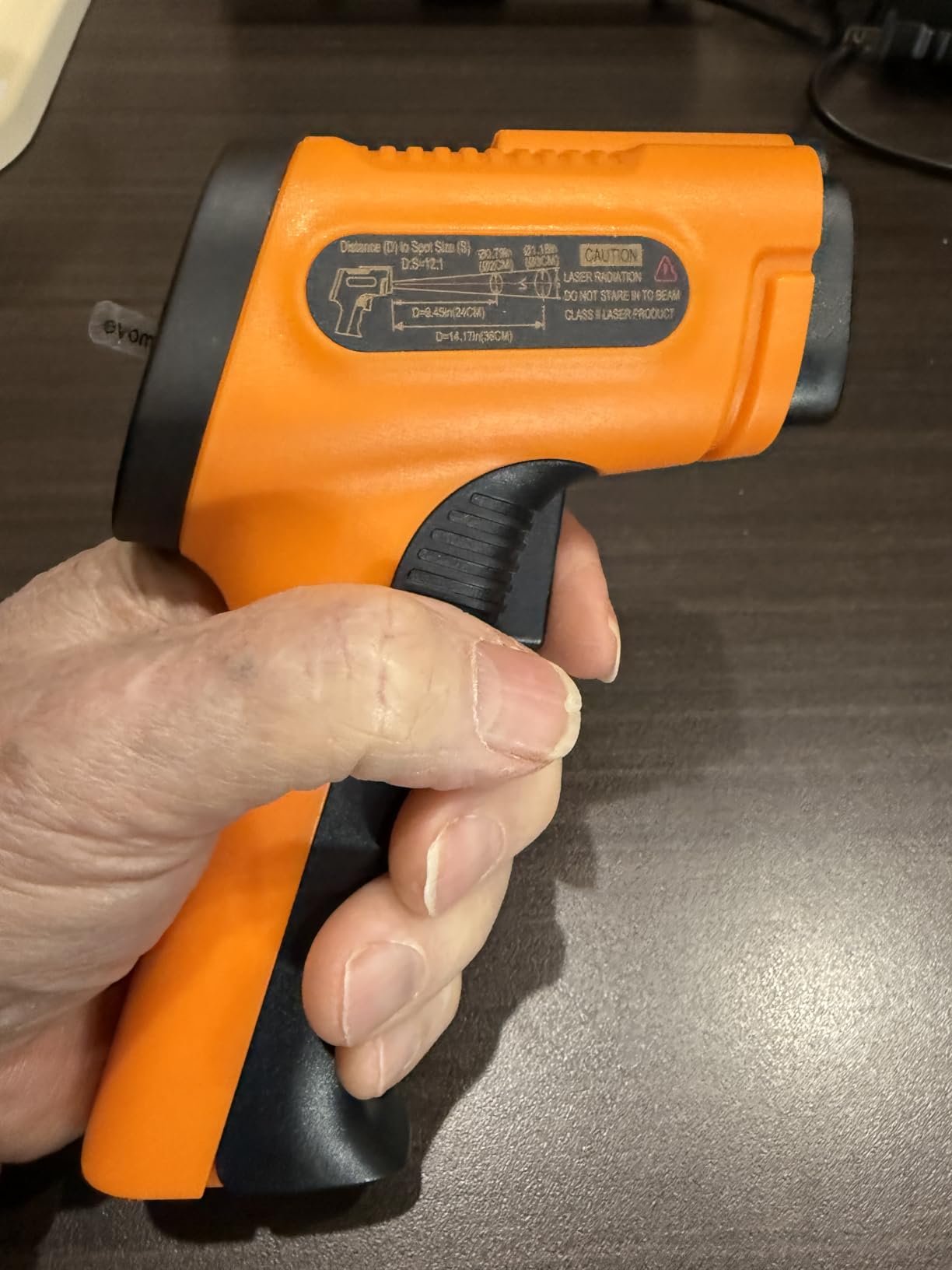
Build quality is better than I expected at this price. The plastic housing feels solid enough for regular home and light professional use, though it lacks the IP ratings and drop protection that Klein Tools and Fluke models offer. The backlit LCD is bright and easy to read, and the 0.5-second response time keeps pace with more expensive options.
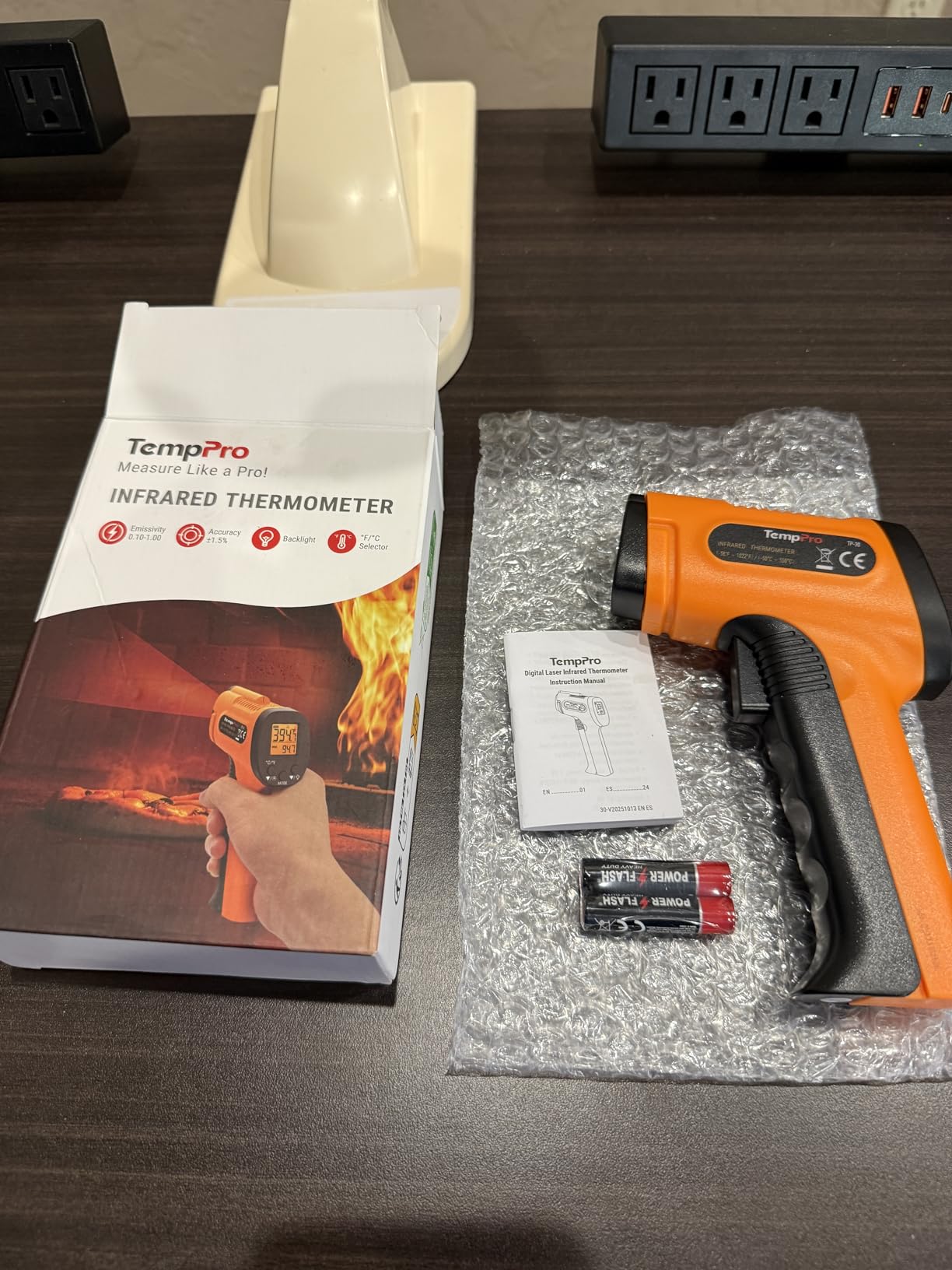
The TP450 shares the same body design and interface as the TP30, so if you have used that model the TP450 will feel familiar. The main upgrades are the 16:1 ratio versus 12:1 and the dual lasers versus single laser, both of which significantly improve targeting accuracy. The 0.1-degree resolution gives you precise readings for applications where a few degrees matter.
Who Should Buy the TempPro TP450
Cooks and grillers who want dual-laser precision and a higher distance-to-spot ratio without paying Klein or Fluke prices will find the TP450 to be an excellent value. The 16:1 ratio is a real step up from 12:1 models, and the dual lasers make targeting intuitive.
DIYers and homeowners who want more features than entry-level models but do not need professional-grade durability will find the TP450 hits the sweet spot between capability and cost.
Who Should Look Elsewhere
If you need the highest possible distance-to-spot ratio, the Klein Tools IR10 at 20:1 gives you more reach. And if you need IP-rated protection and drop-test certification for daily jobsite abuse, the Fluke or Klein models are built to handle that level of punishment.
Anyone on the tightest possible budget should consider the Soonkoda GM50 or Etekcity Lasergrip 774, both of which offer basic infrared measurement capability at lower prices, though without dual lasers or the 16:1 ratio.
12. Soonkoda GM50 – Best Ultra-Budget Pick
Digital Infrared Thermometer gun for cooking,BBQ,Pizza oven,Ir Thermometer with Backlight,-58℉~932℉(-50℃~500℃) Handheld Non Contact Heat Laser Temperature Gun (Not for Human)
Temp: -58 to 932F
Fixed Emissivity 0.95
0.1F Resolution
LCD Backlight
Auto Hold
AAA Included
Pros
- Exceptional value under 10 dollars
- Accurate readings across wide range
- Fast response time
- Bright LCD with backlight
- Auto hold and auto shut-off
- Lightweight and portable
- Good for AC and grills
Cons
- Preset emissivity 0.95 not adjustable
- Plastic build quality
- Not suitable for shiny metal surfaces
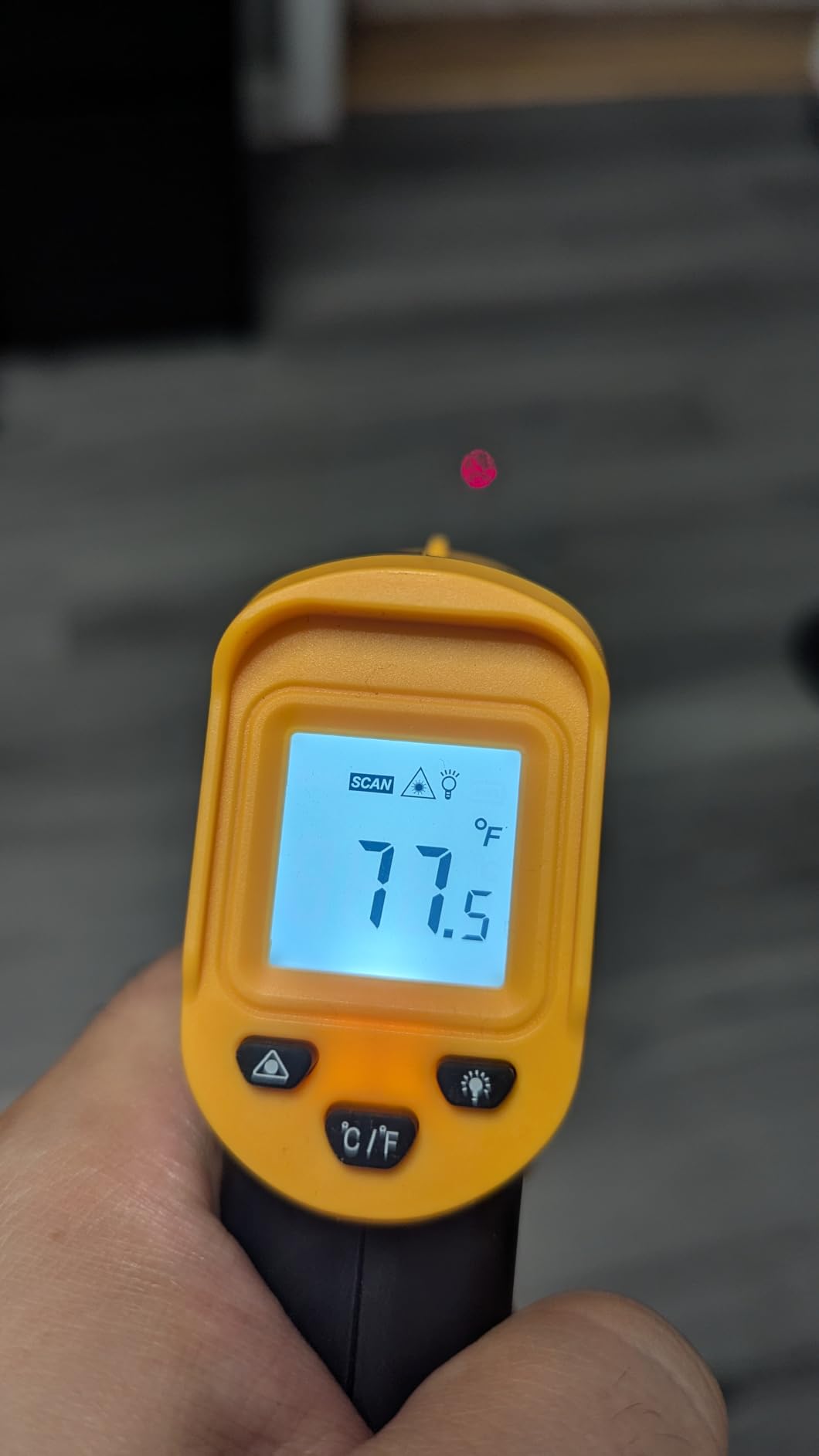
The Soonkoda GM50 proves that you do not need to spend a lot to get a functional infrared thermometer. At under 10 dollars, it currently ranks as the number 2 best seller in the infrared thermometer category on Amazon with nearly 6,000 reviews. I bought one out of curiosity to see how a sub-ten-dollar thermometer compares to the pricier options, and honestly it does a lot more than I expected.
The temperature range of -58 to 932 degrees Fahrenheit covers most common household and cooking applications. The 0.1-degree display resolution gives you precise readings, and the backlight makes the screen readable in low-light conditions. The auto-hold function freezes the reading on the display so you can point, measure, and then look at the screen without keeping the trigger held down.
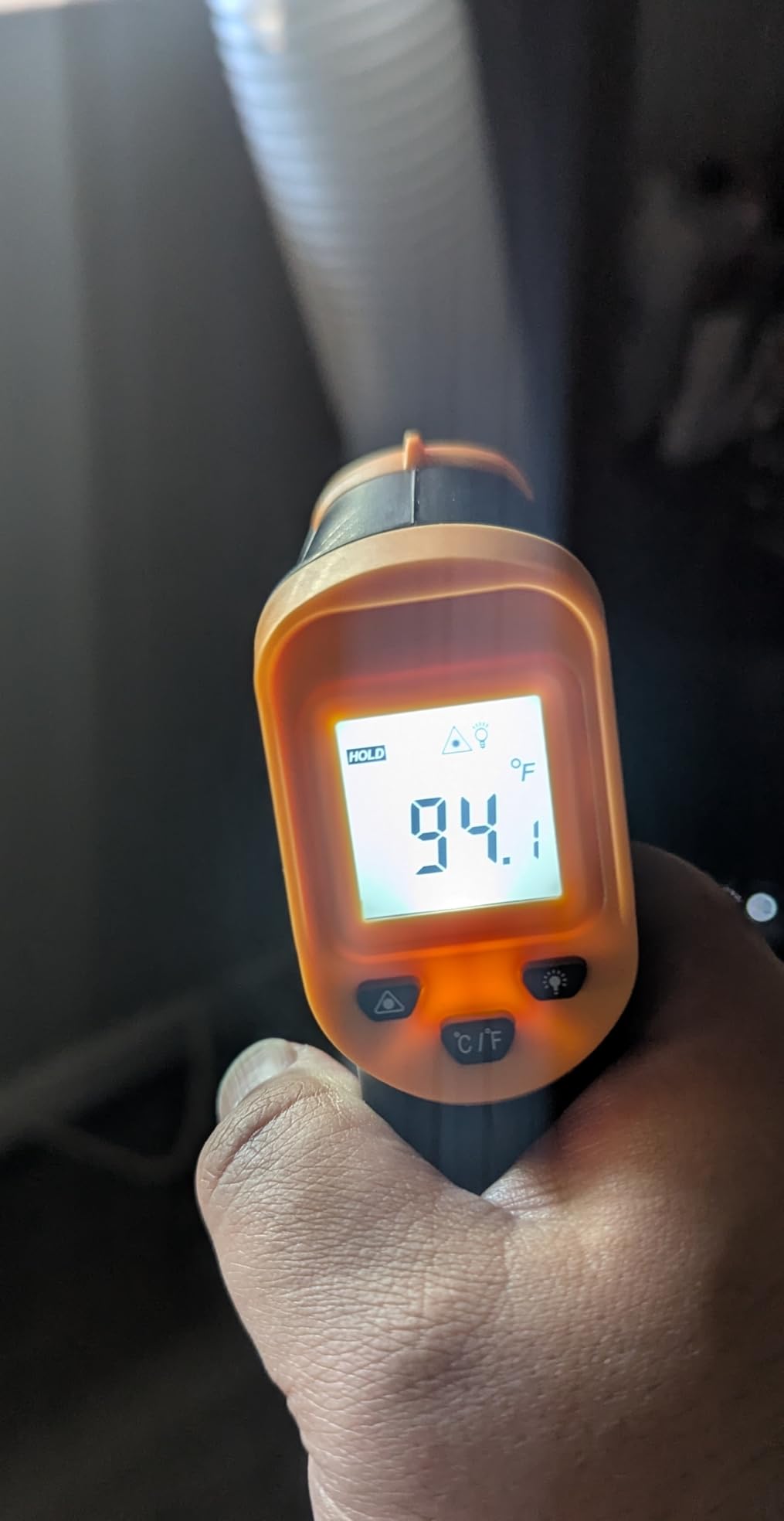
The fixed emissivity of 0.95 is the main limitation here. It works well for dark surfaces like grill grates, AC vent covers, and painted walls, but it will give inaccurate readings on shiny metals, polished surfaces, and bare carbon steel. If most of your temperature checks involve those standard surfaces, the GM50 handles them just fine.
The build is all plastic and feels light in the hand, which is exactly what you expect at this price. It is not going to survive a drop onto concrete like the Fluke or Klein models, but for occasional use around the house it holds up fine. The included AAA batteries mean you can start using it right out of the box, and the auto power-off after about 8 seconds prevents accidental battery drain.
Who Should Buy the Soonkoda GM50
Anyone who wants to try an infrared thermometer for the first time without making a significant investment should start with the GM50. It delivers basic but reliable temperature readings for common surfaces and costs less than a takeout lunch.
It is also a great spare or backup thermometer to keep in a drawer, glove compartment, or toolbox. Some users buy several for different locations, which is practical given the low price point.
Who Should Look Elsewhere
If you need adjustable emissivity, the Etekcity Lasergrip 774 is only slightly more expensive and adds that critical feature. Anyone working with varied surface materials will quickly run into the limitations of the fixed 0.95 emissivity on this model.
Professionals and serious hobbyists should invest in models with adjustable emissivity, better optical resolution, and stronger build quality. The GM50 is best viewed as a capable entry-level tool, not a replacement for a proper thermometer in demanding applications.
How to Choose the Best Infrared Thermometer
Picking the right infrared thermometer comes down to understanding a few key specifications that determine how the tool performs in real-world use. Our team has tested these models across cooking, HVAC, automotive, and home inspection scenarios, and these are the factors that actually matter when making your decision.
Distance-to-Spot Ratio (D:S)
The distance-to-spot ratio tells you how small of an area you can measure from a given distance. A 12:1 ratio means at 12 inches away, you are reading a 1-inch circle on the surface. At 24 inches away, that circle doubles to 2 inches. Higher ratios like the Klein IR10’s 20:1 or the TempPro TP450’s 16:1 let you measure smaller targets from farther away, which is critical for HVAC work and industrial applications. For cooking where you are usually close to the surface, 10:1 or 12:1 is perfectly adequate.
Emissivity Settings
Emissivity is a measure of how efficiently a surface emits infrared radiation, and it varies by material. Dark, matte surfaces like black paint and anodized aluminum have emissivity close to 0.95, which is why most budget thermometers use that as a fixed value. Shiny metals like polished stainless steel, aluminum, and bare carbon steel have much lower emissivity values, often 0.1 to 0.3. If you regularly measure those surfaces, adjustable emissivity is essential for accurate readings. Forum users on r/carbonsteel and r/castiron frequently note that fixed-emissivity IR thermometers give wildly inaccurate readings on bare carbon steel cookware.
Temperature Range
Match the temperature range to your primary use case. Most home cooking stays below 700F, so models with an 842F upper limit like the Etekcity 774 work fine. Pizza oven enthusiasts and industrial users should look at models reaching 1000F or higher, like the Etekcity 1080 at 1130F or the Fluke 62 Max+ at 1202F. The Klein IR10 covers the widest range at -40 to 1200F, making it the most versatile single tool in this roundup.
Laser Targeting Type
Single-laser models point a dot at the center of your measurement area, which is fine for basic targeting. Dual-laser models like the Klein IR5, IR10, Fluke 62 Max+, and TempPro TP450 outline the measurement circle, so you can see exactly what area the sensor is reading. Circle-laser models draw a complete ring around the measurement area. For precision work, dual or circle lasers are significantly better than single-laser systems.
Durability and Protection Ratings
If you work in environments with dust, moisture, or drop hazards, look for IP ratings and drop-test certifications. The Fluke 62 Max and 62 Max+ both carry IP54 ratings and survive 3-meter drops. Klein Tools models offer 2-meter to 3-meter drop protection across the lineup. Budget models like the Etekcity and TempPro units do not carry these ratings, so they are best suited for controlled environments like kitchens and home workshops.
Additional Features Worth Having
MAX/MIN/AVG temperature functions help you track extremes and averages over time. High/low temperature alarms alert you when a reading exceeds set thresholds. A K-type probe input, found on the Klein IR10, lets you take contact measurements alongside IR readings. Auto-scan mode on the Klein IR5 enables continuous surface scanning. And backlit displays are essential for reading temperatures in dark spaces like attics, crawlspaces, and evening grilling sessions.
Keep in mind that no infrared thermometer can measure internal temperatures. They only read surface temperature via infrared radiation. If you need internal food temperatures, use a probe thermometer or choose a dual-function model like the Klein Tools IR07 that includes a built-in probe.
FAQs
What is the most accurate infrared thermometer?
The Fluke 62 Max+ offers the highest accuracy among consumer-accessible infrared thermometers with a +/-1% accuracy rating. The Fluke 62 Max follows closely at +/-1.5% of reading. Both models are NIST-compliant and trusted by professionals in HVAC, industrial maintenance, and automotive diagnostics. Among budget options, the Etekcity Lasergrip 774 and TempPro TP30 both offer +/-1.5% accuracy with adjustable emissivity, which helps maintain accuracy across different surface materials.
Which brand infrared thermometer is best?
Fluke is the gold standard for professional infrared thermometers, offering the highest accuracy ratings, IP54 protection, and 3-year warranties. Klein Tools is the best overall value brand, offering a full range from budget to professional models with excellent build quality at lower prices than Fluke. Etekcity dominates the budget category with the Lasergrip 774 and 1080, both of which have over 47,000 reviews and offer features like adjustable emissivity at a fraction of the cost of professional models.
What are the disadvantages of using an infrared thermometer?
Infrared thermometers can only measure surface temperature, not internal temperature, so they cannot be used to check if meat is fully cooked or if liquids have reached a target core temperature. They give inaccurate readings on shiny or reflective surfaces unless you adjust the emissivity setting. Steam, dust, and glass between the sensor and the target can interfere with readings. Accuracy can drift over time and requires periodic calibration verification. They also cannot measure air temperature, only solid and liquid surfaces.
What to look for when buying an infrared thermometer?
Focus on four key specifications: distance-to-spot ratio (12:1 minimum for general use, 16:1 or higher for distance work), adjustable emissivity (essential for measuring different materials accurately), temperature range that covers your intended applications, and laser targeting type (dual laser is more precise than single laser). Also consider build quality and IP ratings if you will use it in demanding environments, display readability in various lighting conditions, and whether you need extra features like MAX/MIN/AVG tracking, alarms, or a probe input for contact measurements.
Final Thoughts on the Best Infrared Thermometers
Finding the best infrared thermometer for your needs does not have to be complicated. For most people, the Etekcity Lasergrip 774 delivers everything you need at a price that is hard to beat, including adjustable emissivity and a solid 12:1 distance-to-spot ratio. Professionals and serious users will find the Fluke 62 Max+ worth the investment for its unmatched accuracy, dual rotating lasers, and IP54 ruggedness.
The Klein Tools IR10 stands out as the best all-around professional pick with its class-leading 20:1 distance-to-spot ratio, included K-type probe, and adjustable emissivity that handles virtually any surface material. And for those who need both IR and probe measurements in one pocket-sized package, the Klein Tools IR07 is a uniquely capable tool for HVAC work and home diagnostics.
Whichever model you choose, remember that infrared thermometers measure surface temperature only. For internal food temperatures, pair your IR gun with a quality probe thermometer. And always verify your readings periodically against a known reference to make sure your tool stays calibrated over time. The models in this guide have been tested and reviewed by thousands of real users, so you can buy with confidence knowing these are the best infrared thermometers worth your money in 2026.