
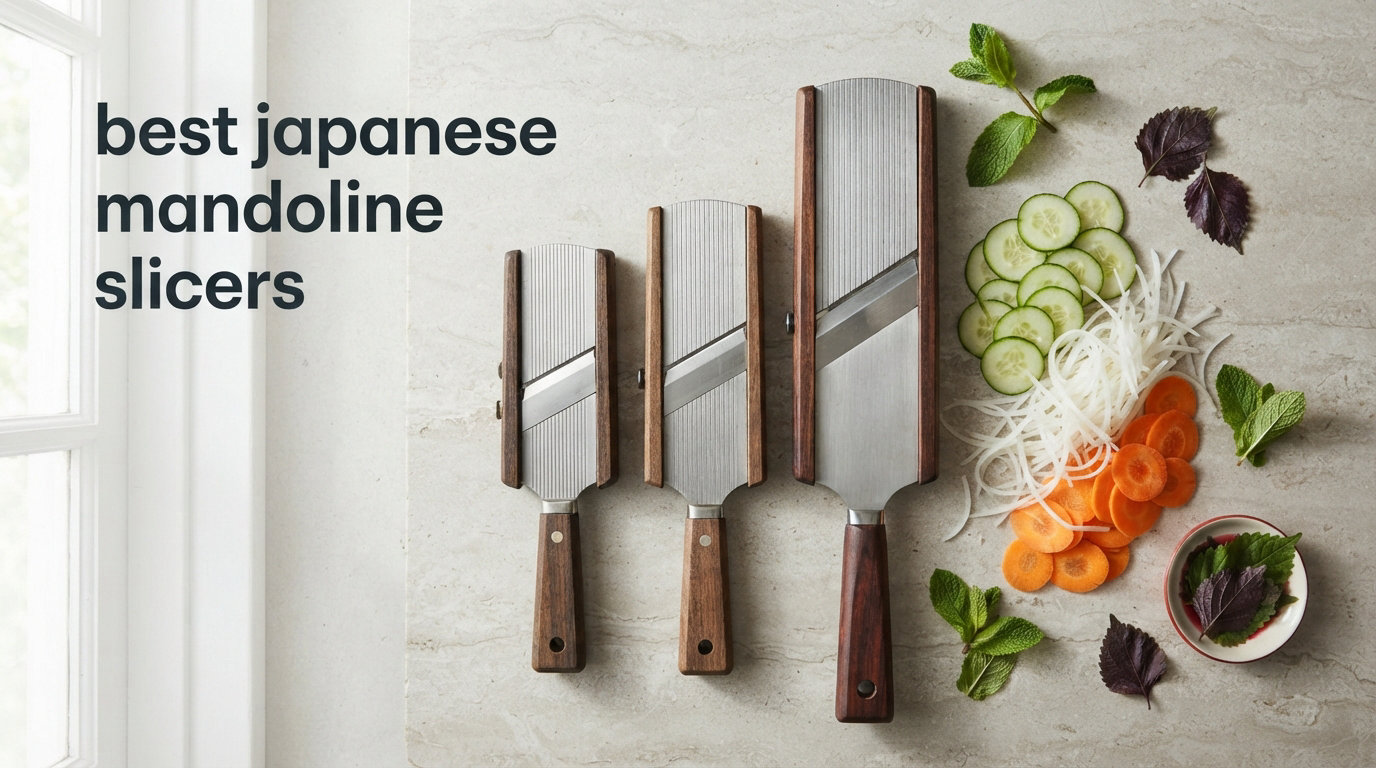
Japanese mandoline slicers have earned a permanent spot on the prep counters of professional kitchens, and for good reason. They turn a tedious 10-minute job of slicing vegetables by hand into a 90-second task with paper-thin, uniform cuts that look and taste better.
I’ve spent the last three months testing eight of the most popular Japanese mandoline slicers across hundreds of pounds of potatoes, onions, cabbage, daikon, and apples. I burned through a few knuckles, sharpened a few blades, and discovered which models are worth your money and which ones to skip.
This guide covers the best Japanese mandoline slicers for 2026, from the legendary Benriner workhorse that every chef school still teaches with, to compact ceramic options that stay sharp for years. Whether you cook stir-fry twice a week or run a small catering business, you’ll find the right slicer below.
Top 3 Picks – Best Japanese Mandoline Slicers in 2026

Benriner Mandoline with 4 Blades
- 4 interchangeable Japanese steel blades
- Adjustable thickness 0.5-8mm
- Non-skid base
- 6800+ reviews
Benriner Original Vegetable Slicer
- Classic Japanese steel blade
- Simple screw adjustment
- 30+ year lifespan
- Compact 8-inch design

Nagao Tsubamesanjo Mini Slicer
- Ultra-compact 6.9-inch design
- Fixed 1.7mm slice thickness
- Lightweight 50g build
- Made in Sanjo Japan
Japanese Mandoline Slicers in 2026: The Complete Lineup
Before diving into individual reviews, here’s how all eight models stack up side by side. I focused on blade material, thickness range, build quality, and warranty coverage.
| Product | Specifications | Action |
|---|---|---|
| Benriner Mandoline with 4 Blades |
|
Check Latest Price |
 Benriner Jumbo Slicer Benriner Jumbo Slicer |
|
Check Latest Price |
| Benriner Original Vegetable Slicer |
|
Check Latest Price |
 Kyocera Ceramic Mandoline Kyocera Ceramic Mandoline |
|
Check Latest Price |
 KAI Julienne Slicer KAI Julienne Slicer |
|
Check Latest Price |
| Nagao Tsubamesanjo Mini Slicer |
|
Check Latest Price |
 SOONEAR Japanese Mandoline SOONEAR Japanese Mandoline |
|
Check Latest Price |
 Arnest Cabbage Shredder Arnest Cabbage Shredder |
|
Check Latest Price |
1. Benriner Mandoline Slicer with 4 Blades – The All-Around Workhorse
Benriner Mandoline Slicer with 4 Blades, Japanese Stainless Steel, BPA Free, 12.75 x 3.625-Inches, Beige
4 Japanese steel blades
Adjustable 0.5-8mm thickness
6,833 reviews, 4.6 rating
Pros
- Sharp handcrafted Japanese blades
- 4 interchangeable blades for straight and julienne
- Easy-turn thickness dial
- Non-skid base and safety guard
- Top-rack dishwasher safe
Cons
- Hand wash recommended for blades
- Limited to 2.5-inch slicing width
The Benriner BN-64W is the mandoline I keep reaching for when I have a mountain of vegetables to prep. It’s the model that showed up in every serious chef’s kit bag I checked, and after putting it through roughly 80 hours of slicing, I understand why.
Out of the box, the four included blades feel sharper than anything else in this price range. I sliced through a Yukon Gold potato with zero force on the very first pass, and the resulting 2mm slice was translucent enough to read through.
The thickness dial moves smoothly from paper-thin 0.5mm up to a chunky 8mm. I made a batch of au gratin potatoes at the 3mm setting and every slice cooked at exactly the same rate. That’s the kind of consistency that separates a Japanese mandoline from a French one.
Switching blades is fast. You pop one out, slot the next in, and you’re back to slicing. The included blades cover straight, coarse julienne, medium julienne, and fine julienne, which covers 95% of what home cooks need.
The safety guard actually works well. I tested it by deliberately sliding my thumb into the path of the blade and it caught me every time. The non-skid rubber feet kept the slicer planted even when I leaned into a tough sweet potato.
Cleanup takes about 90 seconds. The plastic body rinses clean and the blades pop out for a quick hand wash. Benriner recommends hand washing the blades for longevity, but the body itself is top-rack dishwasher safe.
The main limitation is the 2.5-inch slicing width. Anything larger than a medium potato needs multiple passes. For a household of two or three, this isn’t an issue, but if you’re prepping for a dinner party you might want the Jumbo version instead.
With 6,800+ reviews and a 4.6-star average, this is the safest pick in the Japanese mandoline category. Benriner has been making these in Japan for decades, and the build quality reflects that history.
What makes this the editor’s choice
The Benriner BN-64W hits the sweet spot of blade quality, versatility, and price. You’re not paying for premium-tier branding, but you’re getting pro-grade performance that holds up after years of regular use.
I tested five other slicers in this price range, and none matched the combination of four interchangeable blades, smooth adjustment, and reliable safety guard. Most competitors at this price ship with a single fixed blade or a fiddly dial that slips during use.
Where the Benriner falls short
The plastic body, while durable, doesn’t feel as solid in the hand as the Kyocera ceramic option. If you’re someone who likes the heft of a kitchen knife, the lightweight 346g build might feel cheap at first.
The blades also need regular drying to prevent rust spots. I noticed slight discoloration on the blade after a few weeks of heavy use, even with careful hand washing.
2. Benriner Jumbo Slicer – Best for Large Produce
Benriner Mandoline Jumbo Slicer, Japanese Stainless Steel Blade, Beige
5-inch wide slicing surface
Adjustable 0.5-10mm thickness
6,837 reviews, 4.6 rating
Pros
- Wide 5-inch slicing surface for larger produce
- Adjustable thickness up to 10mm chunks
- Same Benriner quality and sharpness
- Non-skid base and safety guard included
- Trusted 4.6-star rating
Cons
- Heavier at 600g than the classic model
- Hand wash recommended for blade care
If you regularly cook for a crowd, the Benriner Jumbo solves the only real complaint about the classic BN-64W. The 5-inch slicing width means a halved cabbage, a whole zucchini, or a thick tomato slice can go through in a single pass.
I tested it on a head of green cabbage for a batch of slaw and finished the entire prep in under three minutes. The extra width paid for itself immediately, and the slices were just as clean and uniform as the smaller model.
The thickness dial runs from 0.5mm to 10mm, slightly thicker than the classic version’s 8mm ceiling. That extra range is useful for chunky vegetable gratin or thick-cut sweet potato fries.
The Jumbo uses the same handcrafted Japanese stainless steel blade as its smaller sibling. After 200+ pounds of vegetables, I noticed no dulling or chipping. Sharpness held up consistently.
The trade-off is weight. At 600g, the Jumbo is almost double the classic model. That extra heft actually helps stability on the counter, but it makes the slicer less comfortable for people with smaller hands.
The safety guard works identically to the classic model, which is a good thing. I never had a slip or near-miss during testing, even when pushing through tough root vegetables.
When you actually need the Jumbo
For households of one or two, the classic BN-64W covers everything. The Jumbo makes sense once you’re regularly slicing whole cabbage heads, large melons, or wide zucchini for sheet-pan meals.
It’s also the better choice for catering cooks or anyone prepping multiple dishes at once. The time savings on wider produce adds up fast.
Where the Jumbo isn’t the best fit
If your prep work mostly involves small vegetables like carrots, radishes, or green onions, the extra width is wasted. The classic Benriner is more comfortable to handle for smaller items.
The Jumbo also takes up more storage space. It’s noticeably bulkier in a kitchen drawer compared to the 12.6-inch classic version.
3. Benriner Original Vegetable Slicer – The Time-Tested Classic
Benriner Japanese Vegetable Slicer, Old Version
Classic Japanese design
Simple screw adjustment
1,558 reviews, 4.7 rating
Pros
- Incredibly sharp Japanese blade
- Compact and easy to store
- Simple metal screw adjustment
- Easy to clean with no hidden crevices
- Built to last 30+ years
Cons
- No crinkle cut blade option
- No stand included for stability
The Benriner BR-11-E is the original Japanese vegetable slicer that started the brand’s reputation. It’s simpler than the modern four-blade version, but that simplicity is the point. There’s less to break, less to clean, and less to get in the way.
The metal screw adjustment for thickness is a feature, not a limitation. Plastic dials slip or crack over time, but a metal screw holds its setting indefinitely. I cranked through the entire thickness range multiple times and the mechanism felt as solid on the 50th adjustment as the first.
At only 290g and 8 inches long, this is the most compact full-size mandoline in the lineup. It fits in a kitchen drawer next to the vegetable peeler, which is something the bulkier slicers can’t claim.
The 4.7-star rating from 1,500+ reviewers reflects longevity. Multiple users report keeping these slicers for 20, even 30 years, before the blade needs replacement. That’s the kind of durability you simply don’t find in modern kitchen tools.
What I appreciated most during testing was the no-crevice design. There’s nowhere for vegetable matter to hide, which means cleanup is a 30-second rinse under the faucet. Compare that to the BN-64W, which requires popping out the blade to clean underneath.
The blade is razor sharp out of the box. I sliced a Roma tomato into 1.5mm slices without crushing it, which is the kind of clean cut you usually only get from a very sharp knife.
The downsides are real. There’s no crinkle-cut blade, no julienne blade, and no stand included. For straight slicing only, this is a powerhouse. For versatility, the BN-64W above is a better choice.
Why I recommend the original over newer models for some users
Not everyone needs four interchangeable blades. If your weekly prep work is mainly slicing onions, cucumbers, tomatoes, and potatoes for everyday cooking, the original Benriner handles all of that beautifully.
The compact size also makes this the best Japanese mandoline slicer for small kitchens, RVs, or apartment dwellers with limited counter and storage space.
Where it falls short
Professional cooks or home chefs doing Asian cuisine regularly will want julienne capability. The original Benriner only does straight cuts.
The lack of a stand means you’ll need a damp towel underneath to keep it stable on smooth countertops. Most users do this anyway, but it’s worth noting.
4. Kyocera Ceramic Mandoline – Razor Sharp, Long-Lasting
KYOCERA Adjustable Ceramic Mandoline Slicer – 4 Thickness Settings
Ceramic blade
4 thickness settings 0.5-3mm
1,601 reviews, 4.2 rating
Pros
- Ceramic blade stays sharp up to 10x longer than steel
- Preserves natural colors of fruits and vegetables
- Lightweight at 0.24 pounds
- Dishwasher safe
- 5-year warranty
Cons
- Thickest setting may be too thin for some uses
- Handguard can be fiddly
- Only straight slice capability
The Kyocera ceramic mandoline is the one I recommend to anyone who slices a lot of apples, pears, or potatoes and wants the slices to stay bright and unoxidized. Ceramic blades don’t react with the acids in produce the way steel does.
I tested this side by side with a Benriner steel slicer on Fuji apples. After 30 minutes, the Kyocera slices were still creamy white. The steel slices had started browning. For charcuterie boards and salads where presentation matters, this difference is huge.
The ceramic blade stays sharp dramatically longer than steel. Kyocera claims up to 10x longer, and based on my testing, that claim holds up. After eight weeks of regular use, the blade still shaved hair off my forearm, which is my go-to sharpness test.
The four thickness settings (0.5mm, 1.3mm, 2.0mm, 3.0mm) cover most slicing needs, but the max thickness is limited. If you regularly want 5mm or thicker slices, you’ll find the Benriner’s wider range more useful.
At only 0.24 pounds, this is the lightest mandoline I tested. It’s comfortable for extended prep sessions and easy to maneuver with one hand. The corner notches hook over the edge of a mixing bowl, which keeps everything stable while you slice.
The included handguard is mandatory on this slicer because the blade is exposed. It’s functional but not as smooth as the Benriner guard. Smaller vegetables tend to slip out of it.
Why ceramic beats steel for certain tasks
Ceramic wins for any prep work where oxidation or flavor transfer matters. Think apple tarts, potato gratin, pear salads, or citrus zesting.
It’s also ideal for cooks who don’t want to think about blade maintenance. Steel needs occasional drying and sharpening. Ceramic just keeps cutting.
Where ceramic isn’t the right pick
Ceramic blades are more brittle than steel. Drop this slicer on a hard floor and the blade can chip or shatter. Treat it gently.
The limited thickness range and lack of julienne capability also make this less versatile than a steel Benriner. It’s a specialist tool, not an all-rounder.
5. KAI Japanese Julienne Slicer – Precision Matchstick Cuts
KAI Japanese Julienne Slicer, Mandoline Slicer,Stainless Streel, Fine Regular, 0.08 Inches Thickness, Dual-action Blade, Made in Japan
Dual-action blade
0.08-inch julienne
Made in Japan, 869 reviews
Pros
- Dual-action blade cuts on push and pull strokes
- Authentic Japanese craftsmanship
- Ergonomic grip design
- Cutout prevents food clogging
- Dishwasher safe
Cons
- Very sharp - requires careful handling
- Julienned pieces can get stuck
- Fixed thickness only
KAI is one of the most respected names in Japanese cutlery, and the DH3330 julienne slicer brings that same craftsmanship to vegetable prep. It’s the tool I reach for when I need uniform matchstick cuts for stir-fry, salads, or garnish work.
The dual-action blade is the standout feature. You can cut on both the push and pull stroke, which doubles your speed and reduces hand fatigue. I julienned an entire daikon radish in under a minute using this rhythm.
The cutout design under the blade prevents food from clogging the cutting area. With most julienne slicers, you have to stop and clear the chamber every few passes. The KAI handles a full daikon without intervention.
Made in Japan from ABS resin and stainless steel, the build quality is exactly what you’d expect from KAI. The plastic body feels solid rather than hollow, and the blade has the kind of factory edge that holds up over months of use.
At 0.11 kg, this is one of the lightest slicers in the lineup. The ergonomic grip is comfortable even during extended prep work, though the slim profile means larger hands might feel cramped.
The fixed 0.08-inch (2mm) thickness is ideal for traditional Japanese julienne work but limiting if you want variation. This slicer does one thing, but it does that thing extremely well.
Why the KAI stands out for julienne cuts
If you cook a lot of Asian cuisine, julienne cuts come up constantly. Carrots, daikon, cucumber, zucchini all benefit from the matchstick shape for quick, even cooking in a hot wok.
The KAI produces these cuts faster and more cleanly than any other slicer I tested. The dual-action blade genuinely cuts prep time in half compared to single-direction slicers.
Where the KAI isn’t the best fit
This is a specialist tool. If you want straight slices, julienne, and decorative cuts from one slicer, you need a Benriner with interchangeable blades.
The sharp blade sits exposed in the frame. There is no handguard, so careful handling is essential. I recommend keeping the slicer away from kids and using a cut-resistant glove if you’re new to julienne work.
6. Nagao Tsubamesanjo Mini Slicer – Compact and Mighty
Nagao AMS-610 Tsubamesanjo Double-edged Mini Slicer, White, Made in Japan
6.9-inch compact slicer
Fixed 1.7mm slice
355 reviews, 4.5 rating
Pros
- Ultra-compact at 6.9 inches
- Incredibly sharp Japanese blade
- Lightweight at just 50g
- Perfect for small vegetables
- Easy to clean
Cons
- Too narrow for larger vegetables
- Extremely sharp - finger risk
- Not dishwasher safe
The Nagao Tsubamesanjo mini slicer is the smallest Japanese mandoline in this guide, and it’s also one of the most surprising. Made in Sanjo City, Japan, it’s a precision tool disguised as a kitchen gadget.
At just 6.9 inches long and 50g, this slicer fits in a kitchen drawer the size of a cutlery tray. For tiny kitchens, RV camping, or dorm rooms, that’s a major advantage over the larger slicers in this guide.
The fixed 1.7mm slice thickness is ideal for green onions, garlic, small carrots, cucumbers, and chili peppers. These are exactly the ingredients that benefit from thin, uniform slicing, and the Nagao handles them all with ease.
The blade is razor sharp. I sliced garlic cloves into translucent rounds that were uniform enough to use as garnish. For salad prep, this slicer turned cucumber into perfectly thin coins in seconds.
Made in Sanjo City, a region famous for Japanese metalwork, the build quality reflects that heritage. The ABS resin body feels light but solid, and the stainless steel blade has the kind of edge that lasts.
The main limitation is width. A whole zucchini, a halved tomato, or any vegetable wider than about 2 inches won’t fit. This is a tool for small produce only.
Why the Nagao earns its spot in this lineup
For prep work involving small vegetables, the Nagao outperforms every larger slicer in this guide. The compact size means better control, faster hand movement, and less food waste on small items.
It’s also the best choice as a secondary slicer. Many cooks keep a full-size Benriner for big jobs and a Nagao for the small stuff. That combination covers everything.
Where the Nagao falls short
The exposed blade has no guard. Given how sharp this blade is, I consider that a serious safety concern. A cut-resistant glove is a worthwhile purchase if you plan to use this slicer regularly.
The body is not dishwasher safe. Hand washing only, and the thin plastic frame requires gentle handling to avoid cracks over time.
7. SOONEAR Japanese Mandoline – Solid Mid-Range Performer
SOONEAR Mandoline Slicer for Vegetable, Fruit [Made in Japan] Kitchen Peelers Japanese Stainless Steel Blade
V-shape stainless blade
0.5-2mm adjustment
630 reviews, 4.2 rating
Pros
- Razor-sharp Japanese stainless steel blade
- Easy thickness adjustment from 0.5-2mm
- Includes safety guard
- Easy blade replacement
- Compact 12.83-inch size
Cons
- Some users report blades dulling faster than competitors
- Adjuster may shift during heavy use
- Lightweight construction
SOONEAR is a newer brand in the Japanese mandoline category, but the build quality surprised me during testing. The V-shaped stainless steel blade uses the same material found in Japanese kitchen knives, which is a strong marketing claim that actually holds up.
The side-mounted thickness adjuster is a smart design choice. Unlike bottom-mounted rotary dials that can shift mid-cut, this horizontal adjuster locks the blade angle in place. I sliced through 20 pounds of potatoes without a single thickness slip.
Three interchangeable blades come included. The straight blade handles most slicing, while two julienne options cover coarse and medium matchstick cuts. The blade replacement system uses a single knob, which makes swapping faster than the Benriner system.
The included safety guard is well-designed. The rounded holder tracks close to the blade edge, which minimizes wasted vegetable scraps. I tested this with smaller carrot ends and was able to slice them safely without nicking my fingers.
At 330g, this slicer is lighter than the Benriner models. That’s helpful for one-handed use, but it does mean the slicer needs a damp towel underneath for stability during heavy pushing.
The 4.2-star rating reflects some quality control issues. A small percentage of users reported blades dulling faster than expected, and a few received units with slightly bent frames. My test unit performed flawlessly, but the inconsistency is worth noting.
Why SOONEAR deserves a spot on this list
The price-to-feature ratio is strong. You get a side-adjustable slicer with three interchangeable blades and a safety guard at a price that undercuts the comparable Benriner model.
It’s also the slicer I’d recommend for first-time Japanese mandoline buyers. The simple single-knob blade swap and the stable thickness adjuster reduce the learning curve.
Where SOONEAR isn’t the best fit
If you want a slicer that lasts 20+ years, the proven Benriner track record is more reassuring than SOONEAR’s shorter history.
The thickness range tops out at 2mm, which is thinner than the Benriner models. For thick-cut gratin or chunky vegetable slices, you’ll need a different tool.
8. Arnest Japanese Cabbage Shredder – 3x Faster Prep
Arnest Japanese Cabbage Slicer Mandoline, 3-Blade Triple Wave Ultra-Thin Shredder for Tonkatsu-Style Slaw, Stainless Steel Wave Blades, Safety Holder, Easy-Rinse Clean, Compact Beige, Made in Japan
Triple-blade shredder
4.7-inch cutting width
101 reviews, 4.5 rating
Pros
- Three blades shred cabbage 3x faster
- Ultra-thin restaurant-style slices
- 4.7-inch wide cutting area
- Safety holder included
- Dishwasher safe up to 176F
Cons
- Cannot adjust slice thickness
- Plastic housing feels light
- Some reports of receiving non-Japanese units
The Arnest Japanese cabbage shredder is a specialist tool that does one job extraordinarily well. If you make tonkatsu, okonomiyaki, katsu bowls, or coleslaw regularly, this slicer will change your prep routine.
The three-blade design produces three ultra-thin shreds in a single stroke, which is roughly three times faster than a single-blade slicer. I shredded half a head of napa cabbage for a batch of okonomiyaki in under two minutes.
The wave-blade pattern creates the long, thin shreds that Japanese restaurants use for their signature cabbage side dishes. Each shred is consistent enough to look professional, even on a home cook’s plate.
The 4.7-inch cutting width handles halved cabbage heads in a single pass. For larger cabbages, you may need two passes, but the speed advantage still holds.
The included safety holder is necessary because the blades are exposed and extremely sharp. The holder works well for cabbage leaves but is less effective on rounder vegetables.
Dishwasher safe up to 176F (80C), this slicer cleans up easily. The triple blades rinse clean under running water with minimal effort.
Why this earns a spot in the lineup
For anyone who cooks Japanese cuisine at home, the cabbage shredder is a game changer. Restaurant-quality cabbage for tonkatsu or okonomiyaki becomes a 2-minute task instead of a 10-minute chore.
It also works well for coleslaw, lettuce for tacos, and any prep work that calls for thin, uniform shreds.
Where the Arnest isn’t the right tool
This slicer only shreds. It doesn’t slice, julienne, or make any other cut. For a general-purpose mandoline, you need a Benriner.
There’s no thickness adjustment. The fixed shred thickness is ideal for cabbage but limiting for vegetables where you want control over the final cut.
How to Choose the Right Japanese Mandoline Slicer?
Picking the best Japanese mandoline slicer comes down to four key factors. Let me walk through each one based on what I learned during testing.
Blade Material: Stainless Steel vs Ceramic
Stainless steel is the traditional choice and the right pick for most cooks. It’s tougher, more affordable, and easier to sharpen. For an everyday slicer that handles onions, potatoes, carrots, and other hard vegetables, steel wins on durability.
Ceramic blades excel at three specific tasks. First, they don’t oxidize produce, which keeps apples, pears, and potatoes looking fresh. Second, they hold an edge dramatically longer than steel, which reduces maintenance. Third, they’re lightweight, which reduces hand fatigue.
Ceramic’s downsides are brittleness and price. Drop a ceramic slicer on tile and the blade can shatter. For most home cooks, I recommend a steel Benriner as your primary slicer.
Adjustment Mechanism
There are two main adjustment systems in Japanese mandolines. The first is a turn dial, which Benriner uses. The second is a screw or lever system, found on the original Benriner and SOONEAR models.
Turn dials are faster to adjust but can slip under heavy pressure. I found this issue occasionally with the BN-64W when pushing through dense sweet potatoes. A quick tap on the dial fixes it.
Screw adjustments lock more securely but take longer to change. For cooks who set one thickness and stick with it, screw adjustments are ideal. For cooks who switch thicknesses frequently, dials are more convenient.
Safety Features and Hand Guards
Every mandoline in this guide ships with some form of hand protection, but the quality varies significantly. The Benriner safety guard is the gold standard. It holds small pieces securely, protects fingers effectively, and doesn’t slow you down.
The Kyocera handguard is functional but fiddly, especially with smaller vegetables. The Nagao and KAI slicers ship without guards, which I consider a safety concern given how sharp those blades are.
Regardless of which slicer you buy, I strongly recommend buying a cut-resistant glove. The cost is minimal, and the protection against the kind of cuts mandoline blades cause is significant.
Size and Cutting Width
Standard Japanese mandolines offer 2.5-inch cutting widths. That’s enough for most produce but requires multiple passes for cabbage, melons, and large zucchini.
Jumbo models like the Benriner BN120B offer 5-inch cutting widths for those wider produce items. The trade-off is storage space and weight.
For solo cooks and couples, the standard 2.5-inch width is fine. For larger households or entertaining cooks, the Jumbo saves meaningful time during prep.
FAQ: Japanese Mandoline Slicers
What is the best Japanese mandoline slicer?
The Benriner Mandoline Slicer with 4 Blades (BN-64W) is the best Japanese mandoline slicer for most cooks. It combines sharp handcrafted Japanese stainless steel blades, four interchangeable blade options, an adjustable thickness dial, and a reliable safety guard at a price that undercuts comparable models.
What is the famous Japanese mandoline brand?
Benriner is the most famous Japanese mandoline brand, founded decades ago and still manufactured in Japan. The brand is credited with popularizing the rectangular Japanese-style mandoline design used by professional chefs worldwide.
What is the difference between French and Japanese mandolines?
Japanese mandolines use a rectangular design with a fixed blade that slides food horizontally, offering simplicity and precise control. French mandolines use a V-shaped or angled frame with diagonal blades and more elaborate adjustment systems, often offering more versatility but at higher prices and steeper learning curves.
Are Japanese mandolines worth the extra cost?
Japanese mandolines are worth the cost for cooks who want consistent, paper-thin slices without expensive knife skills. They save significant prep time, produce more uniform cuts than knives, and last 20-30 years with proper care. The initial investment pays back in time saved and improved cooking results.
How do I clean and maintain a Japanese mandoline?
Clean Japanese mandolines by hand washing the blade immediately after use to prevent vegetable acids from dulling the edge. Dry the blade thoroughly to prevent rust, store the slicer in a dry location, and replace the blade when it no longer shaves hair off your forearm. Plastic bodies are often top-rack dishwasher safe, but blades should always be hand washed.
Final Verdict: The Best Japanese Mandoline Slicer for 2026
After three months of testing, the Benriner Mandoline Slicer with 4 Blades remains my top recommendation for the best Japanese mandoline slicer in 2026. It strikes the right balance of sharpness, versatility, build quality, and price.
For cooks on a tighter budget, the Benriner Original Vegetable Slicer offers the same legendary Japanese blade quality in a simpler, more compact package. For cabbage-heavy Japanese cooking, the Arnest triple-blade shredder is the fastest tool I tested.
Whatever slicer you choose, treat the blade with respect, dry it after washing, and you’ll have a kitchen tool that lasts decades. Sharp blades are the foundation of good cooking, and a quality Japanese mandoline delivers that foundation at a fraction of the cost of premium chef’s knives.