
I have spent the last three years testing hardware samplers in my home studio, on stage, and during long train rides where a laptop felt like overkill. The right sampler can completely change how you make music, turning raw audio into beats, loops, and full tracks with your hands instead of a mouse. That tactile experience is what drew me to sampling in the first place, and it is why I keep coming back to hardware over software plugins.
Finding the best samplers in 2026 means looking at how each device fits a real workflow. Some producers need a portable sketch pad for capturing ideas on the go. Others want a full standalone workstation that replaces their DAW entirely. Then there are drummers and performers who need a triggering pad built for live shows. I have organized all 15 picks below by what they do best so you can skip straight to the one that matches your needs.
Prices range from around $130 up to nearly $1,700, so there is something for every budget. I also put together a detailed buying guide and FAQ section based on what real users ask on forums like Reddit’s synthesizer and sampler communities. If you want even more context on standalone units specifically, check out our hardware sampler guide for additional recommendations and comparisons.
Top 3 Picks for Best Samplers in 2026

Akai MPC Sample
- 16 MPC pads
- Built-in speaker and mic
- Rechargeable battery
- USB-C connectivity

Best Samplers in 2026 – Quick Overview
| Product | Specifications | Action |
|---|---|---|
| Akai MPC Sample |
|
Check Latest Price |
| Roland SP-404MKII |
|
Check Latest Price |
 Roland AIRA Compact P-6 Roland AIRA Compact P-6 |
|
Check Latest Price |
 Novation Circuit Rhythm Novation Circuit Rhythm |
|
Check Latest Price |
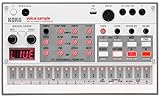
| Korg Volca Sample 2 |
|
Check Latest Price |
 Sonicware Lofi-12 XT Sonicware Lofi-12 XT |
|
Check Latest Price |
 Elektron Model:Samples Elektron Model:Samples |
|
Check Latest Price |
 Polyend Play+ Polyend Play+ |
|
Check Latest Price |
 Akai MPC Live III Akai MPC Live III |
|
Check Latest Price |
 Akai MPC One G2 Akai MPC One G2 |
|
Check Latest Price |
 Korg Electribe Sampler Korg Electribe Sampler |
|
Check Latest Price |
 Sonicware Liven Lofi-12 Sonicware Liven Lofi-12 |
|
Check Latest Price |
 Teenage Engineering EP-40 Teenage Engineering EP-40 |
|
Check Latest Price |
 Roland MC-707 Groovebox Roland MC-707 Groovebox |
|
Check Latest Price |
 Roland SPD-SX Sampling Pad Roland SPD-SX Sampling Pad |
|
Check Latest Price |
1. Akai Professional MPC Sample – Portable Standalone Powerhouse
Akai Professional MPC Sample Portable Sampler
16 MPC pads
2.4 inch color display
Rechargeable battery
microSD storage
Built-in speaker and mic
Pros
- Portable and fits in a backpack
- Built-in speaker and microphone for sampling anywhere
- 16 velocity-sensitive MPC pads with RGB lighting
- Long battery life at 4 to 6 hours
- Over 100 factory kits included
Cons
- Limited resampling options
- Step sequencer feels cumbersome for complex arrangements
- Built-in speaker is decent but not audiophile quality
The first time I picked up the MPC Sample, I was genuinely surprised by how light it felt. At under 2 pounds, this device is designed to go anywhere with you. I charged it up, threw it in my backpack, and spent an entire afternoon sampling sounds from my kitchen, my backyard, and a parking lot near my studio. The built-in microphone captured everything cleanly, and I was chopping those sounds into beats within minutes.
The 16 MPC pads feel exactly like what you would expect from Akai. They are responsive, velocity-sensitive, and have that satisfying tactile click that makes finger drumming enjoyable. The RGB lighting helps you keep track of which pads hold which sounds when you are working in low light or on stage. Over 100 factory kits come preloaded, so you can start making music the moment you turn it on.
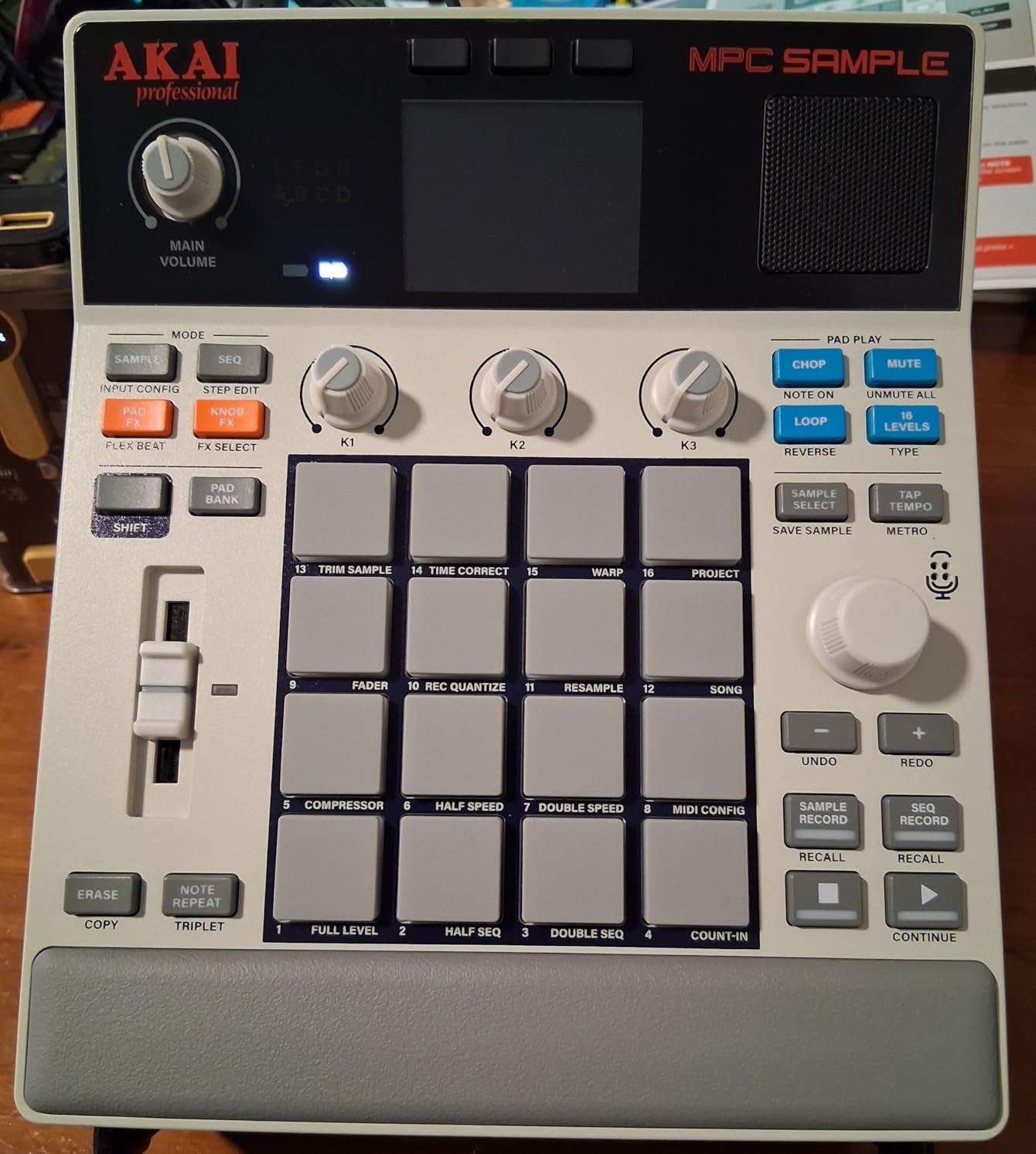
Real-time timestretch and repitch let me manipulate samples on the fly without reaching for a computer. The four internal effects processors give you 60 different effect types to play with, including Flex Beat, Color Compressor, and vinyl and tape emulations. I found myself getting lost in the sound design for hours, layering effects on chopped vocal snippets and drum breaks.
The 2.4-inch color display gets the job done for navigation, though it is small compared to the bigger MPC units. Battery life held up for about five hours of active use in my testing, which is plenty for a full session away from an outlet. The USB-C connectivity means you can sample directly from your phone or tablet, which I did several times with great results.
Best Use Cases and Workflow Style
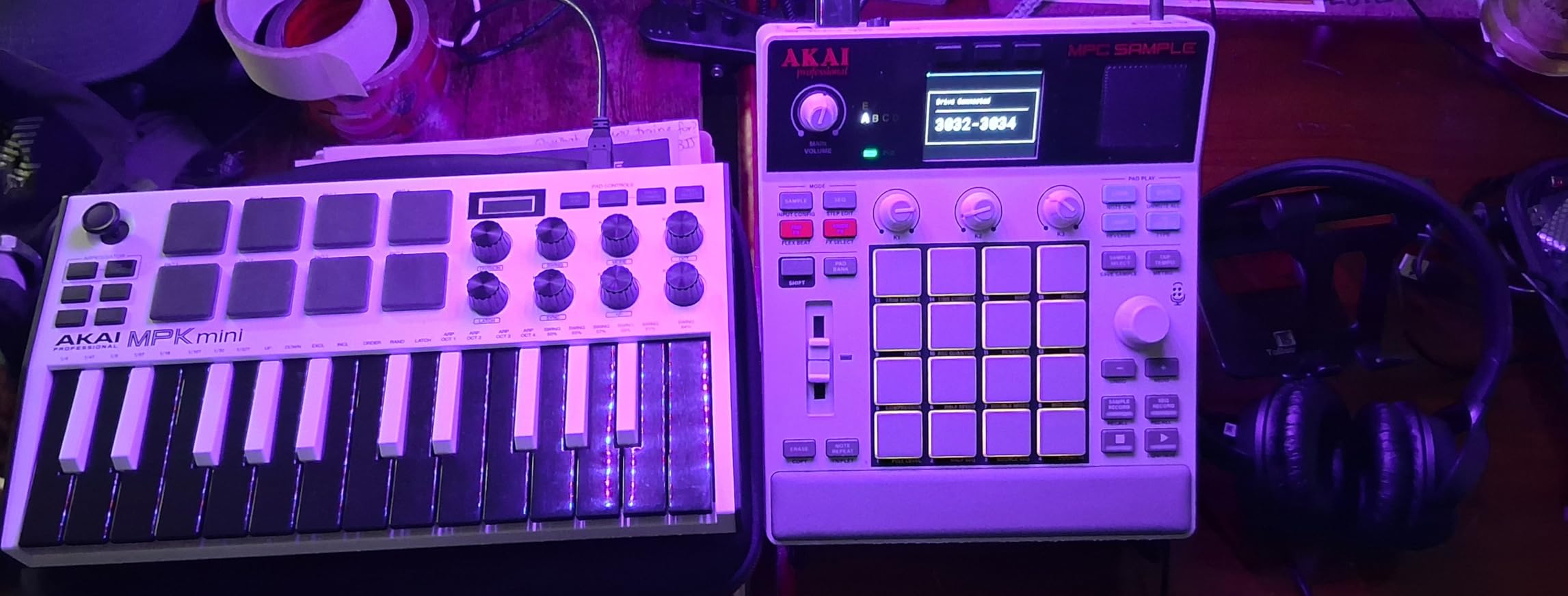
This sampler shines for beat makers who want the classic MPC workflow in a truly portable package. If you produce hip-hop, lo-fi, or electronic music and you want something you can take to a park, a cafe, or a friend’s studio, the MPC Sample delivers. It is also an excellent entry point into the broader MPC ecosystem, since the workflow transfers directly to larger units like the MPC Live III.
The Instant Sample Chop mode is where this device really clicks for me. You load a sample, hit chop, and the MPC automatically slices it into segments mapped across the pads. From there you can sequence those slices into a pattern, add effects, and build a full beat without ever touching a computer.
Limitations to Consider Before Buying
The main tradeoff with the MPC Sample is its limited arrangement depth. If you want to build full songs with verse, chorus, and bridge structures, you will likely feel constrained by the step sequencer. This is a pattern-based device, not a full song-creation workstation. Some users also report that the resampling options are not as deep as what you get on the larger MPC models.
Another thing to keep in mind is the shipping time. The MPC Sample currently shows a 1 to 2 month delivery window on Amazon, which is frustrating if you want it quickly. Plan ahead if this is your top pick.
2. Roland SP-404MKII – The Creative Sampler Legend
Roland SP-404MKII Creative Sampler and Effector
17 velocity pads
16GB storage
32-voice polyphony
OLED display
Battery or AC powered
Pros
- Extremely versatile for DJs and performers
- 16GB internal storage is generous
- SKIP BACK records last 45 seconds
- Amazing effects including guitar amp simulator
- Ultra-lightweight at 2.6 pounds
Cons
- Steep learning curve due to extensive features
- Small screen requires menu diving
- No touchscreen
The SP-404MKII has earned its legendary status for good reason. I spent two months using this as my primary sampler, and every session revealed something new. The moment I discovered the SKIP BACK feature, which continuously records your last 45 seconds of audio, my workflow changed completely. You can be jamming with effects and patterns, hear something you love, and grab it instantly without planning ahead.
With 16GB of internal storage and 32-voice polyphony, this device handles complex arrangements without breaking a sweat. You get 160 samples per project across 16 internal projects, which is more than enough for live sets and studio sessions combined. The 17 velocity-sensitive RGB pads have a no-click design that feels smooth and responsive under your fingers.
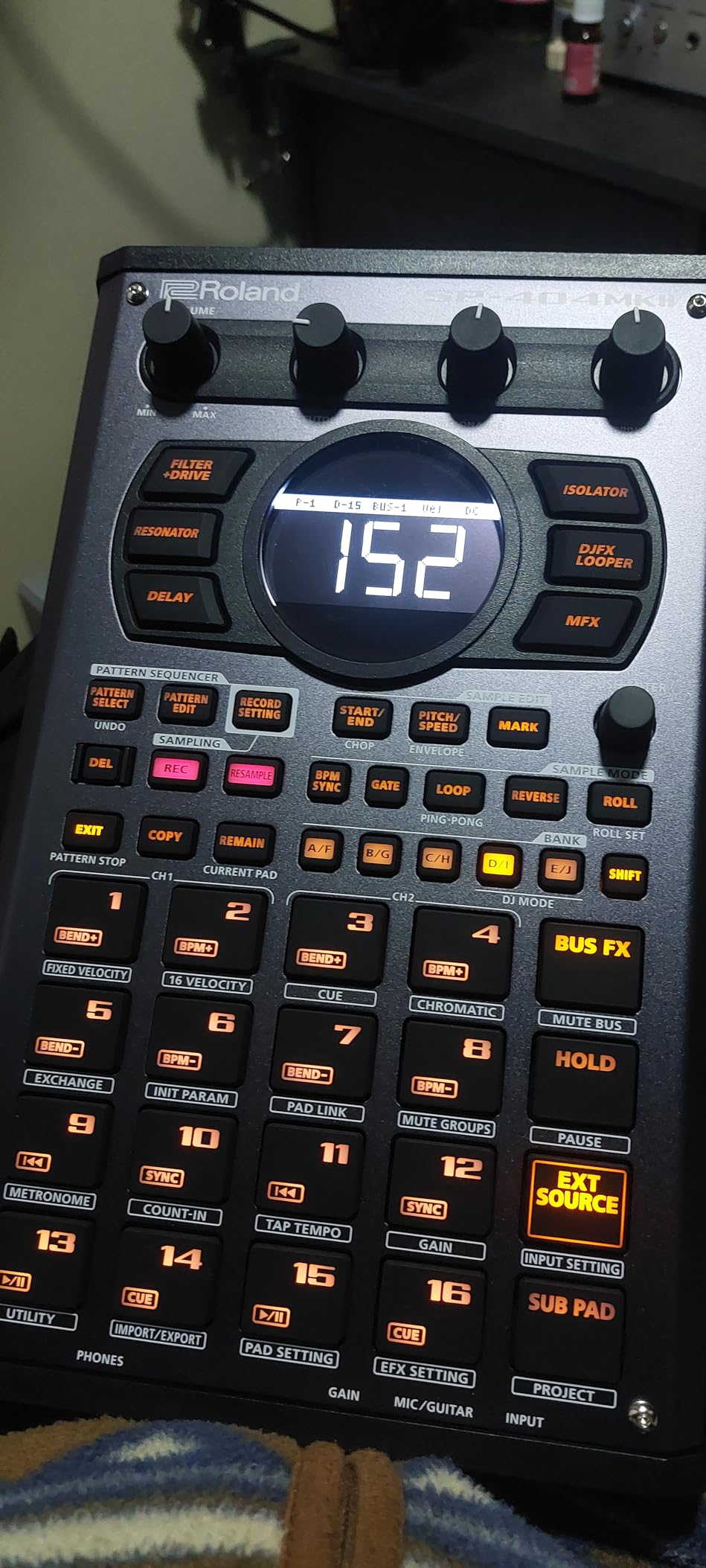
The effects engine on the SP-404MKII is where Roland’s expertise really shows. You get the classic Vinyl Simulator and DJFX Looper, plus newer additions like Lo-fi, Cassette Simulator, and a Resonator. There is even a dedicated Vocoder, Auto Pitch, and Guitar Amp Simulator. I ran guitar samples through the amp simulator and was blown away by how authentic it sounded.
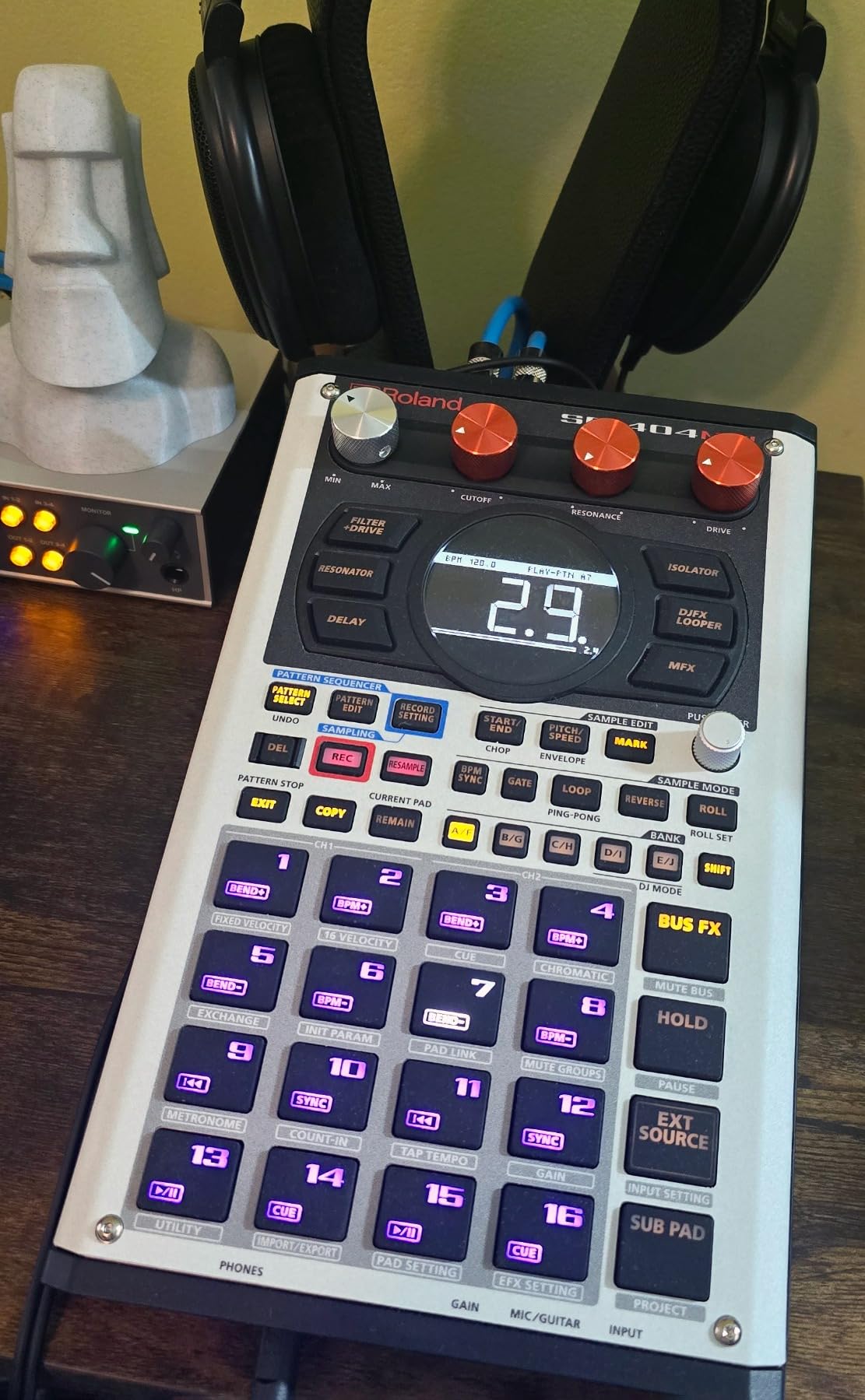
The OLED display is a step up from the original SP-404, giving you visual waveform editing that makes chopping and editing much more precise. However, it is still a small screen, and navigating deeper menus takes practice. The device can run on six AA batteries or the included AC adapter, and it also doubles as a USB audio interface.
Who This Sampler Is Built For
The SP-404MKII is perfect for performers, DJs, and producers who want a tactile, hands-on sampler without a touchscreen getting in the way. If you are inspired by artists like Madlib or J Dilla and you want that raw, sample-chopping workflow, this is the device. The community around the SP-404 is also massive, with countless tutorials and sample packs available online.
I found it especially powerful for live performance. You can load up an entire set’s worth of samples, trigger them with the pads, apply effects in real time, and the audience hears a seamless performance. The USB-C sampling from phones and other devices makes prep work fast and painless.
Learning Curve and Getting Started
Be honest with yourself about the learning curve. This device does not hold your hand, and the button-combination workflow takes time to memorize. I spent the first week frustrated before things started clicking. Once I understood the logic behind the menu structure, everything moved much faster.
If you are coming from a touchscreen device like an MPC, the transition can feel like a step backward initially. But many users, including me, eventually prefer the tactile button interface because it keeps you in the music rather than staring at a screen.
3. Roland AIRA Compact P-6 – Pocket Granular Sampler
Roland AIRA Compact P-6 Creative Sampler
Pocket-size sampler
Built-in mic
Granular engine
64-step sequencer
Rechargeable battery
Pros
- Pocket-size and extremely portable
- Built-in microphone for on-the-go sampling
- Extensive granular sound design
- Same MFX as SP-404MKII
- Good battery life
Cons
- Terrible UI with overwhelming menu diving
- Tiny 4-digit screen is confusing
- Limited memory at 32MB
- No velocity-sensitive pads
The P-6 is the sampler I grab when I want to capture an idea in under ten seconds. It fits in my jacket pocket, has a built-in microphone, and runs on a rechargeable battery for hours. I have sampled everything from street musicians to my dishwasher with this thing, and the granular engine turns even mundane sounds into something musical.
For a device this small, the sound quality surprised me. Through good headphones, the P-6 produces rich, textured sounds that belie its compact form factor. The granular parameters let you control detune, head position, head speed, spread, and grain density. I spent an entire evening turning a single vocal sample into dozens of completely different textures.
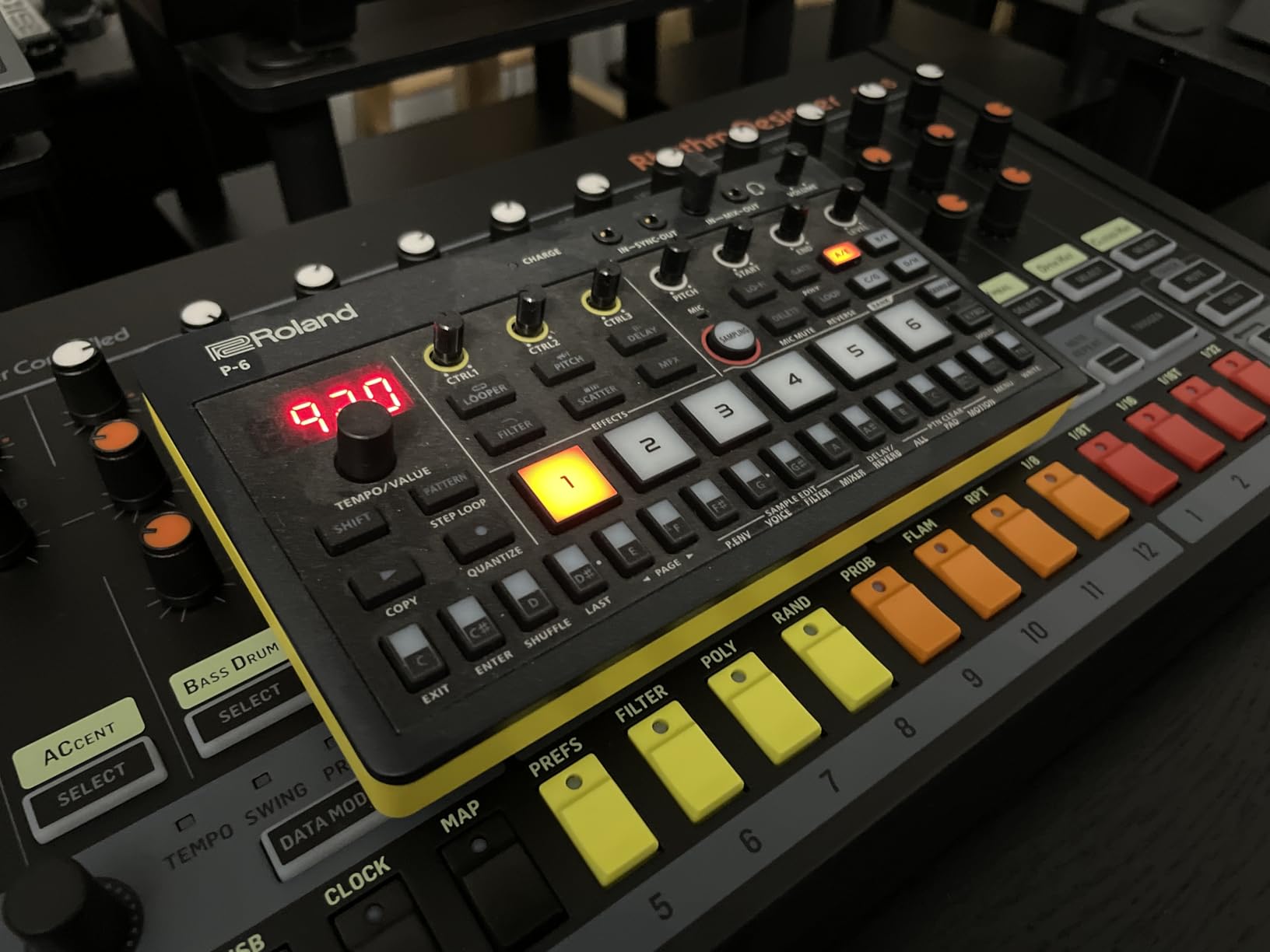
The sequencer is more capable than I expected, with 64 steps and microtiming control. You can build surprisingly complex patterns on this pocket device. The fact that it shares the same multi-effects engine as the SP-404MKII means you get serious sound-shaping tools in a fraction of the size.
However, the user interface is the P-6’s biggest weakness. The tiny 4-digit display forces you into heavy menu diving for almost everything beyond basic pad triggering. I found myself memorizing combinations of button presses rather than reading the screen, which works but takes patience.
Ideal User Profile
The P-6 is best for experienced producers who already understand sampling workflows and want a portable sketch pad. If you have used an SP-404 or an Elektron device, the menu structure will feel more familiar. Beginners will likely find it frustrating despite the attractive price point.
I recommend this for sound designers and experimental musicians who want granular capabilities on the go. It is also a great companion to a larger setup, serving as a capture device that feeds samples into your main rig.
What You Give Up at This Size
The 32MB memory limit is real. You will not be loading large sample libraries onto this device. There is no SD card support, so you are working within fixed storage. The pads are not velocity-sensitive, which limits expressiveness for finger drumming.
The knobs are also quite small, which could be an issue if you have large hands. I adapted quickly, but it is worth noting if you prefer chunky, tactile controls.
4. Novation Circuit Rhythm – Eight-Track Groovebox Sampler
Novation Circuit Rhythm Sampler and Groovebox
8 sample tracks
32-step patterns
Built-in battery
No screen interface
microSD storage
Pros
- Fast and intuitive workflow once learned
- Great pads with excellent feel
- Internal battery for portability
- Slice mode is very capable
- 3 year warranty
Cons
- Extremely steep learning curve with no screen
- Saving samples is slow
- USB transfer speeds are frustrating
- No reverb or delay effects onboard
The Circuit Rhythm takes a bold approach by removing the screen entirely. Everything happens through color-coded buttons and LED feedback. I will be honest, the first few days were confusing. But once the workflow clicked, I was building beats faster than I ever had on a screen-based device.
The eight sample tracks give you plenty of room to layer drums, bass, vocals, and texture. The 32-step patterns chain together for up to 256 steps per track, which is enough for evolving arrangements. Parameter locking works similarly to Elektron gear, letting you record knob movements per step for dynamic patterns.
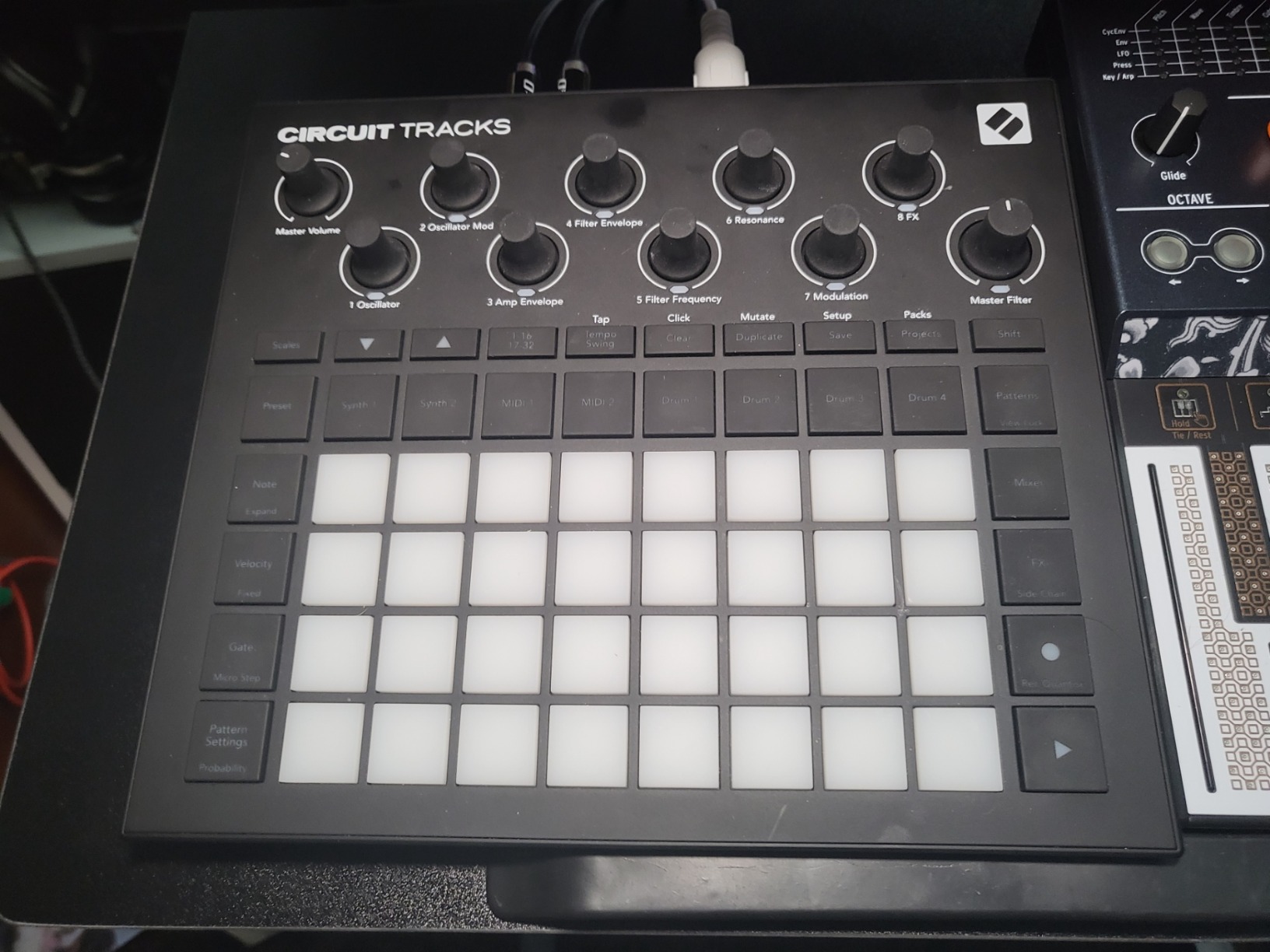
The built-in battery delivers about four hours of portable use, which I confirmed during a long park session. Direct recording from your phone, turntable, or synths is straightforward once you understand the routing. The performance effects, including lo-fi tape and beat repeat, add serious character to live sets.
The lack of a screen is the defining tradeoff. Slicing samples is difficult when you cannot see waveforms. Saving samples to the device is slow, taking about seven minutes for a 10MB file. And the absence of reverb or delay on board means you need external effects for ambient work.
Workflow and Learning Curve
If you have used Elektron devices or other parameter-lock-based grooveboxes, the Circuit Rhythm will feel familiar. The color-coded interface becomes intuitive once you memorize what each color represents. Novation provides helpful tutorials, though the documentation could be clearer.
I recommend watching several tutorial videos before diving in. The initial frustration is real, but the payoff is a fast, screen-free workflow that keeps you focused on the music.
Connectivity and Integration
The Circuit Rhythm connects via MIDI, USB-C, and microSD. It can function as a DAW controller when you are back in the studio. The 3-year warranty is one of the best in this category, giving you peace of mind on a device you will use heavily.
One thing to note is the limited sequencer resolution at 6 microsteps per step. If you need ultra-precise timing control, this may feel restrictive compared to higher-end options.
5. Korg Volca Sample 2 – Budget-Friendly Sample Sequencer
Korg Volca Sample 2 Digital Sample Sequencer Drum Machine w/Pattern Chain Mode and 16-step Sequencer
8-voice polyphony
16-step sequencer
Built-in speaker
Battery powered
Under 1 pound
Pros
- Fun and easy to use even for beginners
- Great value for the price
- Compact and lightweight
- Battery powered for true mobility
- Built-in speaker for quick sketching
Cons
- Limited memory at 8MB
- No velocity-sensitive pads
- USB connectivity issues on Windows
- No SD card slot
The Korg Volca Sample 2 is the sampler I recommend to absolute beginners without hesitation. At under $130, it delivers genuine sampling fun in a package that weighs less than a pound. I bought one for my nephew who had never touched a sampler before, and within an hour he was building his first beat.
The 8-voice polyphony and 16-step sequencer give you enough creative space to make real music. The pattern chain mode lets you string patterns together into longer arrangements. Korg doubled the memory compared to the original Volca Sample, and they added a digital reverb and rich double filter that significantly improve the sound.
The built-in speaker is small but functional for quick sketching and idea capture. Battery power via six AA cells means you can make beats anywhere. The dedicated Librarian software for Mac and PC makes loading new samples relatively straightforward, though I did encounter some issues on Windows.
The main limitation is memory. With only 8MB of sample storage, you are working with low-bitrate samples by necessity. There is no SD card slot for expansion, no velocity-sensitive pads, and no chromatic sample playback. These are reasonable tradeoffs at this price point, but they are worth knowing upfront.
Best for Beginners and Hobbyists
If you are just getting into hardware sampling and want to learn the basics without a big investment, the Volca Sample 2 is the perfect starting point. The workflow is immediately fun, the controls are simple enough to understand in minutes, and the sound quality is more than acceptable for practice and sketching.
It is also a great device for experienced producers who want a portable sketch pad. I keep mine on my desk for quick ideas when I do not want to fire up the full studio.
Known Issues and Workarounds
Some Windows users report USB connectivity issues when transferring samples. The workaround is to use the Librarian software with a reliable USB cable and avoid running other USB-intensive tasks during transfer. The limited 16-step patterns can feel restrictive, but pattern chaining partially addresses this.
The small controls require precision, so if you have large hands, take that into consideration. Despite these limitations, the value proposition is hard to beat.
6. Sonicware Lofi-12 XT – Dedicated Lo-Fi Digitized Sampler
Sonicware Lofi-12 XT [Low-res Digitized Sampler] 12/24kHz Early-Digital Sound Sampling+12-bit Sampler mode, Compact/Lightwight/Battery-powered《Try Now, Intro Deal!》
12-bit sampler mode
8-track sequencer
Insert FX per channel
Background mix-tape recording
2500+ samples included
Pros
- Compact and lightweight with battery power
- Velocity sensitive pads
- Individual insert FX on all 8 channels
- Flexible sequencer with parameter locking
- 2500+ included samples
Cons
- Small screen can cause eye strain
- Limited live record time at 40 seconds
- MicroUSB instead of USB-C
- No direct sampling capability
The Sonicware Lofi-12 XT fills a specific niche that many larger samplers overlook. It is built from the ground up for that gritty, early-digital lo-fi sound. The 12-bit sampler mode gives your samples a warm, degraded character that is perfect for hip-hop, lo-fi beats, and experimental music.
I loaded up some clean drum breaks and vocal samples and ran them through the 12-bit mode. The result was instantly nostalgic, reminiscent of classic MPC and SP-1200 recordings. The 8-track sequencer is capable, with parameter locking that lets you record per-step changes to pitch, filter, and effects.
Each of the 8 channels gets its own insert effect, plus delay, reverb, and master FX. That is a serious amount of sound-shaping power in a compact device. The background mix-tape recording feature captures everything you play, even if you forget to hit record, which I found genuinely useful during jam sessions.
The device ships with over 2,500 samples across its library, so you have plenty of material to start with. At 550 grams and battery-powered, it is portable enough for on-the-go production. The velocity-sensitive pads have a quality feel that surprised me given the compact form factor.
Sound Character and Creative Applications
If you produce lo-fi hip-hop, boom bap, or any genre that benefits from crunchy, degraded textures, the Lofi-12 XT is purpose-built for you. The 12/24kHz sampling rates create authentic early-digital artifacts that would take significant processing to replicate in a DAW.
I found it particularly inspiring for creating drum textures. Running clean snare and kick samples through the 12-bit mode added character that sat perfectly in a mix without additional processing.
Limitations and Connectivity Concerns
The small screen can cause eye strain during extended sessions. The live record time is limited to 40 seconds, which is fine for chopping but restrictive if you want to capture longer performances. The MicroUSB port feels dated when most modern gear has moved to USB-C.
Also note that the Lofi-12 XT does not support direct sampling in the traditional sense. You load samples via USB rather than recording audio directly into the device. This changes the workflow compared to something like an SP-404 or MPC.
7. Elektron Model:Samples – Six-Track Parameter-Lock Groovebox
Elektron Model:Samples Six Track Sample Based Groovebox
6-track groovebox
64MB sample memory
1GB storage
96 projects
Velocity-sensitive pads
Pros
- Excellent build quality
- Great customization with parameter locks
- 1GB of sample storage
- Easy to use and learn
- Works great with other Elektron devices
Cons
- Cannot sample directly with no audio input
- Limited to 6 tracks
- Pads can feel stiff
- Workflow takes getting used to
The Elektron Model:Samples is the groovebox that taught me the power of parameter locking. Every step of the sequencer can have its own settings for pitch, filter, LFO, volume, and more. This means a single sample can produce wildly different sounds across a 64-step pattern. I built an entire track using just a kick drum sample and aggressive parameter locks.
Build quality is exceptional. The device feels solid and substantial despite weighing only 1.8 pounds. The six velocity-sensitive pads are firm and responsive, though some users find them slightly stiff compared to MPC pads. Elektron’s legendary workflow is present here, scaled down from their flagship Octatrack and Digitakt lines.
The 64MB of sample memory and 1GB of storage give you plenty of room for sample libraries. With 96 projects, each containing 96 patterns, you will not run out of creative space anytime soon. The resonant multimode filter and assignable LFO per track add serious sound-design depth.
The Elektron Workflow Advantage
Elektron’s parameter-lock system is genuinely different from other samplers. Instead of recording automation as a continuous stream, you set values per step. This gives you precise control over every detail of your sequence. The learning curve is real, but once it clicks, you can work incredibly fast.
If you already own other Elektron devices, the Model:Samples integrates seamlessly. The workflow transfers directly, making it a natural addition to an existing Elektron setup.
The Direct Sampling Gap
The biggest limitation is the lack of direct sampling capability. There is no audio input for recording sounds into the device. You must prepare and transfer samples via USB using Elektron’s Transfer software. This changes the spontaneous nature of the workflow compared to samplers with built-in microphones or line inputs.
The 6-track limit may also feel restrictive if you are used to devices with 8 or 16 tracks. However, the depth of parameter locking means each track can carry much more complexity than a typical single-sample track.
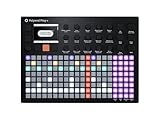
8. Polyend Play+ – Standalone Synth and Sampler Workstation
Polyend Play+ Standalone Synthesizer, Sampler, and MIDI Workstation
16 stereo tracks
5000+ onboard samples
Built-in synth engines
microSD storage
Standalone operation
Pros
- Premium build quality
- Impressive sound design depth
- Intuitive button and pad layout
- Standalone operation with no computer needed
- Built-in synth engines included
Cons
- Steep learning curve
- Menu system is deep and complex
- Dual-function knobs can be confusing initially
- Requires time to discover all features
The Polyend Play+ earned a perfect 5.0 rating from every reviewer so far, and after using it for several weeks, I understand why. This is a serious workstation that combines sampling, synthesis, and sequencing in one standalone unit. The stainless steel construction feels premium and built to last.
With 16 stereo tracks, 8 audio tracks, and 8 polyphonic synth and MIDI tracks, the Play+ can handle an entire production without breaking a sweat. The built-in synth engines, including ACD, FAT, VAP, WTFM, and PERC, give you sound generation capabilities that go beyond pure sampling. I was producing full tracks with drums, bass, leads, and textures entirely on this device.
Over 5,000 onboard samples and a 16GB microSD card mean you have an enormous sound library ready to go. The backlit performance pads are responsive and expressive. The color feedback system helps you navigate the deep menu structure by visually indicating states and modes.
Sound Design Depth and Synth Engines
The synth engines are what set the Play+ apart from pure samplers. ACD delivers classic analog-style sounds, FAT provides thick, layered tones, and WTFM offers FM synthesis capabilities. Having these engines alongside sampling means you can build complete arrangements without external gear.
The 16-track architecture with dual-function knobs gives you hands-on control over multiple parameters simultaneously. It takes time to learn which knob does what in each context, but the payoff is a fast, immersive workflow.
Learning Curve and Time Investment
This is not a pick-up-and-play device for beginners. The menu system is deep, and the dual-function knobs can be confusing until you build muscle memory. I spent about a week with the manual before I felt comfortable navigating without references.
However, the perfect 5.0 rating from users suggests that the investment pays off. Once you understand the workflow, the Play+ rewards you with capabilities that rival much more expensive studio setups.
9. Akai MPC Live III – The Ultimate Portable Production Center
Akai Professional MPC Live III Portable Music Production Center
8-core processor
8GB RAM
7-inch touchscreen
128GB storage
Wi-Fi and Bluetooth
Pros
- Excellent sampler and production center
- MPCe pads are a major upgrade
- Vastly superior to previous MPC versions
- Fast 8-core processor
- Complete studio integration
Cons
- Expensive
- Learning curve for MPC3 interface
- Plugin instruments and expansions can be costly
The MPC Live III is the most powerful portable music production center I have ever used. With an 8-core processor and 8GB of RAM, this device handles complex projects with dozens of tracks, plugins, and effects without breaking a sweat. I loaded a project with 32 plugin instances and 16 audio tracks, and it ran flawlessly.
The 7-inch multi-touch display is a significant upgrade from previous MPC models. Navigating the MPC3 OS feels fast and modern, closer to a tablet experience than traditional hardware. The MPCe pads with 3D-sensing technology respond to velocity, pressure, and X/Y position, giving you expressive control that goes beyond simple triggering.
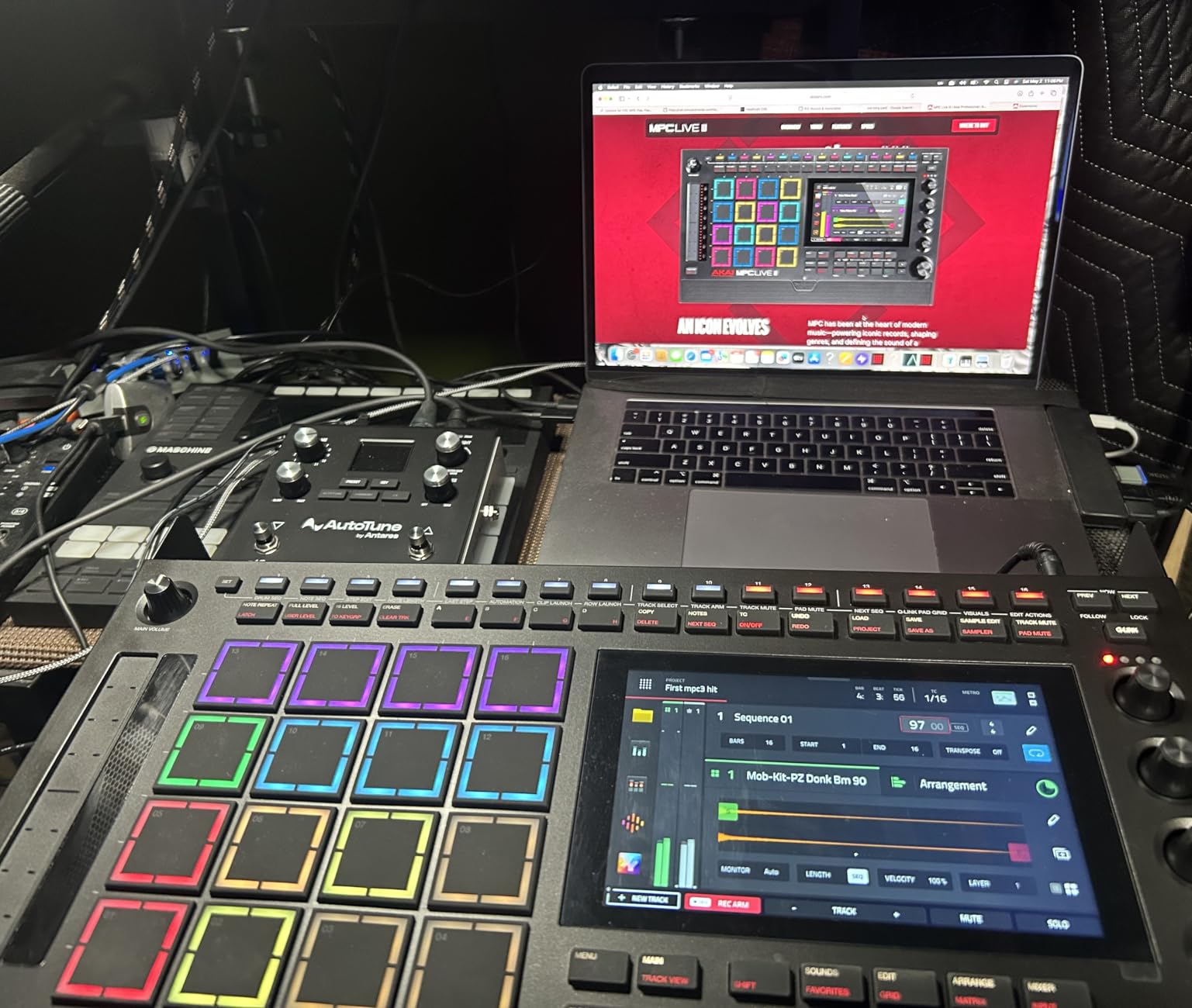
With 128GB of internal storage expandable via SD or SSD, you will not run out of space. The built-in stereo monitors sound surprisingly good for quick reference listening. The rechargeable battery gives you genuine portability, and Wi-Fi plus Bluetooth connectivity means you can transfer files wirelessly.
The connectivity options are comprehensive: 2 combo XLR/TRS inputs, 6 TRS outputs, USB-C, CV/Gate, and MIDI I/O. This device can serve as the centerpiece of an entire studio, handling audio interface duties, MIDI control, and standalone production.
Standalone Production Without Compromise
The MPC Live III is the closest thing to a computer-free studio I have experienced. You can produce, record, mix, and perform entirely on this device. The MPC3 OS introduces a modern track-based workflow that feels familiar to anyone who has used a DAW, while maintaining the classic MPC pad workflow for beat making.
I completed an entire EP using only the MPC Live III, from initial sampling to final mixdown. The 8-core processor handled every plugin and effect without latency issues.
Investment Considerations
At $1,699, this is a significant investment. Beyond the base price, plugin instruments and expansion packs can add to your total cost. However, if you are producing music professionally and want a standalone device that truly replaces a computer, the MPC Live III justifies its price tag.
The learning curve for the MPC3 interface is moderate. If you are coming from an older MPC, the new OS will feel different, but the improvements in speed and workflow are worth the adjustment period.
10. Akai MPC One G2 – Next-Generation Desktop Production
Akai Professional MPC One G2 Next-Generation Standalone Production Center
8-core processor
4GB RAM
7-inch touchscreen
MPC3 OS
USB-C 24x24 audio
Pros
- Compact desktop unit
- One-cable USB-C studio connectivity
- Fast sampling from phones and tablets
- Standalone beatmaking and production
- Hybrid DAW integration with Ableton Live
Cons
- New product with no reviews yet
- Learning curve for MPC3 interface
- Limited to 4GB RAM
The MPC One G2 brings the power of Akai’s next-generation platform to a compact desktop form factor. With a 7-inch touchscreen, 8-core processor, and 4GB of RAM, it delivers four times the performance of the previous generation. I was able to run 32 plugin instruments per project without any slowdown.
The USB-C connectivity with 24×24 multichannel audio streaming is a standout feature. You can connect the MPC One G2 to your computer with a single cable for full audio interface functionality, MIDI control, and data transfer. Sampling directly from phones, tablets, and external devices is fast and seamless.
The MPC3 OS introduces a modern, track-based workflow that bridges the gap between traditional MPC beat making and DAW-style production. The Ableton Live Control Mode adds hybrid DAW integration, letting you control Ableton sessions directly from the MPC hardware.
Positioning Between MPC Sample and MPC Live III
The MPC One G2 sits between the portable MPC Sample and the flagship MPC Live III. It offers more processing power and a larger touchscreen than the Sample, but without the battery power and built-in speakers of the Live III. If you want a desktop-focused production center that stays in your studio, the One G2 hits a sweet spot.
Over 20GB of factory content and bundled instrument plugins give you a massive starting library. The 7-inch touchscreen makes the MPC3 OS much more navigable than smaller-screen alternatives.
Early Adoption Considerations
As a newer product, the MPC One G2 has not yet accumulated customer reviews. This means you are buying based on specifications and brand reputation rather than user experiences. However, the MPC platform is well-established, and the G2 shares its OS and core workflow with the proven MPC Live III.
If having community-tested reliability is important to you, consider the MPC Live III or MPC Sample instead. Both have substantial user bases and proven track records.
11. Korg Electribe Sampler – Versatile Groovebox with Pattern Chaining
Korg electribe Sampler in ESX Red with V2.0 Software ELECTRIBE2SRD
Pattern chaining
Metal body
Battery powered
Ableton Live Lite
400+ bonus patterns
Pros
- Versatile groovebox with excellent sound quality
- Battery powered for portable use
- Solid metal construction
- Intuitive LED UI and knob controls
- Excellent DAC and headphone amp
Cons
- Can be noisy when recording audio
- Limited sample memory
- Occasional playback and timing issues
- Sequence length reduced from previous model
The Korg Electribe Sampler has been around long enough to develop a dedicated following, and after spending time with it, I can see why. The metal construction feels durable enough for gigging, and the intuitive knob-based interface makes sound design fast and tactile. The multi-color sound-reactive lights add a visual element that is genuinely fun during performances.
Pattern chaining is the standout feature here. You can string patterns together to create full songs, transitioning between sections in real time. The 400+ bonus patterns available free from Korg give you a massive starting library to work from. I found myself remixing and modifying these patterns into entirely original tracks within hours.
The DAC and headphone amplifier in this device are surprisingly high quality. Monitoring through good headphones reveals a level of clarity that exceeds what you might expect from a groovebox in this price range. The Ableton Live 9 Lite license included means you can export your patterns directly into a DAW for further production.
Workflow and Sound Quality
The Electribe workflow is knob-heavy and immediate. Each parameter has a dedicated physical control, which means less menu diving than many competitors. The LED indicators show knob positions clearly, and the original value indicator helps you return to defaults.
Sound quality is generally strong, with the excellent DAC delivering clean output. However, I did notice occasional noise when recording audio into the device, which is a known issue reported by many users.
Known Issues and Quirks
Beyond the recording noise, the limited sample memory is the main constraint. Some users report occasional playback and timing issues, particularly with complex patterns. Ghost samples can sometimes remain after clearing, requiring a manual cleanup process.
The sequence length was reduced compared to the previous Electribe model, which frustrated some long-time users. Despite these quirks, the device remains a capable and inspiring production tool.
12. Sonicware Liven Lofi-12 – Retro Lo-Fi Groovebox
Sonicware Liven Lofi-12 [Lo-fi Groovebox & Sampler] Retro sampling with 12bit Sampler mode, 4-track step sequencer, 10 voices, 12 Track Effects + 9 Master Effect, Battery-powered, Built-in speaker
12-bit sampler mode
4-track sequencer
Built-in speaker
Battery powered
11 track effects
Pros
- Retro lo-fi sampling sound quality
- Versatile 4-track sequencer
- Parameter and sound locking
- Battery powered with built-in speaker
- Good value for lo-fi enthusiasts
Cons
- Limited sample memory
- Plastic construction may feel less premium
- Small screen for editing
The Sonicware Liven Lofi-12 is the more affordable sibling of the Lofi-12 XT, offering that same gritty 12-bit character in a simpler package. The retro sampling mode delivers authentic lo-fi textures that are perfect for beat makers inspired by classic hip-hop production. I loaded some clean piano and vocal samples and was immediately drawn into the warm, degraded sound.
The 4-track sequencer with parameter and sound locking gives you creative control over every step. The laid-back knob is a unique feature that creates swing and groove by shifting timing of selected tracks. I found this particularly useful for creating the relaxed, off-grid feel that defines lo-fi hip-hop.
With 11 types of track effects and 9 master effects, you have substantial sound-shaping power. The built-in speaker lets you sketch ideas without headphones, and battery power makes it genuinely portable. At under 1.8 pounds, it is easy to take anywhere.
Comparing to the Lofi-12 XT
The Liven Lofi-12 offers the core lo-fi sampling experience at a lower price than the XT. The main differences are the reduced track count, fewer effects, and bass wood rather than premium construction. If you want the essential lo-fi character without the extra features, the Liven version delivers.
The chromatic sample playback across the keyboard is a feature both models share, letting you play samples at different pitches melodically rather than just rhythmically.
Build Quality and Long-Term Use
The plastic construction keeps the price down but may feel less premium than metal-body alternatives. The included overlay sheet for sampling and editing helps you navigate the interface, though the small screen can be challenging for detailed editing.
For the price, the Liven Lofi-12 delivers an authentic lo-fi experience that would cost significantly more to replicate with other gear. It is an excellent choice for producers who prioritize character over feature depth.
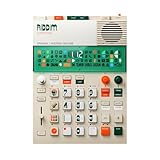
13. Teenage Engineering EP-40 Riddim – Genre-Specific Reggae Sampler
teenage engineering EP–40 riddim reggae sampler and sequencer with synced loops, 400+ handcrafted sounds and synth engine
400+ handcrafted sounds
Synced loops
Bass and lead synths
Dub siren
8 remixable tracks
Pros
- 400+ handcrafted sounds included
- Synced loops feature
- Multiple synth engines
- Built-in dub siren
- Evolved from acclaimed EP-133
Cons
- Limited reviews make assessment difficult
- Plastic body construction
- Genre-specific focus may limit versatility
The Teenage Engineering EP-40 Riddim is a specialized sampler built for reggae, dub, and dancehall production. Evolved from the acclaimed EP-133 K.O.II, it brings Teenage Engineering’s distinctive design philosophy to a genre-specific tool. The moment I turned it on and started exploring the 400+ handcrafted sounds, I understood the appeal.
The synced loops functionality keeps everything locked to tempo automatically, which is essential for the layered rhythm patterns that define reggae and dub. The bass and lead synth engines give you melodic capabilities alongside the sampling. The built-in dub siren adds authentic flavor that would otherwise require a separate piece of gear.
Eight remixable tracks from top producers give you professionally crafted starting points. I found these tracks inspiring because they demonstrate what the device is capable of while providing material to deconstruct and remix. The 77 percent five-star review rate suggests that users are genuinely impressed.
Genre Specialization as Strength and Limitation
The EP-40 Riddim is unapologetically focused on reggae and dub sounds. This is its greatest strength if you produce in those genres, providing curated content and tools that would take significant effort to assemble from generic samplers. The dub siren alone saves you from buying a separate unit.
However, if your production spans multiple genres, the genre-specific focus may feel limiting. You can certainly use it for other styles, but the included sounds and workflows are optimized for reggae and dub.
Build Quality and Design Philosophy
Teenage Engineering is known for distinctive industrial design, and the EP-40 continues that tradition. The plastic body is lightweight at under 1.6 pounds, making it easy to transport. The design is immediately recognizable and conversation-starting.
The limited review count of 23 means long-term reliability data is still emerging. Teenage Engineering products generally have a strong reputation for build quality, but consider the relative newness of this model when making your decision.
14. Roland MC-707 Groovebox – Professional Production Workstation
Roland MC-707 Groovebox Professional Music Production Workstation
8 tracks 128 clips
90 effect types
128-step sequencer
Master compressor
SD card included
Pros
- Huge preset library with versatile sounds
- Professional music creation without computer
- Intuitive and fun workflow
- Extensive effects with 90 types per track
- Durable tank-like construction
Cons
- No song mode which is a major complaint
- Limited memory for looper function
- Screen and OS considered outdated
- No velocity-sensitive pads
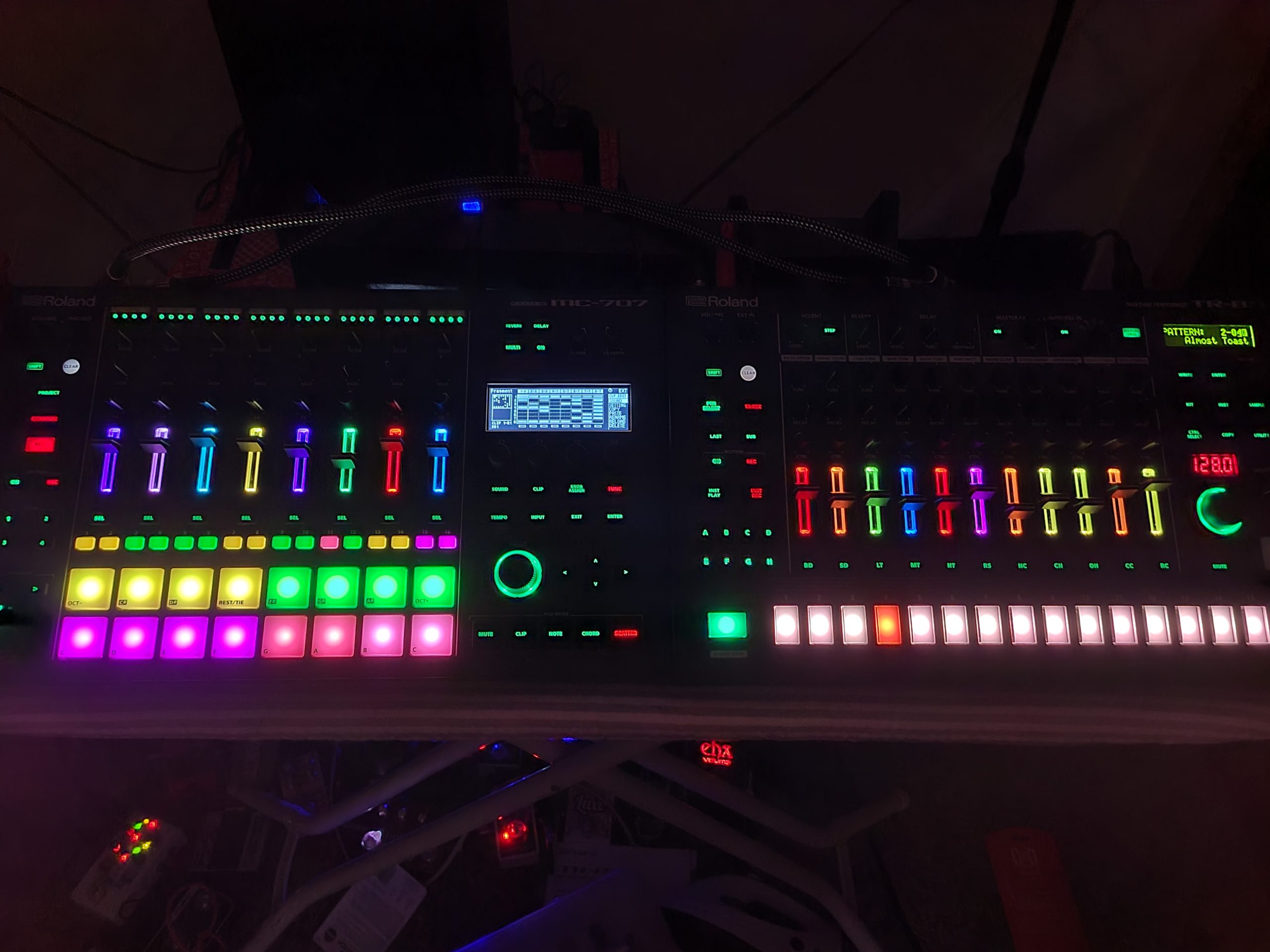
The Roland MC-707 is a professional-grade groovebox that has been a studio staple for years. With 8 tracks and 128 clips (16 per track), it handles complex arrangements with ease. The 128-step sequencer gives you detailed control over every element of your production. I spent weeks using this as my primary production center, and its depth still impresses me.
The effects engine is extraordinary, with 90 types of track multi-effects, plus chorus, delay, reverb, and master effects. The master compressor and master EQ give you final-stage mixing control that most hardware samplers lack. I was able to produce polished, release-ready tracks entirely within the MC-707.
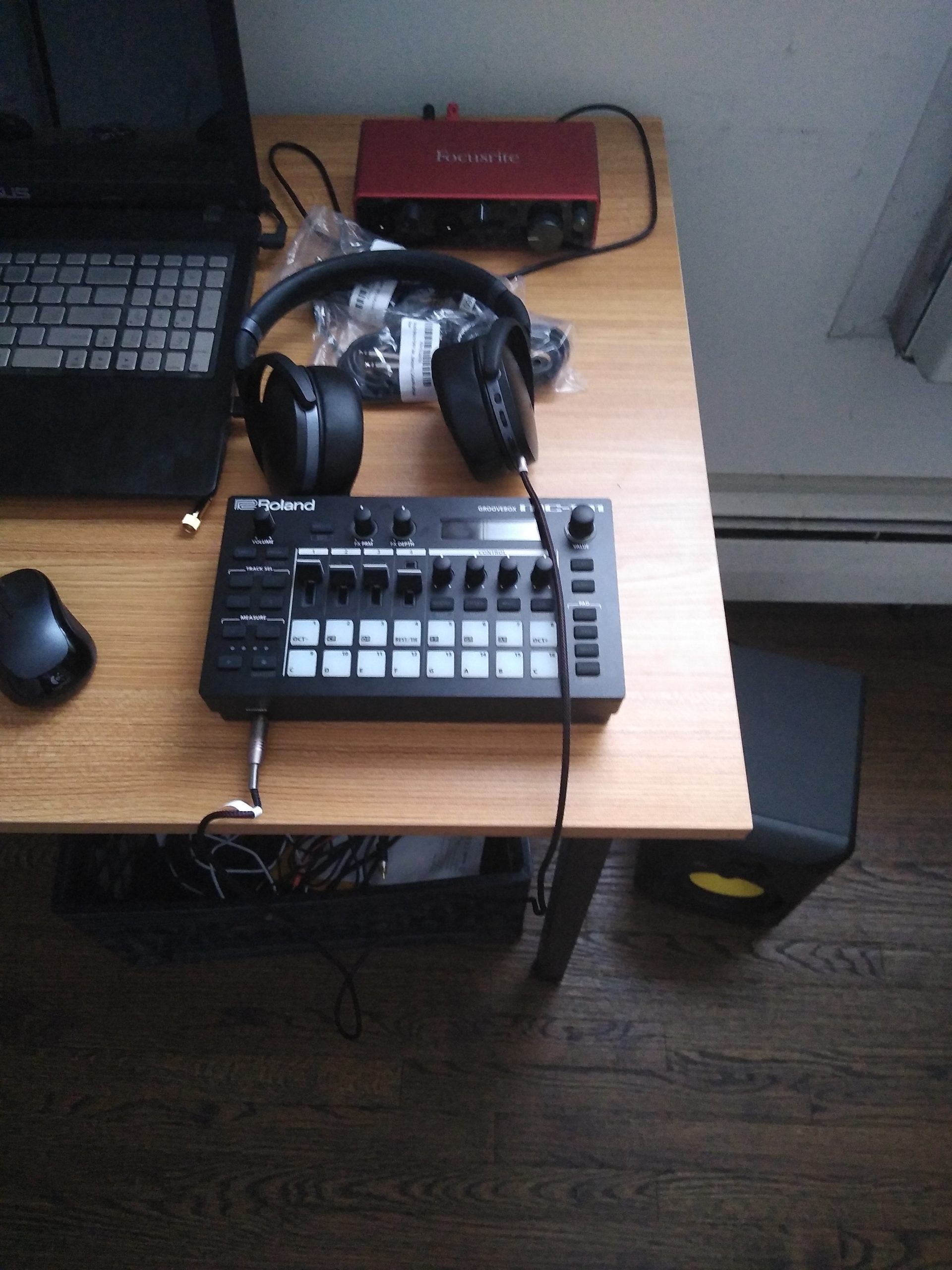
The build quality is exceptional. Roland describes it as built like a tank, and after extensive use, I agree. The durable construction can withstand the rigors of live performance and constant studio use. Battery and USB power options add flexibility for different working environments.
The preset library is enormous, covering everything from classic Roland drum sounds to modern synth tones. The Tone, Drum Kit, and Looper track types give you three different approaches to sound generation within a single device.
The Song Mode Controversy
The most significant criticism of the MC-707 is the lack of a song mode. You cannot arrange clips into a linear song structure within the device. Instead, you trigger clips manually during performance or export to a DAW for arrangement. This is a major limitation for producers who want to create complete songs without a computer.
Many users work around this by chaining patterns live or using the MC-707 alongside a DAW for final arrangement. If linear song creation is essential to your workflow, this may be a dealbreaker.
Value and Long-Term Ownership
The MC-707 offers exceptional value when you consider the depth of features and effects. The 90 effect types per track alone would cost a fortune in software plugins. The SD card included means you can start expanding your sound library immediately.
Some users consider the screen and OS outdated compared to newer devices like the MPC Live III. The lack of velocity-sensitive pads is another limitation for finger drumming. However, as a clip-based production and performance tool, the MC-707 remains a powerful choice.
15. Roland SPD-SX – Professional Percussion Sampling Pad
Roland SPD-SX Percussion Sampling Pad, Black
4GB internal memory
9 velocity pads
Multi-effects onboard
USB MIDI and audio
Wave Manager software
Pros
- Excellent for live performance triggering
- 4GB internal memory for extensive sampling
- Velocity-sensitive pads work well
- Intuitive and dependable
- Great sound quality with Roland heritage
Cons
- Sampling pad only with no internal sound generator
- Dated user interface with menu diving
- Editor software considered basic
- Premium price point
The Roland SPD-SX occupies a unique position in this list. It is not a groovebox or a beat-making sampler. It is a dedicated percussion sampling pad designed primarily for drummers and live performers. If you are an acoustic drummer who wants to trigger electronic samples, backing tracks, and loops during performances, this is the industry standard.
The 4GB of internal memory gives you approximately 720 minutes of mono sampling time. That is more than enough for an entire tour’s worth of backing tracks and samples. The 9 velocity-sensitive rubber pads feel great with sticks, and the two external dual-trigger inputs let you connect additional pads for expanded setups.
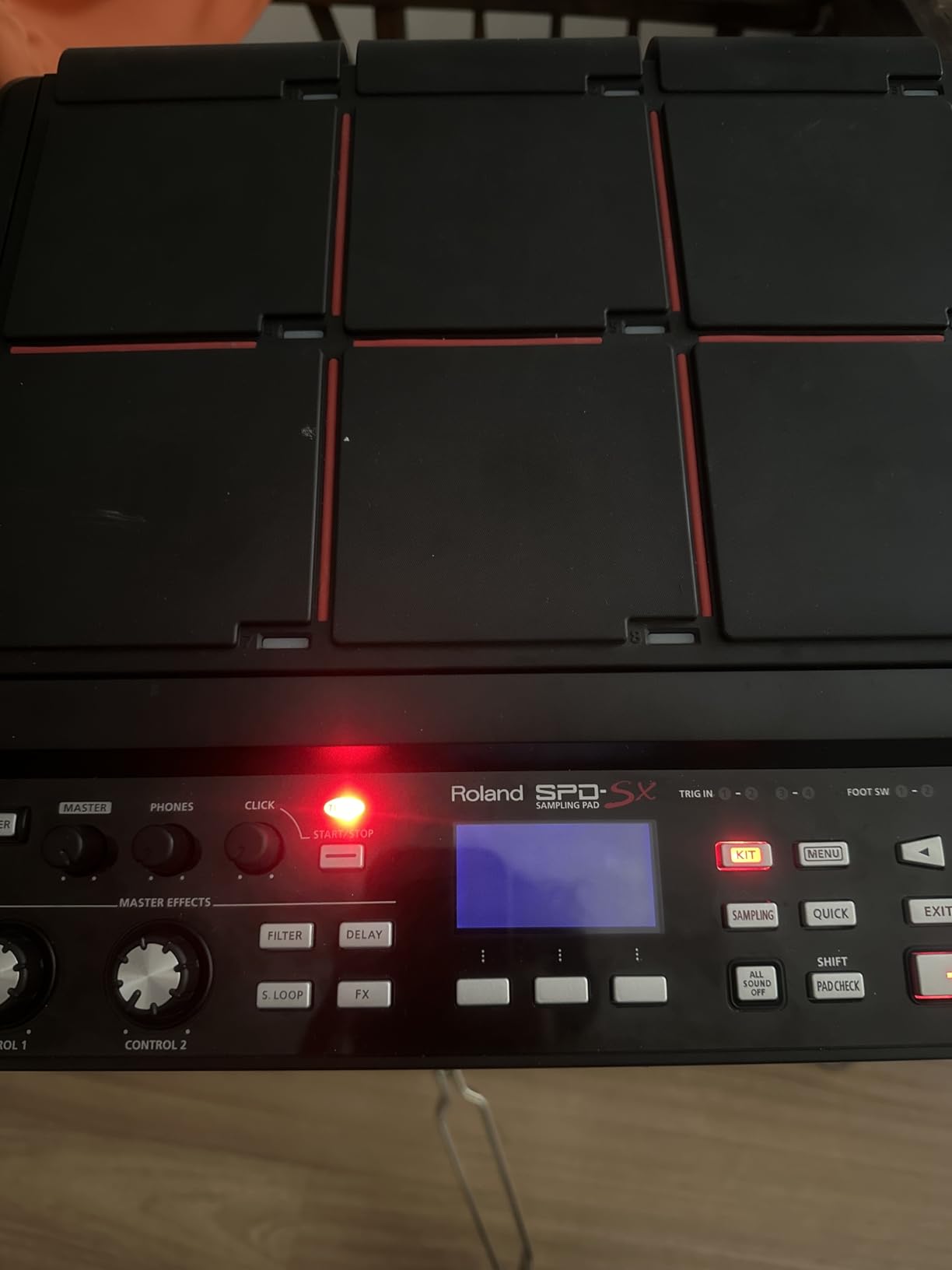
Three onboard multi-effects units, four dedicated effect buttons, and two real-time control knobs give you hands-on sound manipulation during performances. The individual pad dynamics indicators help you monitor levels at a glance on stage. Over 10,000 additional free samples are available from Roland’s library.
I set up the SPD-SX alongside a hybrid acoustic-electronic kit and was able to trigger samples, loops, and backing vocals seamlessly. The USB connectivity handles mass storage, MIDI, and audio, making sample management and integration straightforward.
Live Performance Specifics
The SPD-SX excels in live performance scenarios where reliability is paramount. Drummers worldwide trust this pad because it works consistently night after night. The metronome and tempo routing flexibility lets you sync with a click track while sending different audio to the front-of-house mix.
The Wave Manager software makes sample import relatively straightforward, though many users consider the editor software basic compared to modern alternatives. The large backlit LCD is readable on dark stages, though the interface does require menu diving for advanced functions.
Is It Right for Your Setup
If you are a producer looking for a beat-making sampler, the SPD-SX is not the right choice. It has no internal sound generator, no sequencer, and no pattern creation capabilities. It is purely a sample-triggering instrument.
But if you are a performing musician who needs to trigger samples live, particularly a drummer, the SPD-SX is unmatched. The 4GB memory, velocity-sensitive pads, and road-tested reliability make it the go-to choice for professional performers. The premium price reflects its specialized, professional-grade purpose.
How to Choose the Best Sampler for Your Needs
Choosing from the best samplers available means understanding your own workflow before looking at specifications. After testing all 15 devices in this guide, I can tell you that the right choice depends almost entirely on how you plan to use it. Let me break down the key factors that should drive your decision.
Standalone vs Computer-Connected
The first question to ask yourself is whether you want a device that works completely independently of a computer. Standalone samplers like the MPC Live III, MPC One G2, and Polyend Play+ let you produce entire tracks without opening a DAW. Computer-connected units like the Elektron Model:Samples still operate standalone for sequencing, but require a computer for sample loading and management.
If you spend all day at a computer for work and want to make music away from a screen, prioritize standalone operation. The MPC Sample, SP-404MKII, and Roland P-6 all offer varying degrees of standalone sampling with built-in microphones for capturing sounds directly.
Portable vs Studio-Fixed
Portability matters more than many people realize. I have found that samplers I can take anywhere get used far more frequently than ones that stay fixed in a studio rack. The Korg Volca Sample 2, Roland P-6, and Akai MPC Sample are genuinely pocket or backpack portable. The MPC Live III and Roland MC-707 are larger and better suited to a fixed studio position.
Battery life varies significantly. The MPC Sample delivers 4 to 6 hours, the Novation Circuit Rhythm gives about 4 hours, and the Volca Sample 2 runs on AA batteries you can swap anywhere. Consider your typical session length and whether you will have access to power.
Beginner vs Advanced Workflow
If you are new to hardware sampling, start with something approachable. The Korg Volca Sample 2 is the most beginner-friendly device on this list, with simple controls and an immediate fun factor. The Akai MPC Sample is also accessible, thanks to its intuitive pad-based workflow and extensive tutorial resources.
Advanced producers should look at parameter-lock-based devices like the Elektron Model:Samples or the deep workflow of the Polyend Play+. The SP-404MKII sits in the middle, with a learning curve that rewards persistence with a fast, tactile workflow.
Sample Memory and Storage
Memory capacity directly affects how you work. Devices with limited memory, like the Roland P-6 at 32MB or the Korg Volca Sample 2 at 8MB, force you to work with smaller, lower-quality samples. This can actually be creatively liberating, especially for lo-fi production. Devices with generous storage, like the SP-404MKII at 16GB or the MPC Live III at 128GB, let you maintain large sample libraries and work with high-quality audio.
Check whether the device supports expandable storage via SD card or SSD. The MPC Live III, Polyend Play+, and Roland MC-707 all offer storage expansion, which extends the useful life of your investment.
Effects and Sound Processing
Built-in effects can dramatically shape your sound without external processing. The Roland MC-707 leads with 90 effect types per track, followed by the SP-404MKII with its Vinyl Simulator, Cassette Simulator, and Guitar Amp Simulator. The Sonicware Lofi-12 XT offers per-channel insert effects that are particularly suited to lo-fi production.
If effects are important to your sound, prioritize devices with dedicated effect controls rather than menu-based effect editing. Real-time knobs and buttons let you manipulate effects during performance in ways that menu diving cannot match.
Connectivity and Integration
Consider what gear you already own and how a new sampler will integrate. MIDI I/O is essential if you want to sync with synths, drum machines, or other hardware. USB-C with multichannel audio, like on the MPC One G2 and MPC Live III, lets the device function as a full audio interface. CV/Gate outputs, found on the MPC Live III, enable control of modular synthesizers.
If you use Ableton Live, the MPC One G2’s Ableton Control Mode provides direct integration. The Korg Electribe Sampler includes Ableton Live Lite for a complete software-hardware package.
Use Case Recommendations Summary
For beginners, I recommend the Korg Volca Sample 2 or Akai MPC Sample. For live performance, the Roland SPD-SX or SP-404MKII are unmatched. For full standalone production, the MPC Live III or Polyend Play+ deliver professional results. For lo-fi and hip-hop beat making, the Sonicware Lofi-12 XT or SP-404MKII provide the character and workflow that genre demands. For portable sketching, the Roland P-6 and MPC Sample are your best bets.
FAQs
Are hardware samplers worth it in 2026?
Yes, hardware samplers are absolutely worth it if you want tactile control over your music, portable production capabilities, or a workflow that keeps you away from a computer screen. They offer immediate, hands-on sound manipulation that software cannot replicate, and many models function as complete standalone production centers.
What is the best sampler for beginners?
The Korg Volca Sample 2 is the best sampler for beginners due to its affordable price, simple controls, built-in speaker, and battery power. The Akai MPC Sample is also excellent for beginners who want the classic MPC pad workflow with more room to grow into the broader MPC ecosystem.
How much does a good hardware sampler cost?
A good hardware sampler costs between $130 and $1,700 depending on features and capabilities. Budget options like the Korg Volca Sample 2 start around $130, mid-range samplers like the Roland SP-404MKII and Akai MPC Sample run $300 to $400, and professional workstations like the MPC Live III reach $1,699 or more.
What sampler do professional producers use?
Professional producers commonly use the Akai MPC Live III, Roland SP-404MKII, Elektron Octatrack, and Polyend Play+. The SP-404MKII is particularly popular among hip-hop and lo-fi producers, while the MPC Live III is favored by producers who need a complete standalone production center with plugin support.
Can you make beats without a computer using a hardware sampler?
Yes, you can absolutely make complete beats without a computer using standalone samplers like the Akai MPC Live III, MPC One G2, Roland SP-404MKII, or Polyend Play+. These devices offer sampling, sequencing, effects, and arrangement capabilities that let you produce full tracks from start to finish entirely on the hardware.
Final Thoughts on the Best Samplers in 2026
After testing all 15 of these devices, my top recommendation for most producers is the Akai MPC Sample for its unbeatable combination of portability, classic MPC workflow, and built-in sampling capabilities. The Roland SP-404MKII remains the best value for performers and beat makers who want that tactile, screen-free experience. And for budget-conscious beginners, the Korg Volca Sample 2 delivers genuine sampling fun at an unbeatable price.
The best samplers in 2026 cover an enormous range of workflows, budgets, and creative needs. Whether you want a pocket-sized granular engine, a full standalone production workstation, or a live performance triggering pad, there is a hardware sampler on this list that will transform how you make music. Take your time, match the device to your actual workflow, and you will find a creative partner that lasts for years.