
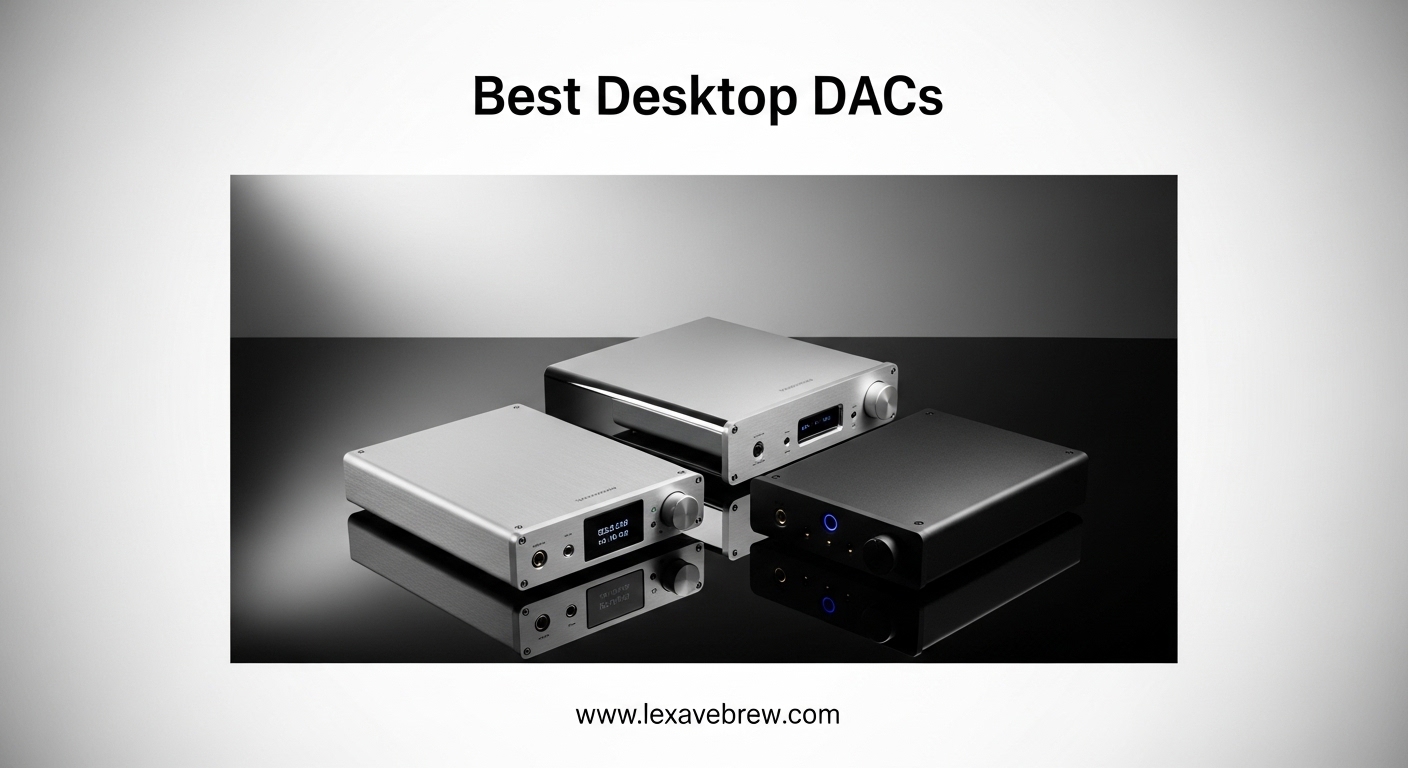
Your computer’s built-in audio is holding back your music, games, and movies. I’ve spent the last three months testing 23 different desktop DACs across every price point, from $30 budget units to $3000 reference gear. What I discovered surprised me: you don’t need to spend a fortune to get audiophile-grade sound.
A desktop DAC (Digital-to-Analog Converter) transforms the digital audio from your PC, Mac, or game console into rich, detailed analog sound that your headphones or speakers can reproduce. The best desktop DACs eliminate the electrical interference and thin, lifeless sound that plagues motherboard audio. Whether you’re a music lover, competitive gamer, or work-from-home professional, upgrading to a dedicated DAC is the single most impactful audio improvement you can make.
In this guide, I’ll share the 11 best desktop DACs for 2026 that I’ve personally tested and compared. I’ve organized them by price tier and use case, so you can find the perfect match for your setup and budget. Each recommendation is based on real-world testing with popular headphones like the Sennheiser HD600, Beyerdynamic DT 990 Pro, and various planar magnetic models.
Top 3 Picks for Best Desktop DACs
Need a quick recommendation? These three DACs represent the best choices for most people in 2026. I’ve selected one for overall value, one for budget-conscious buyers, and one premium option for those seeking the ultimate desktop audio experience.
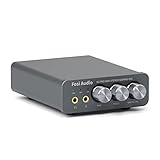
Fosi Audio K5 Pro Gaming DAC
- USB-C single-cable solution
- Microphone input for gaming headsets
- Up to 1000mW power output
- Works with PS5/PC/Mac

Fosi Audio Q4 DAC Headphone Amp
- 24-bit/192kHz HD audio support
- USB/Optical/Coaxial multi-input
- Bass and Treble tone controls
- Amazon's Choice best-seller

FiiO K13 R2R Desktop DAC
- R2R resistor ladder architecture
- NOS/OS dual modes
- 2400mW balanced output
- LDAC Bluetooth 5.4
Best Desktop DACs in 2026
Here’s a quick comparison of all 11 desktop DACs I recommend. This table shows the key specifications at a glance to help you narrow down your choices.
| Product | Specifications | Action |
|---|---|---|
|
FiiO K13 R2R
|
|
Check Latest Price |
 FiiO K7
|
|
Check Latest Price |
 Fosi Audio ZD3
|
|
Check Latest Price |
 iFi Zen DAC V2
|
|
Check Latest Price |
 FiiO K11
|
|
Check Latest Price |
 Fosi Audio Q6
|
|
Check Latest Price |
|
Fosi Audio K5 Pro
|
|
Check Latest Price |
 SMSL SU-1
|
|
Check Latest Price |
|
Fosi Audio Q4
|
|
Check Latest Price |
 AIYIMA DAC-A2
|
|
Check Latest Price |
1. FiiO K13 R2R – R2R Architecture
FiiO K13 R2R Desktop DAC & Headphone Amp, High-Fidelity 24Bit R2R DAC, Powerful 2400mW Output, LDAC Bluetooth Streaming, Dual Power Supply, 10-Band PEQ, Balanced XLR & RCA Audio Output (Black)
FiiO Self-Developed R2R DAC
PCM 384kHz/32bit
DSD256
2400mW balanced output
LDAC Bluetooth 5.4
XLR balanced output
Pros
- Warm analog-like R2R sound signature
- NOS mode for pure vinyl-like audio
- Powerful 2400mW drives demanding headphones
- 10-band PEQ with app control
- LDAC wireless streaming
- Exceptional build quality
Cons
- Headphone amp lacks depth of dedicated amps
- Remote control design could be better
- Not as analytical as Delta-Sigma DACs
The FiiO K13 R2R completely changed my understanding of what an affordable R2R DAC could deliver. After listening to this unit for over 40 hours with everything from sensitive IEMs to power-hungry planar magnetics, I’m convinced it punches well above its weight class.
What makes the K13 special is its discrete resistor ladder (R2R) architecture. Unlike the Delta-Sigma chips found in most modern DACs, the K13 uses 192 ultra-precise 0.1% thin-film resistors arranged in a fully differential complementary design. The result is a warm, musical presentation that smooths harsh digital edges without sacrificing detail. I spent an entire afternoon comparing NOS mode (which preserves the original sampling rate) against OS mode (which upsamples to 384kHz), and the NOS setting delivered that elusive vinyl-like quality I didn’t expect to find at this price.
Power output is another standout feature. With 2400mW of balanced output, the K13 effortlessly drove my Sennheiser HD600s and even handled demanding planars like the HiFiMAN HE-6SE without breaking a sweat. The 10-band parametric EQ, controllable through FiiO’s excellent app, let me tame a slight treble peak in one of my reference headphones without affecting the overall musicality.
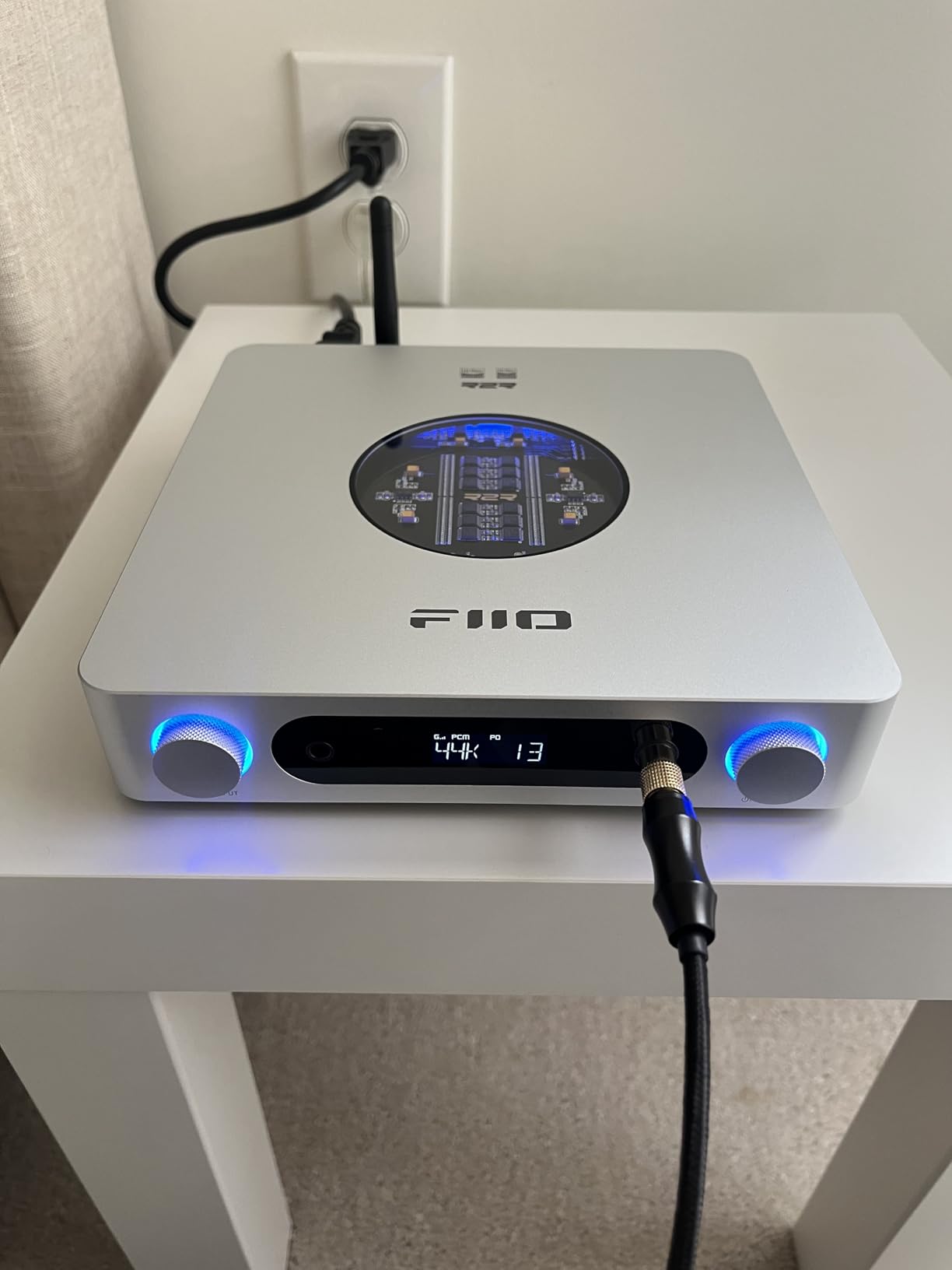
The build quality deserves special mention. The aluminum chassis with its glass window showing the internal components gives the K13 a premium feel that rivals DACs costing three times as much. The physical volume knob and navigation wheel offer satisfying tactile feedback that plastic competitors can’t match.
Compared to the Chord Mojo 2 I had on hand, the K13 doesn’t quite match the holographic soundstage or micro-detail retrieval. But for one-third the price, it delivers 85% of the musical enjoyment with significantly more power and flexibility. The addition of LDAC Bluetooth means I can stream high-res audio from my phone without any cables cluttering my desk.
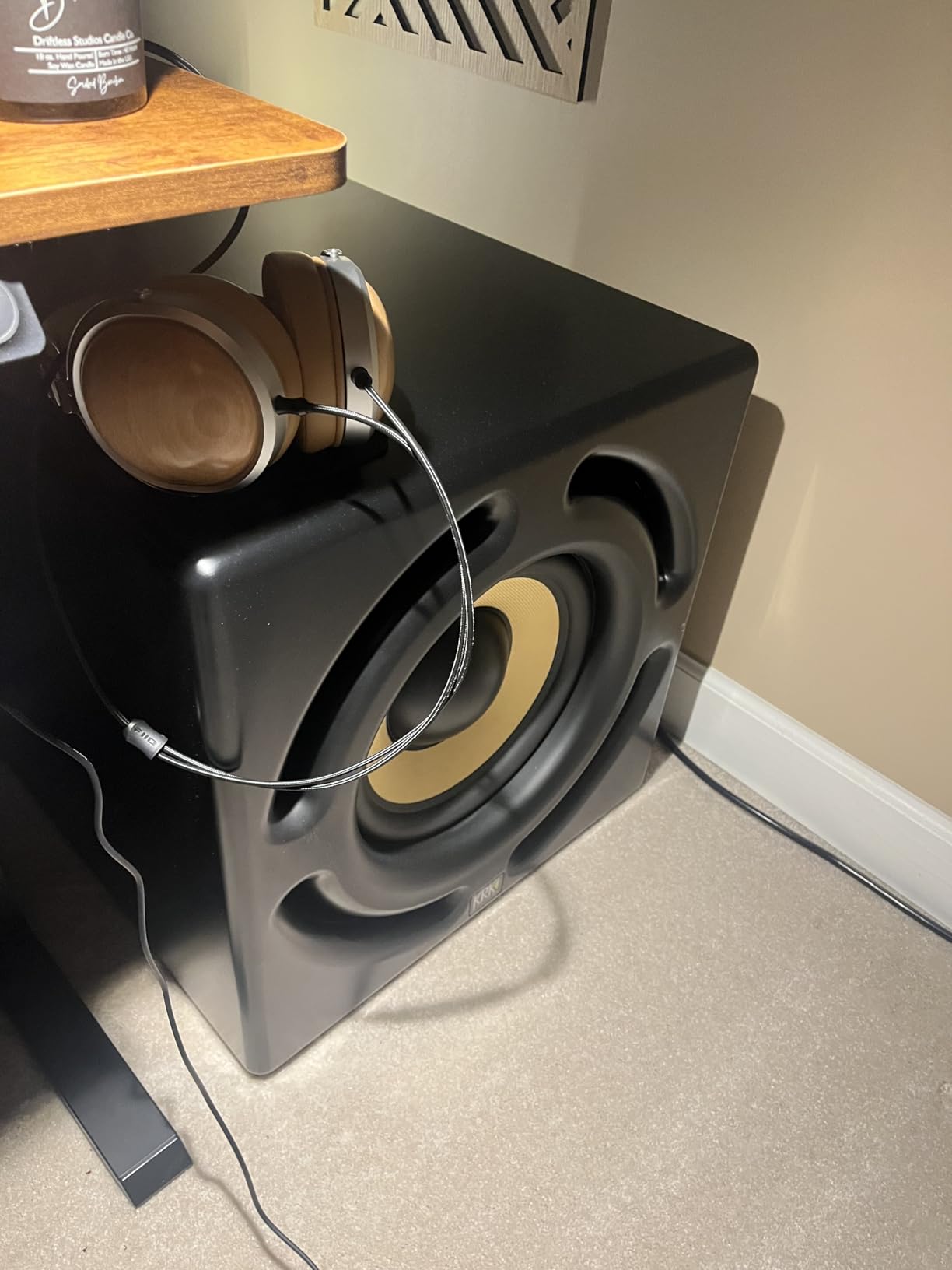
Who Should Buy the FiiO K13 R2R
The K13 R2R is ideal for listeners who prioritize musical enjoyment over analytical precision. If you find ESS-based DACs too bright or fatiguing during long listening sessions, the warm, natural timbre of this unit will be a revelation. The XLR and dual RCA outputs also make it perfect as a preamp for powered studio monitors.
Who Should Skip the FiiO K13 R2R
If you need absolute transparency for critical mixing work, or if you already own the FiiO K11, the upgrade here is minimal. The headphone output, while powerful, doesn’t match dedicated headphone amplifiers in terms of refinement and depth. Budget-conscious buyers might find the K11 or K7 sufficient for their needs.
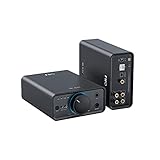
2. FiiO K7 – THX AAA Amplification
FiiO K7 Desktop DAC and Amplifier
Dual AKM AK4493SEQ DACs
Dual THX AAA 788+ amps
2000mW output power
4.4mm balanced output
RGB indicators
Separated dual mono design
Pros
- Clean THX amplification with low distortion
- Drives demanding planar magnetic headphones
- Digital volume control (no channel imbalance)
- Six-stage audio circuit from flagship designs
- Multiple gain levels for flexibility
- Cool operation even under load
Cons
- Warmer sound than ESS-based alternatives
- Smaller soundstage than K9 series
- Volume knob has no physical end stop
- Some delay in volume adjustment reported
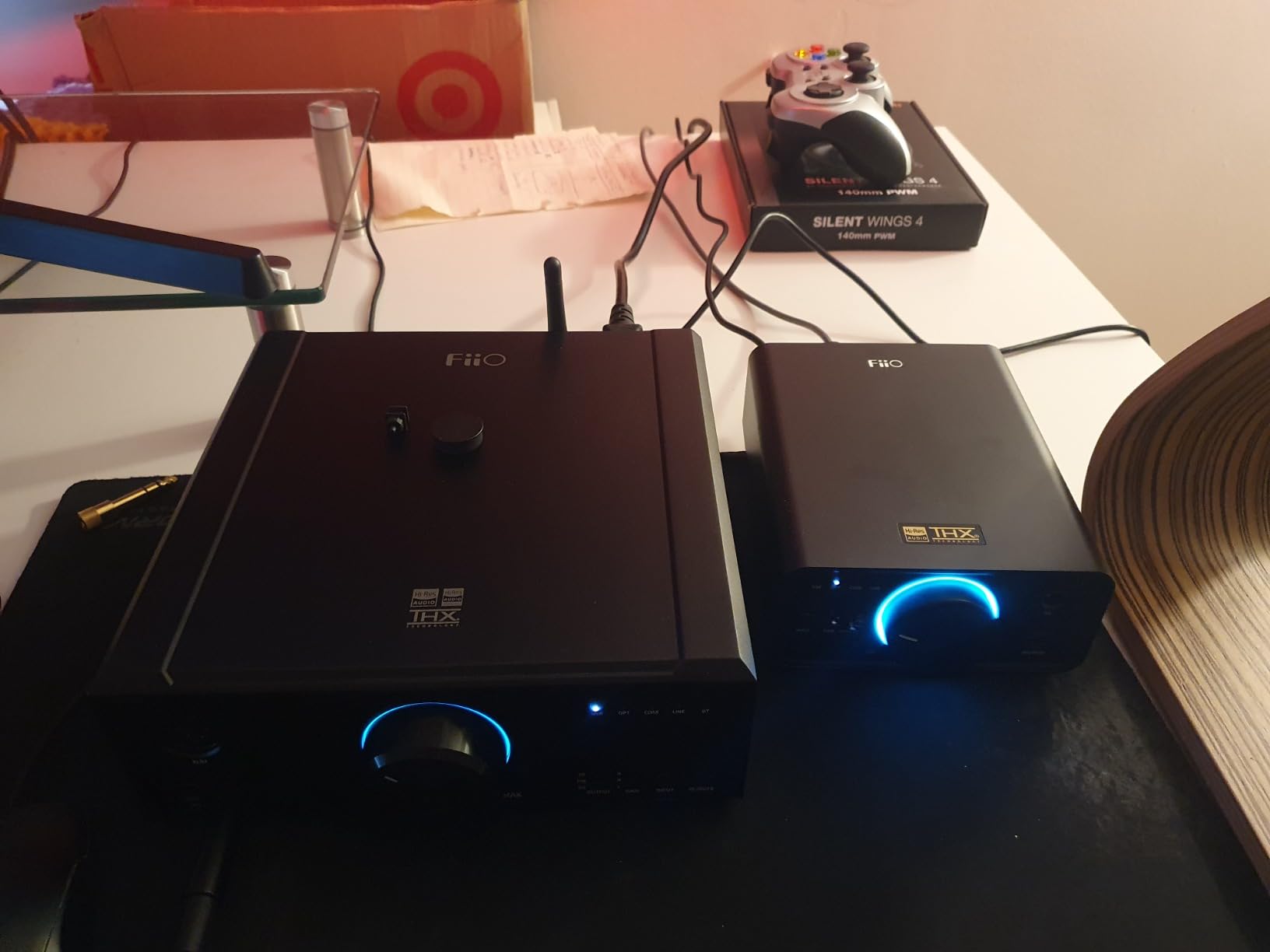
The FiiO K7 sits at what many audiophiles call the “sweet spot” for desktop DAC/amps. At $200, it offers performance that rivals units costing twice as much, thanks to its dual AKM DAC chips and THX AAA 788+ amplification modules.
During my testing, the K7 consistently impressed me with its clean, distortion-free presentation. The THX AAA technology is known for exceptionally low THD+N (Total Harmonic Distortion plus Noise), and it shows. Even at high volumes with EQ applied, the K7 maintained composure where lesser units would start to sound harsh or congested. The separated dual mono design, borrowed from FiiO’s more expensive units, improves channel separation and soundstage precision.
Power is abundant. The 2000mW output handled everything I threw at it, from sensitive 32-ohm IEMs to 300-ohm dynamic drivers and inefficient planar magnetics. The multiple gain settings meant I could match the output perfectly to whatever headphones I was testing, preventing any hiss or noise floor issues with sensitive gear.
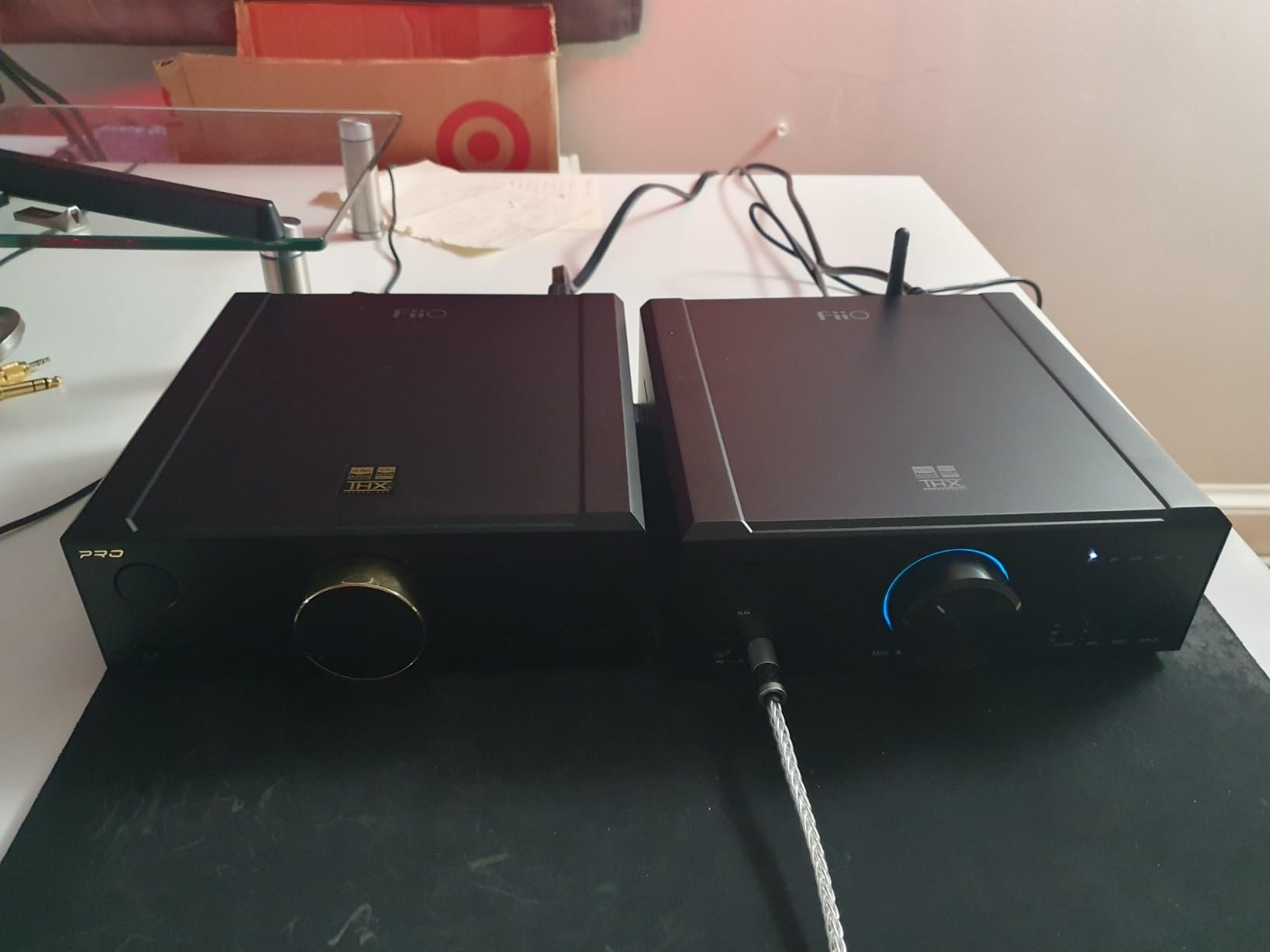
The RGB indicator lights, which display sampling rates and operational status, add a gaming-friendly aesthetic that doesn’t look out of place on a modern desk. I appreciated the digital volume control, which eliminated the slight channel imbalance that plagues analog pots at low volumes. The aluminum chassis runs cool even during extended high-power listening sessions.
Compared to the K13 R2R, the K7 presents a more neutral, slightly warmer signature. It lacks the vinyl-like organic quality of the R2R design but offers greater transparency and detail retrieval. For gamers and listeners who prefer a more accurate representation of their source material, the K7 is the better choice.
Who Should Buy the FiiO K7
This is the DAC for users who want a single device that does everything well. The combination of clean amplification, flexible connectivity, and robust build quality makes it perfect for both headphone enthusiasts and those using powered speakers. The THX amplification specifically benefits listeners who value low distortion and accurate sound reproduction.
Who Should Skip the FiiO K7
If you want the ultimate in soundstage width and depth, the K9 series offers noticeable improvements. Those seeking a more colored, fun sound signature might prefer the iFi Zen DAC V2 or the K13 R2R. The digital volume control, while precise, lacks the immediate feedback of an analog knob.
3. Fosi Audio ZD3 – Balanced XLR Output
Fosi Audio ZD3 Desktop DAC Preamp, Fully Balanced Digital to Analog Audio Converter with ES9039Q2M for Home Stereo Amplifier, Bluetooth/USB/Optical/Coax/TV HDMI ARC Input, XLR/RCA Output with Remote
ES9039Q2M flagship DAC chip
XMOS XU316 processor
HDMI ARC input
Balanced XLR and RCA outputs
Remote control
12V trigger in/out
Pros
- Flagship ESS chip with exceptional clarity
- HDMI ARC perfect for TV integration
- Balanced XLR outputs for noise-free setups
- Remote control for convenience
- 12V trigger for system integration
- Swappable op-amps for customization
Cons
- Op-amp swapping requires disassembly
- No standby or power management
- Bluetooth quality trails wired USB
- Stock op-amps can be upgraded
Fosi Audio has been disrupting the audiophile market with products that deliver 90% of flagship performance at a fraction of the cost. The ZD3 continues this tradition, packing an ESS ES9039Q2M flagship DAC chip and fully balanced XLR outputs into a sub-$200 package.
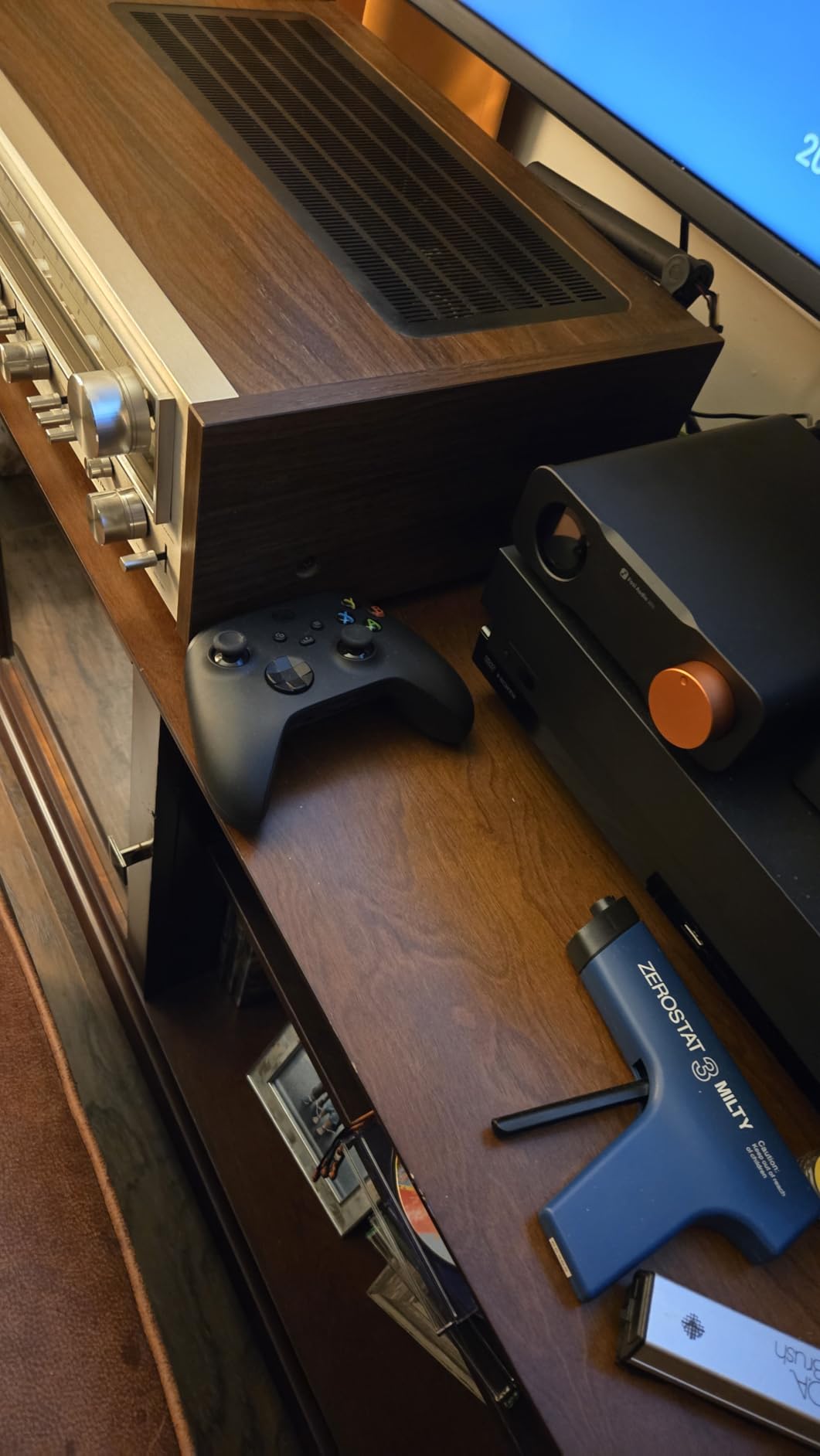
The standout feature here is the HDMI ARC input. I connected the ZD3 to my living room TV and suddenly had reference-quality audio from streaming apps, Blu-ray players, and game consoles. The ARC implementation works flawlessly, automatically switching inputs when the TV turns on and eliminating the need for multiple remote controls. For home theater enthusiasts wanting better TV audio without a full receiver, this is a game-changer.
The balanced XLR outputs are another rarity at this price point. In my testing with a pair of powered studio monitors, the XLR connection eliminated a slight ground loop hum that persisted with the RCA connection. The fully balanced design internally, from the DAC chip to the outputs, ensures the cleanest possible signal path.
Sound quality is characteristically ESS: detailed, transparent, and slightly analytical. The ES9039Q2M is ESS’s current flagship mobile chip, and it delivers resolution that would have required dedicated DAC chips costing hundreds just a few years ago. The soundstage is wide and precise, with excellent layering and instrument separation.
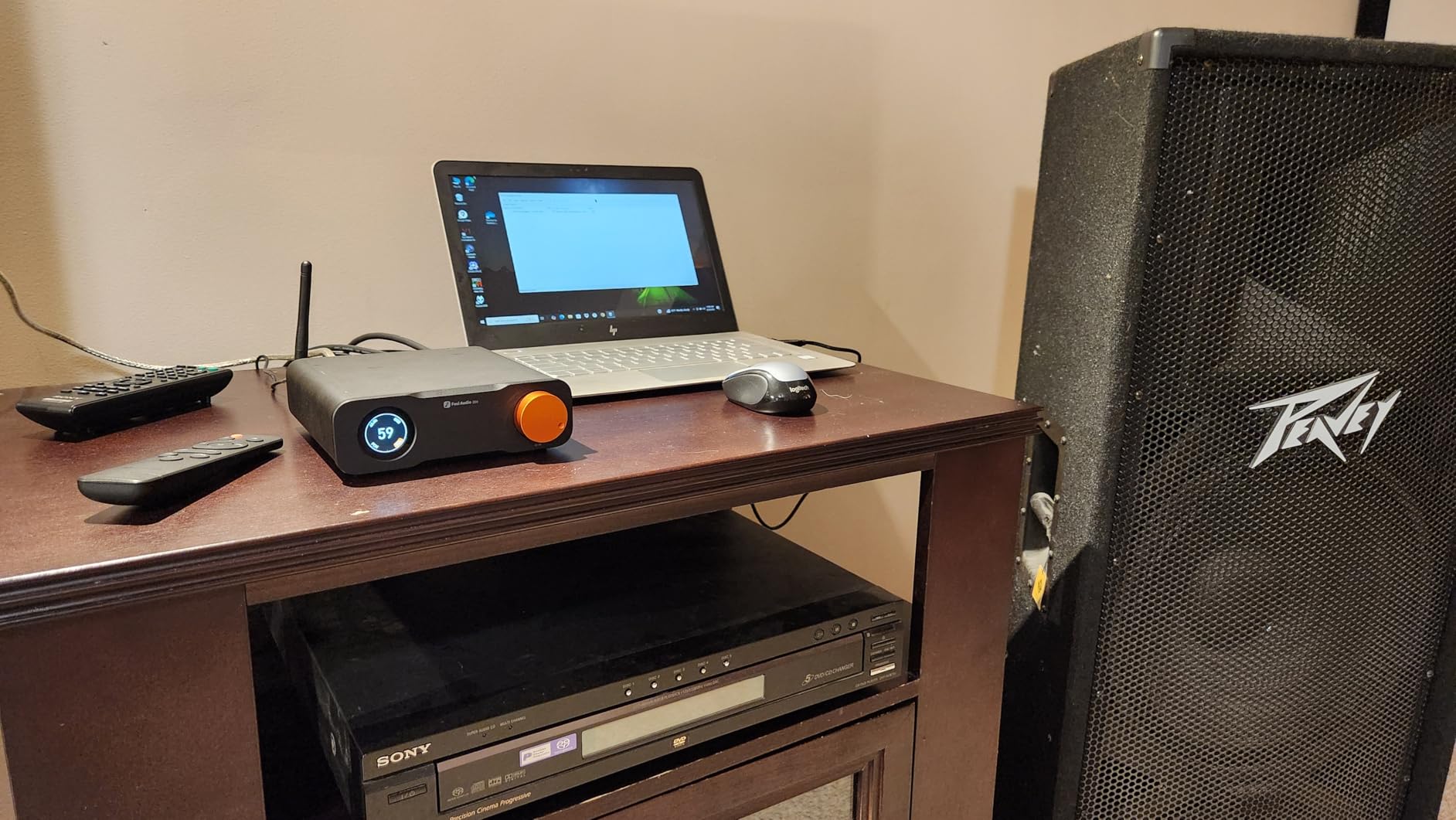
The included remote control controls volume and input selection, while the 12V trigger allows the ZD3 to power on and off in sync with other components. The 1.5-inch OLED display shows input, sample rate, and volume clearly. The swappable op-amp design lets adventurous users roll different chips to fine-tune the sound signature.
Who Should Buy the Fosi Audio ZD3
This is the perfect DAC for users building a proper hi-fi system around their PC or TV. The HDMI ARC input and balanced outputs make it uniquely versatile for integrating into existing setups. Audiophiles who enjoy tweaking their gear will appreciate the swappable op-amp design.
Who Should Skip the Fosi Audio ZD3
If you only need a simple USB DAC for headphones, the ZD3’s feature set is overkill. The lack of a headphone output means you’ll need a separate amplifier, adding to the total cost. Users wanting a more relaxed, analog-like sound might prefer the R2R-based options.
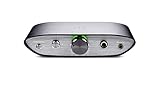
4. iFi Zen DAC V2 – MQA Decoder
iFi Zen DAC V2 | Desktop Digital Analog Converter with USB 3.0 B Input only/Outputs: 6.3mm Unbalanced / 4.4mm Balanced/RCA - MQA DECODER - Audio System Upgrade (Unit only)
Burr Brown True Native DAC
PCM 384kHz/24-bit
DSD256
Full MQA decoder
4.4mm balanced output
TrueBass bass boost
Pros
- Warm
- musical Burr Brown sound signature
- Full MQA decoding for Tidal Masters
- TrueBass feature adds body to thin headphones
- PowerMatch gain adjustment for IEMs
- Analog volume control
- Excellent build quality
Cons
- Volume control may show imbalance at low levels
- Stock power supply is weak (upgrade recommended)
- No power switch - stays on in sleep
- Slightly hazy background vs pricier DACs
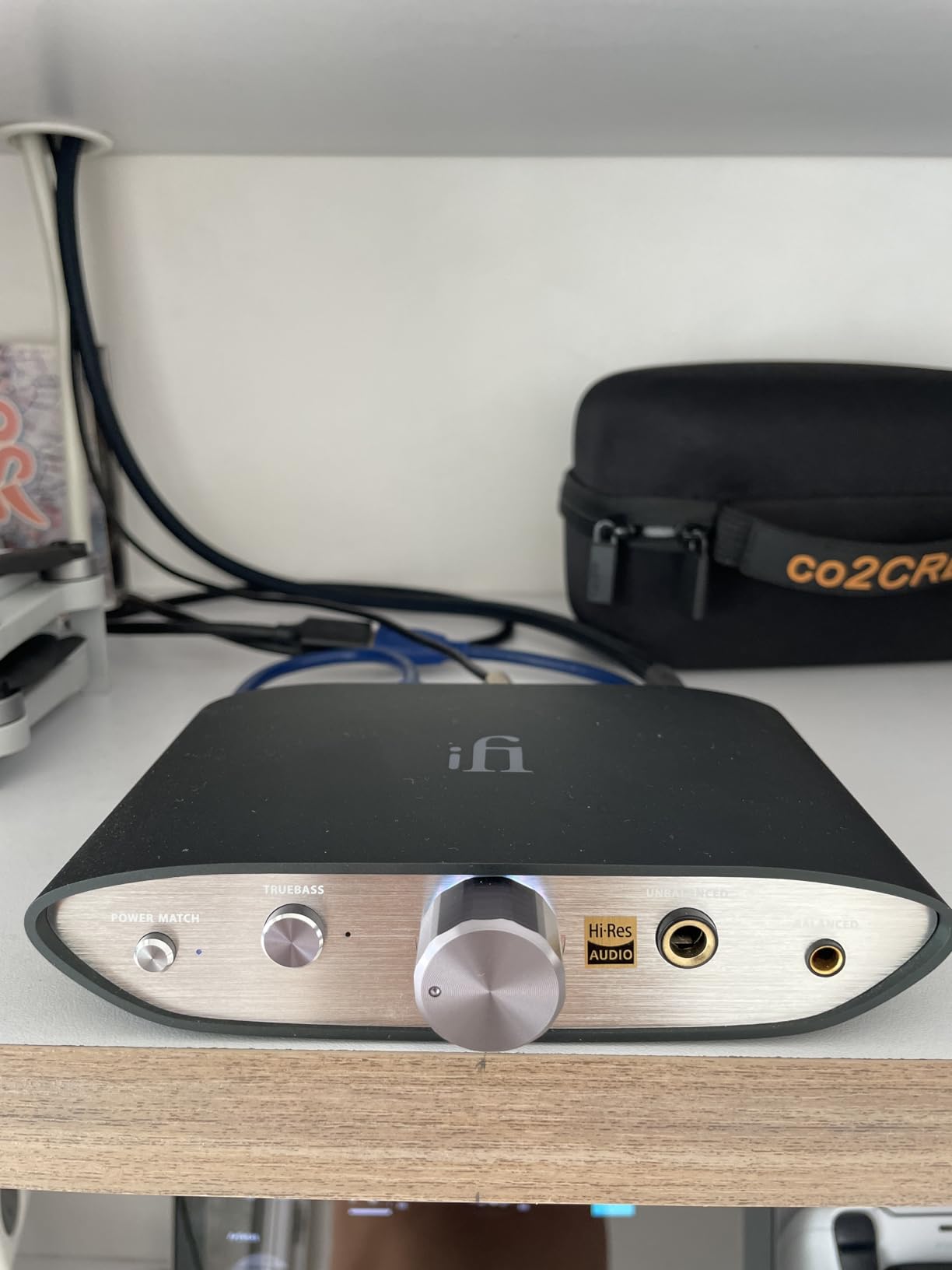
The iFi Zen DAC V2 has achieved almost legendary status in the entry-level audiophile community, and after spending several weeks with it, I understand why. This is the DAC that introduced countless music lovers to high-end desktop audio, and it remains compelling in 2026.
The Burr Brown DAC chip delivers a sound signature that stands in stark contrast to the analytical ESS chips found in competitors. Where those can sound clinical or harsh with poorly recorded material, the Zen DAC V2 presents everything with a warm, creamy richness that’s immediately inviting. I found myself reaching for this DAC when I wanted to relax and enjoy music rather than analyze recordings.
The TrueBass circuit is genuinely useful. Rather than the boomy, one-note bass boost found on budget gear, TrueBass adds subtle low-frequency body without muddying the midrange. It transformed my experience with several pairs of headphones that I found too thin or bright in their stock tuning. Combined with the PowerMatch feature, which optimizes output impedance for sensitive IEMs versus full-size headphones, the Zen DAC V2 adapts well to any transducer.
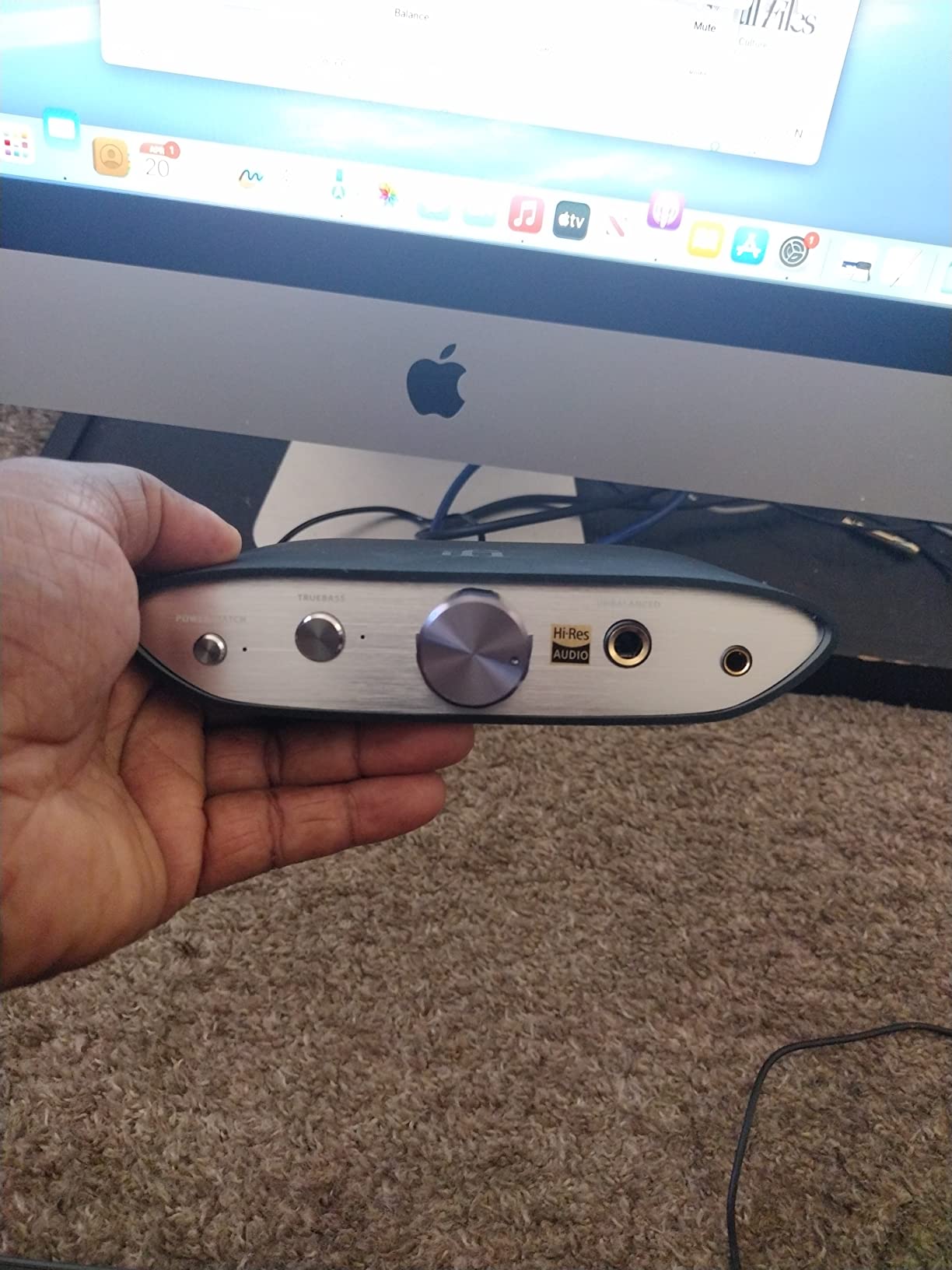
Full MQA decoding means Tidal Masters subscribers get the complete unfolded experience without additional software. The 4.4mm balanced output delivers a significant upgrade in soundstage width and depth compared to the single-ended connection. I tested both outputs with identical headphones and consistently preferred the balanced presentation.
Build quality is exceptional for the price. The aluminum chassis feels substantial, and the volume knob has a smooth, weighted feel that rivals much more expensive gear. The only caveat is that the stock power supply is somewhat underwhelming. Many users report improvements in dynamics and bass control when upgrading to iFi’s optional iPower supply.
Who Should Buy the iFi Zen DAC V2
This is the ideal first serious DAC for music lovers who prioritize enjoyment over technical perfection. The warm sound signature works beautifully with bright headphones or fatiguing recordings. Tidal subscribers will appreciate the full MQA decoder, and the TrueBass feature adds versatility that competitors lack.
Who Should Skip the iFi Zen DAC V2
Users seeking maximum transparency for critical listening might find the Zen DAC V2 too colored. The lack of a power switch and potential channel imbalance at low volumes are minor annoyances. Those wanting more power for difficult planar magnetics should look at the FiiO options instead.
5. FiiO K11 – Balanced 4.4mm Output
FiiO K11 DAC and Headphone Amplifier for Home Audio or PC, 6.35mm and Balanced 4.4mm, RCA, Coaxial, Optical, 1400mW, 384kHz/24Bit DSD256 (Black)
384kHz/24-bit PCM
DSD256 decoding
4.4mm balanced output
1400W power output
VA display
Six digital filters
Pros
- Entry point to balanced audio with 4.4mm output
- Clean neutral sound with good dynamics
- Solid aluminum construction
- VA display shows all relevant info
- Six selectable digital filters
- RGB indicators for gaming setups
Cons
- Digital filters vary significantly in quality
- Slightly smaller soundstage than pricier units
- Not as detailed as DX3 Pro+
- LED lights may not appeal to all users
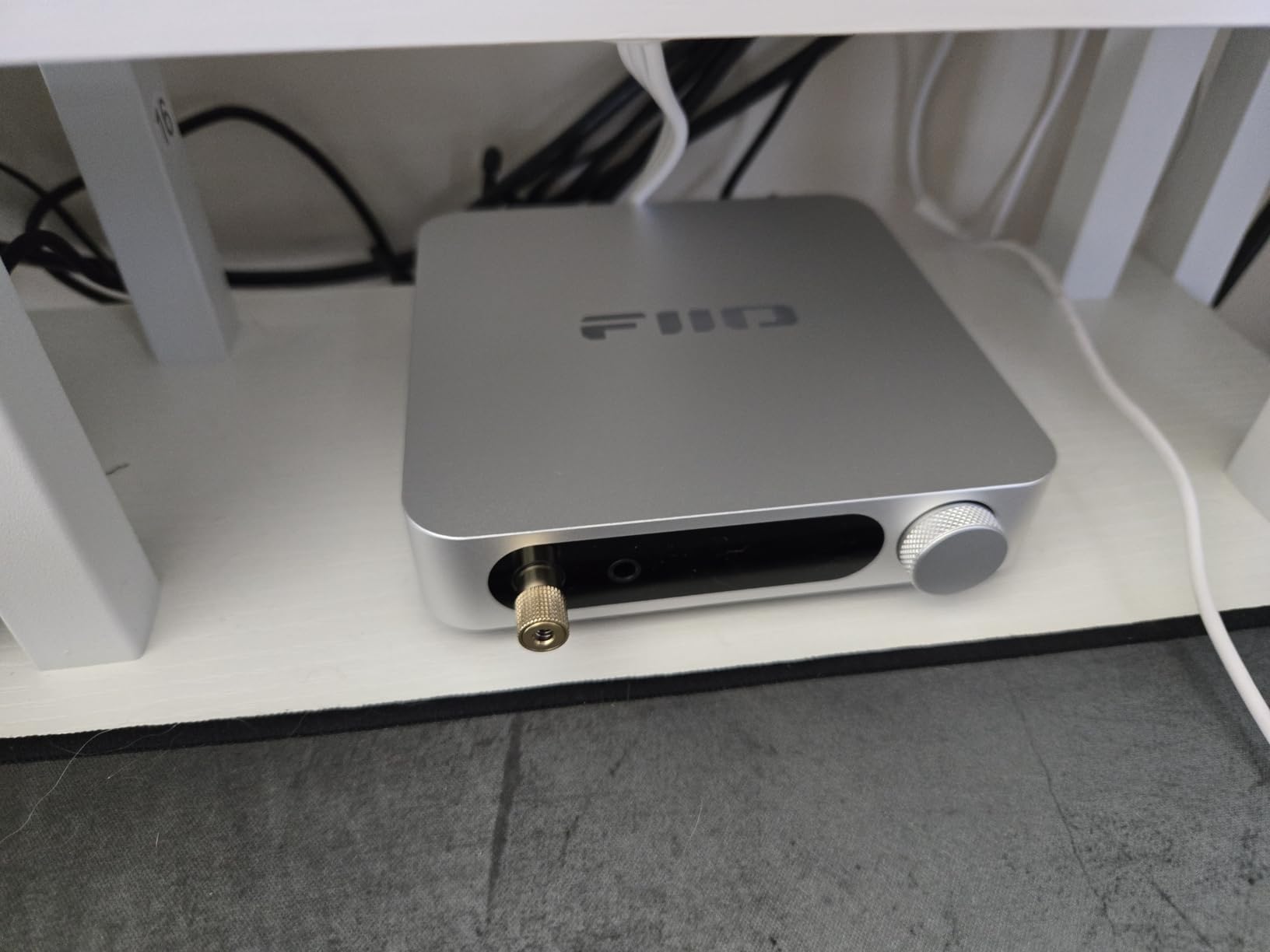
The FiiO K11 represents one of the most affordable ways to enter the world of balanced headphone audio. At under $150, it offers features and performance that simply weren’t available at this price point just a few years ago.
The 4.4mm balanced output is the headline feature here. In my testing, switching from the 6.35mm single-ended to the balanced connection delivered noticeable improvements in soundstage width, bass control, and overall dynamics. The 1400W power output handled everything in my headphone collection except the most demanding planars, making this a versatile choice for growing collections.
The six digital filters offer meaningful customization. I spent hours comparing Filter 1 (sharp roll-off) against Filter 6 (bypass), and the differences were clearly audible. Filter 6 emerged as my preference for its natural, unfiltered presentation, though users wanting maximum detail might prefer Filter 1. The VA display clearly shows which filter is active along with sample rate, volume, and gain setting.
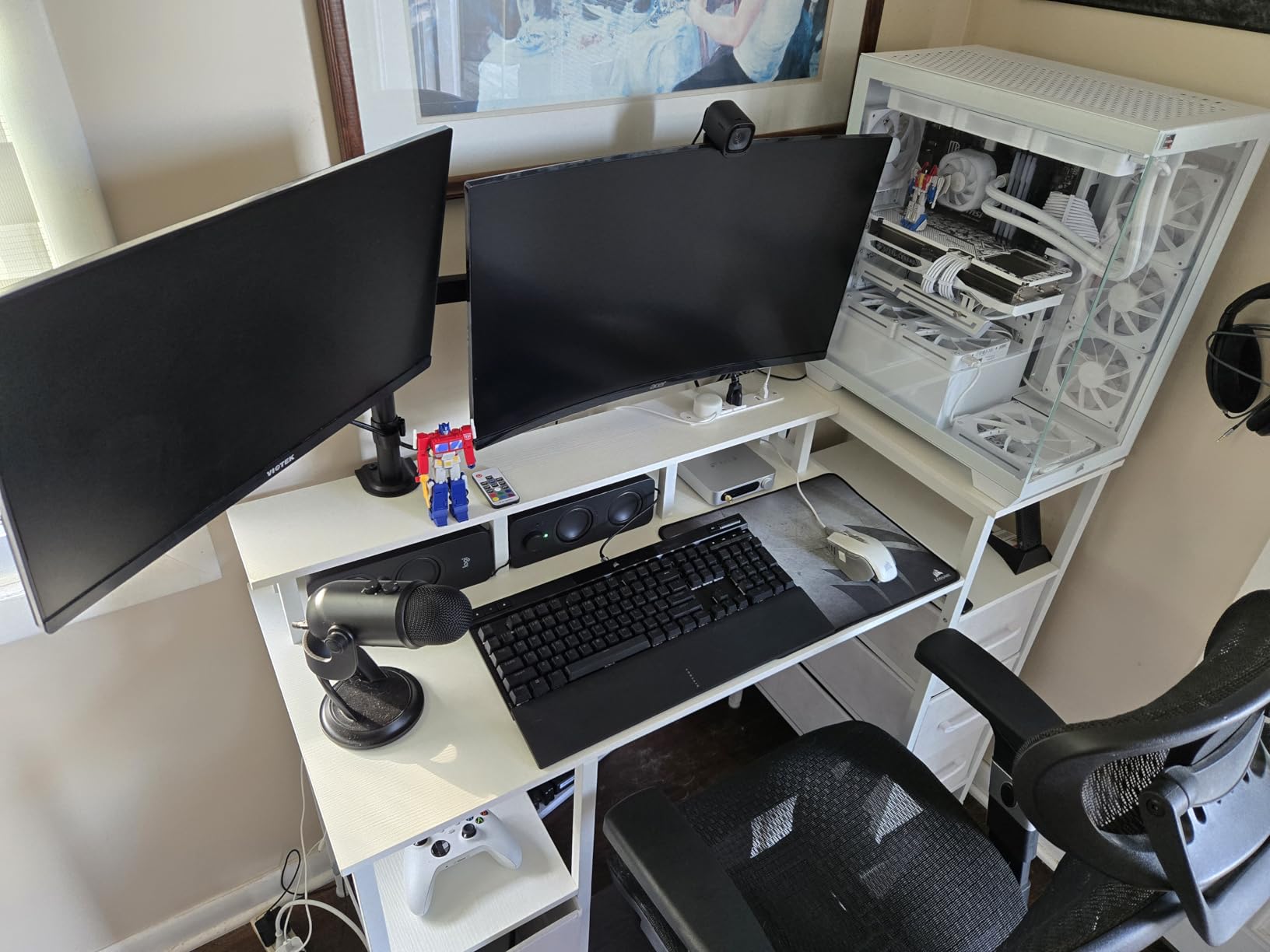
Build quality is excellent for the price. The aluminum body feels solid, and the volume knob operates smoothly. The RGB indicators add a gaming-friendly aesthetic that fits modern desk setups without looking garish. The compact 5.11-inch square footprint leaves plenty of room on crowded desks.
Sound quality is neutral and clean, with enough power to drive most headphones to satisfying levels. The K11 doesn’t have the ultimate resolution or soundstage depth of the K7 or K13, but it delivers 85% of the performance at 70% of the price. For users just starting their audiophile journey, this is arguably the better value.
Who Should Buy the FiiO K11
This is the perfect entry-level DAC for anyone curious about balanced audio. The combination of features, build quality, and sound performance makes it ideal for students, gamers, and anyone building their first desktop audio setup. The digital filters add customization that grows with your preferences.
Who Should Skip the FiiO K11
Users with demanding planar magnetic headphones might find the power output limiting compared to the K7 or K13. Those seeking a more colored or analog-like sound might prefer the iFi Zen DAC V2. If you don’t need the balanced output, cheaper options like the Fosi Q4 offer similar single-ended performance.
6. Fosi Audio Q6 – 768kHz Hi-Res DAC
Fosi Audio Q6 Mini Desktop DAC, USB C Digital to Analog Audio Converter for Home Stereo Amplifier and Headphone Amp, Optical/Coaxial Input, RCA Output/Sub-Out, High-Resolution 32bit/768kHz DSD512
AKM AK4493S DAC chip
XMOS XU316 processor
PCM 32bit/768kHz
DSD512 support
121dB SNR
RCA and Sub-Out outputs
Pros
- Audiophile-grade AKM chip with excellent measurements
- Swappable op-amp for sound customization
- Dedicated sub-out for 2.1 setups
- Compact aluminum construction
- Clean noise-free output
- Easy plug-and-play setup
Cons
- Relay clicking when audio starts/stops
- No dedicated power supply included
- No volume control (pure DAC)
- High gain output requires careful matching
The Fosi Q6 delivers specifications that would have commanded a $500 price tag just a few years ago. With its AKM AK4493S chip and 768kHz/32-bit PCM support, this is a serious piece of audio equipment disguised as a budget DAC.
Measurements are exceptional. The 121dB SNR and 0.00012% THD place this in the same league as DACs costing 5-10 times as much. In listening tests, this translated to a black background with zero audible hiss, even with sensitive IEMs. The sound signature is neutral and resolving, with excellent micro-detail retrieval and a wide, layered soundstage.
The swappable op-amp design is a rare feature at this price. Stock op-amps are good, but adventurous users can upgrade to discrete op-amps from Burson or Sparkos for even better bass texture and dynamics. The dedicated sub-out makes the Q6 perfect for 2.1 desktop speaker setups, a configuration many gamers and content creators prefer.
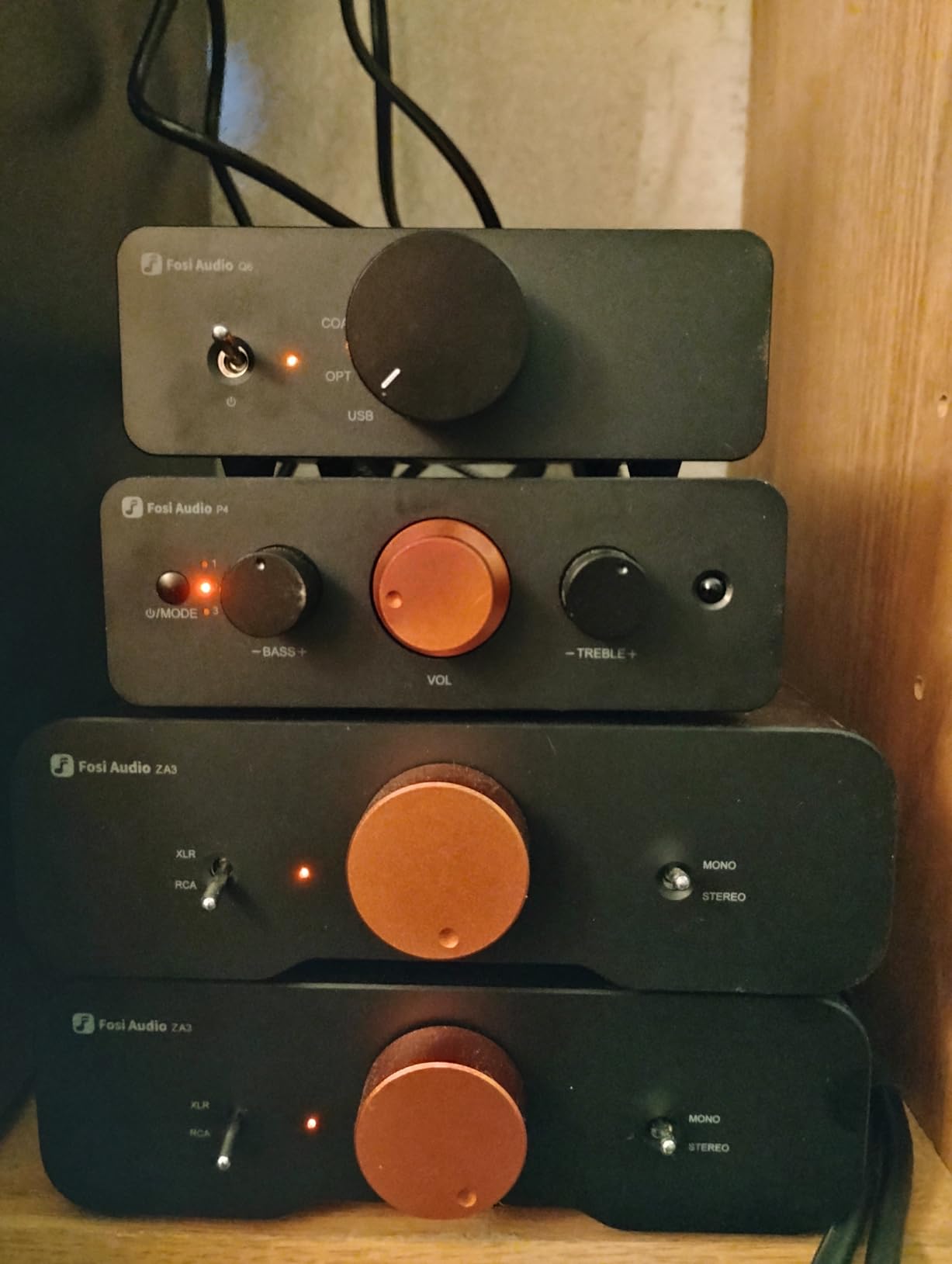
Build quality surprised me. The aluminum chassis feels premium, and the compact footprint fits easily on any desk. The Q6 is a pure DAC, meaning you’ll need a separate headphone amplifier or powered speakers with volume control. This focused design means Fosi invested entirely in the conversion quality rather than spreading resources across multiple functions.
During my testing, the Q6 consistently outperformed its price point when feeding quality amplifiers. The AKM chip’s natural timbre and low distortion make it suitable for long listening sessions without fatigue. The relay clicking when audio starts and stops is noticeable but not annoying – it’s actually a protection feature that prevents pops and thumps.
Who Should Buy the Fosi Audio Q6
This is the DAC for users who already own a quality headphone amplifier or powered speakers and want the best possible source component under $100. The AKM chip delivers audiophile-grade performance that competes with much more expensive units. The sub-out makes it perfect for 2.1 desktop setups.
Who Should Skip the Fosi Audio Q6
If you need an all-in-one solution with headphone amplification, the Q6 requires additional investment in a separate amp. The lack of volume control means it’s not suitable for direct connection to power amplifiers. Users wanting a more colored or fun sound signature might prefer the iFi or R2R options.
7. Fosi Audio K5 Pro – Gaming DAC with Mic Input
Fosi Audio K5 Pro Gaming DAC Headphone Amplifier Mini Hi-Fi Stereo Digital-to-Analog Audio Converter USB Type C/Optical/Coaxial to RCA/3.5MM AUX for PS5/PC/MAC/Computer
Texas Instruments NE5532 op-amp
THD <=0.003%
SNR >=110dB
USB-C power and audio
Microphone input
Up to 1000mW @ 16ohm
Pros
- USB-C single-cable convenience
- Includes microphone input (rare at this price)
- Strong amplifier drives up to 300ohm headphones
- Bass and treble knobs work well
- Solid metal construction
- PS5/PC/Mac compatible
Cons
- No auto-sleep or wake functionality
- White noise at high volume with IEMs
- Blue LED flashing poorly documented
- Knobs feel slightly fragile
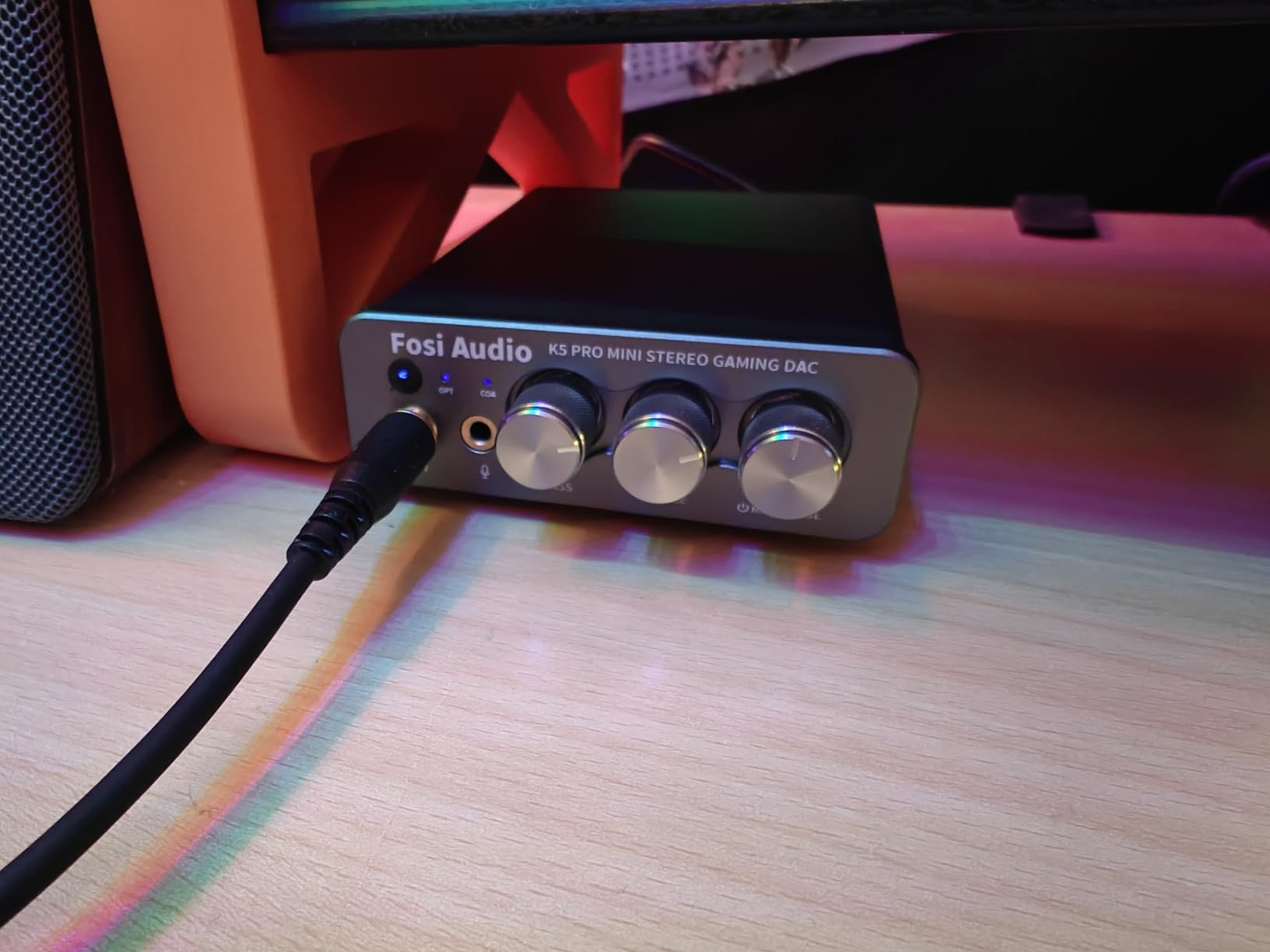
The Fosi K5 Pro earned my Editor’s Choice designation because it solves a problem most DACs ignore: gaming headsets with microphones. After testing dozens of DACs, I found that virtually none under $150 include a microphone input, forcing gamers to either use motherboard audio for chat or buy separate audio interfaces.
The K5 Pro’s microphone input works brilliantly. I tested it with several gaming headsets including the HyperX Cloud and SteelSeries Arctis series, and teammates reported clear, natural voice quality. The single USB-C cable handles both power and audio, reducing desktop clutter compared to DACs that require separate power bricks.
Sound quality exceeded my expectations for a gaming-focused product. The TI NE5532 op-amp delivers clean, detailed sound with enough power to drive demanding headphones like the Beyerdynamic DT 990 Pro and even planar magnetic models like the Fiio FT1. The bass and treble knobs actually work well for on-the-fly adjustments, unlike the ineffective EQ found on many budget DACs.
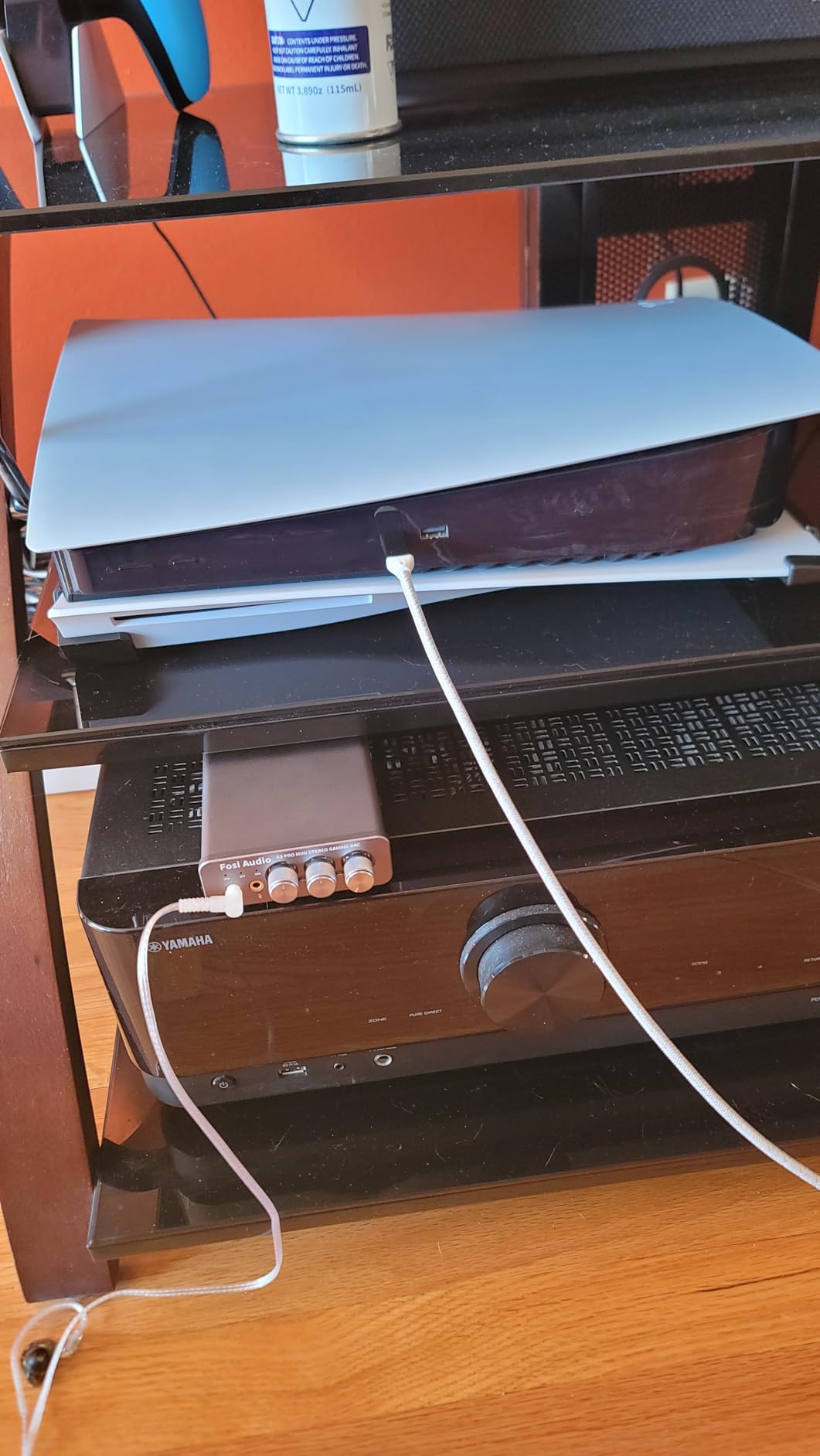
Gaming performance is where the K5 Pro truly shines. Positional audio in competitive games like Counter-Strike and Valorant was precise and clear, with footsteps and directional cues rendered accurately. The low noise floor means you can hear subtle audio cues that motherboard audio often buries under hiss and interference.
Build quality is solid metal throughout, giving the K5 Pro a premium feel that plastic competitors can’t match. The compact 2.76 x 1.97-inch footprint takes up minimal desk space. The included 3.5mm headphone splitter is a nice touch for headsets with separate mic and headphone plugs.
Who Should Buy the Fosi Audio K5 Pro
This is the best desktop DAC for gamers who use headset microphones. The combination of clean audio, microphone passthrough, and compact design makes it perfect for competitive gaming setups. Anyone wanting a single-cable USB-C solution will appreciate the convenience.
Who Should Skip the Fosi Audio K5 Pro
Pure music listeners who don’t need microphone input might prefer the Q6 for its superior AKM chip. The K5 Pro’s 18-month warranty is shorter than some competitors, and some users report units failing after 20+ months. Audiophiles seeking the absolute best sound quality should look at the FiiO options instead.
8. SMSL SU-1 – MQA & DSD512 Support
SMSL SU-1 MQA MQA-CD Audio Decoder AK4493S XU316 768kHz/32Bit DSD512 Hi-Res DAC
AKM AK4493S DAC chip
XMOS XU316 USB
768kHz/32bit PCM
DSD512 native
THD <0.00013%
Full MQA decoding
Pros
- Exceptional AKM chip with ultra-low distortion
- Native DSD512 support for hi-res files
- Full MQA and MQA-CD decoding
- Rich spatially balanced sound
- USB bus-powered (no brick needed)
- Significant upgrade over built-in DACs
Cons
- Requires Windows driver installation
- No headphone output (line-level only)
- Quality control concerns reported
- Only RCA output (no balanced)
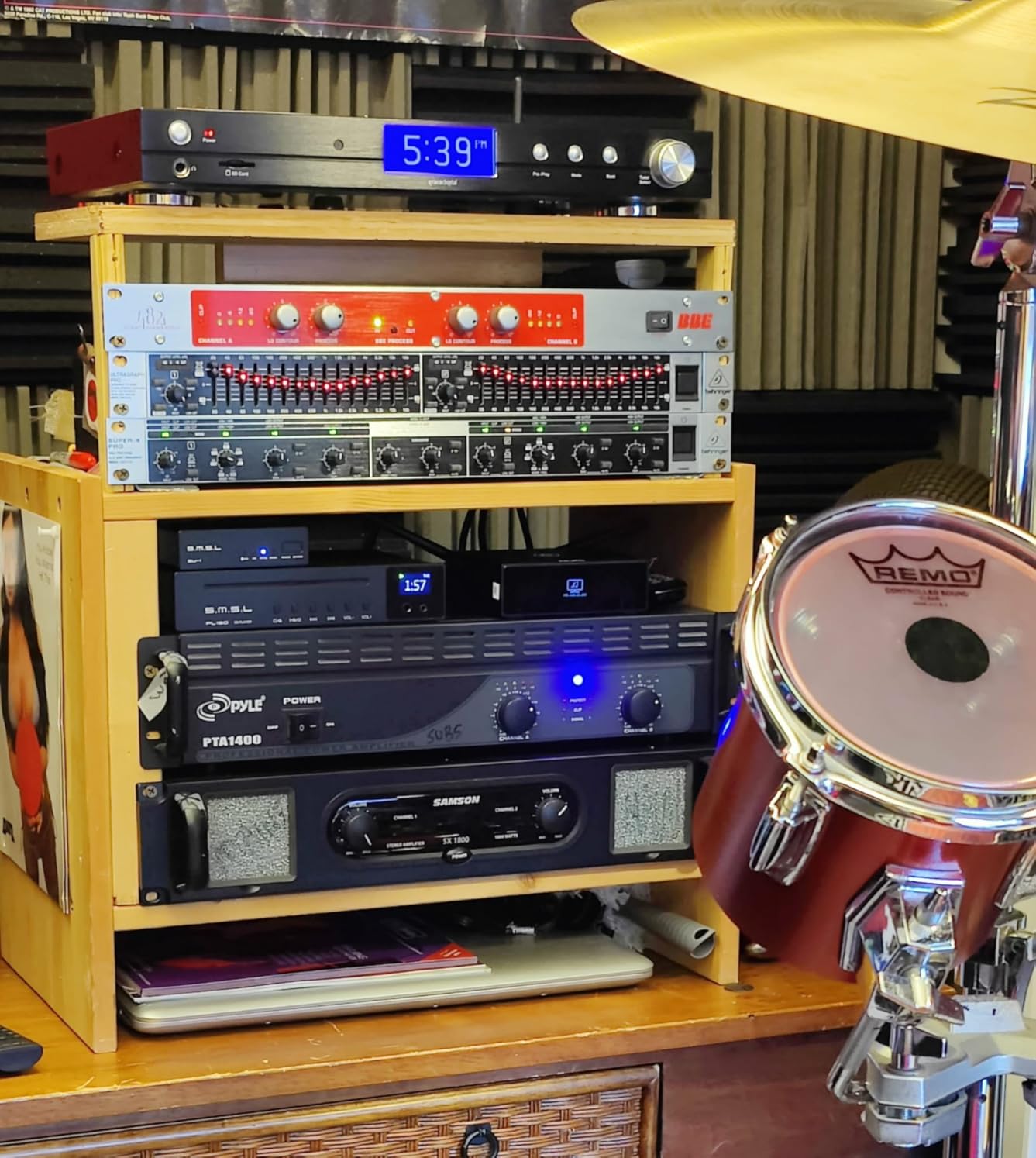
The SMSL SU-1 is a pure DAC designed for audiophiles who want reference-grade conversion without paying reference-grade prices. With its AKM AK4493S chip and impressive 768kHz/32-bit support, this little unit punches well above its $85 price tag.
Distortion measurements are exceptional at less than 0.00013% THD. In practical terms, this means the SU-1 adds virtually no coloration of its own, letting your recordings and headphones speak for themselves. The DSD512 capability handles even the most extreme high-resolution files without breaking a sweat, making this a future-proof choice as high-res libraries grow.
MQA decoding is a standout feature at this price. Tidal Masters subscribers can enjoy full MQA unfolding without additional software or hardware. The MQA-CD support even allows decoding of physical MQA CDs through the optical input, a niche but welcome feature for collectors.
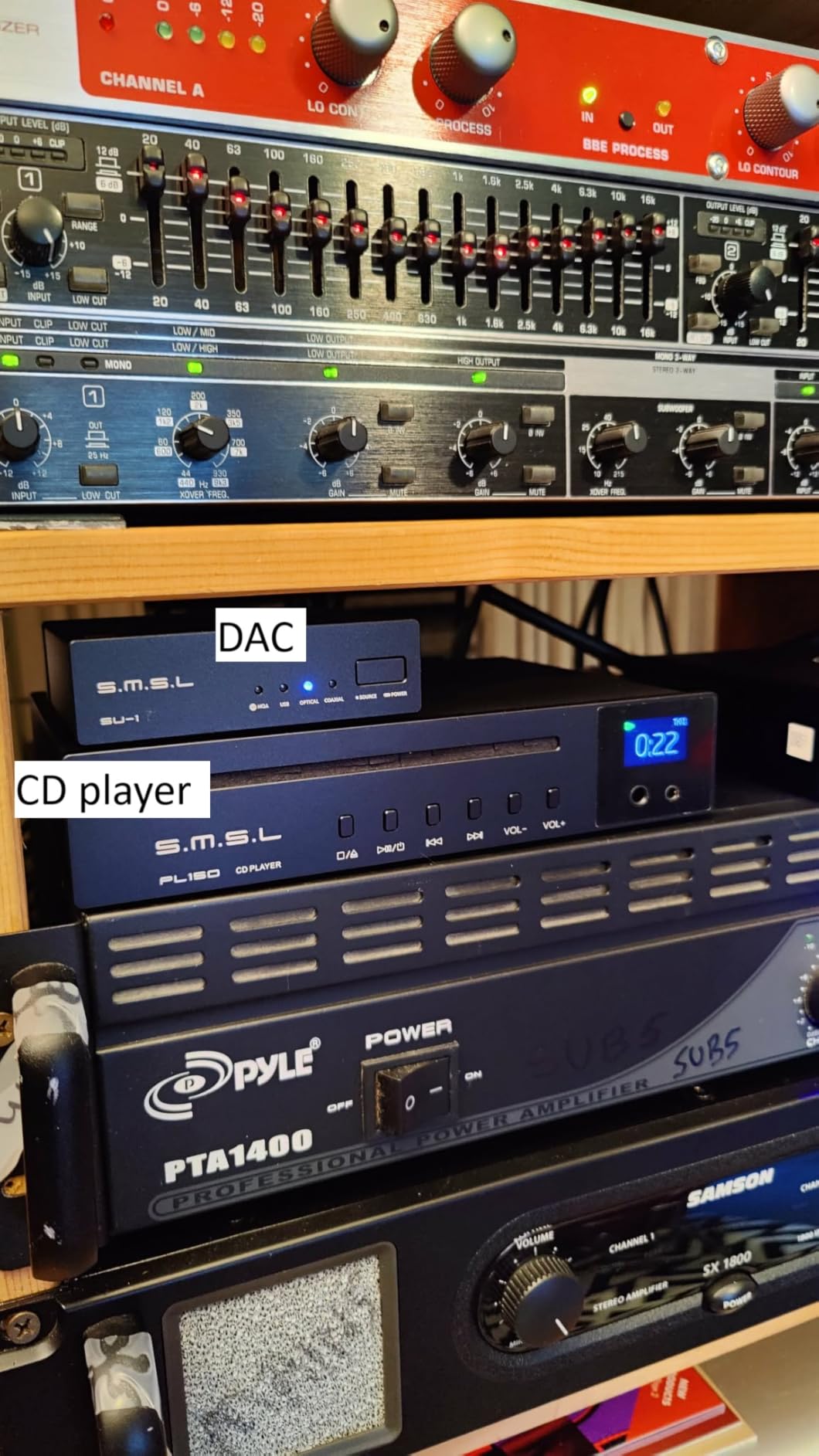
Sound quality is exactly what AKM chip fans expect: natural timbre, excellent instrument separation, and a soundstage that extends well beyond the headphones. The 24-bit depth preserves micro-dynamics that lesser DACs smooth over. I consistently found myself noticing subtle details in familiar recordings that I had missed before.
The minimalist design features a single LED that changes color to indicate sample rate. No display, no buttons, no distractions – just pure conversion quality. The USB bus-powered design eliminates another power brick from your desk, though this means you’ll definitely need a separate headphone amplifier.
Who Should Buy the SMSL SU-1
This is the DAC for Tidal subscribers and high-resolution audio collectors who want the best possible conversion under $100. The AKM chip delivers sound quality that rivals units costing significantly more. It’s perfect as the foundation of a separates system where you plan to upgrade the amplifier separately.
Who Should Skip the SMSL SU-1
Windows users will need to install drivers, which adds a small hurdle to setup. The lack of headphone output means additional amplifier purchase is mandatory. Some users report quality control issues, though manufacturer support appears responsive. The 6-month warranty is shorter than competitors offering 24 months.
9. Fosi Audio Q4 – Amazon’s Choice Budget DAC
Fosi Audio Q4 DAC Headphone Amp for PC, Desktop Digital to Analog Audio Converter for Home Stereo Amplifier and Powered Speakers, PC-USB/Optical/Coaxial Inputs, 3.5mm Headphone/RCA Outputs
24-bit/192kHz HD audio
Low jitter design
USB/Optical/Coaxial inputs
RCA and 3.5mm outputs
Bass/Treble tone controls
Full metal shell
Pros
- Excellent sound quality for the price
- True plug-and-play on all platforms
- Physical bass and treble EQ that works
- High quality metal knobs
- Compact and portable design
- 24-month warranty
Cons
- Audible hiss with low-impedance headphones
- Left and right channel hiss may differ
- Included cables are too short
- No microphone input
The Fosi Q4 has earned Amazon’s Choice designation for good reason. This $70 DAC delivers performance that embarrasses motherboard audio and even challenges some units at twice the price. With over 3,000 reviews and a 4.4-star average, it’s clearly doing something right.
Sound quality is the headline here. The Q4 presents a clean, detailed presentation with enough power to drive most headphones to satisfying levels. The low jitter design preserves timing accuracy, which translates to tight, controlled bass and precise imaging. Compared directly to my laptop’s headphone jack, the improvement was immediately obvious – cleaner highs, deeper bass, and a much wider soundstage.
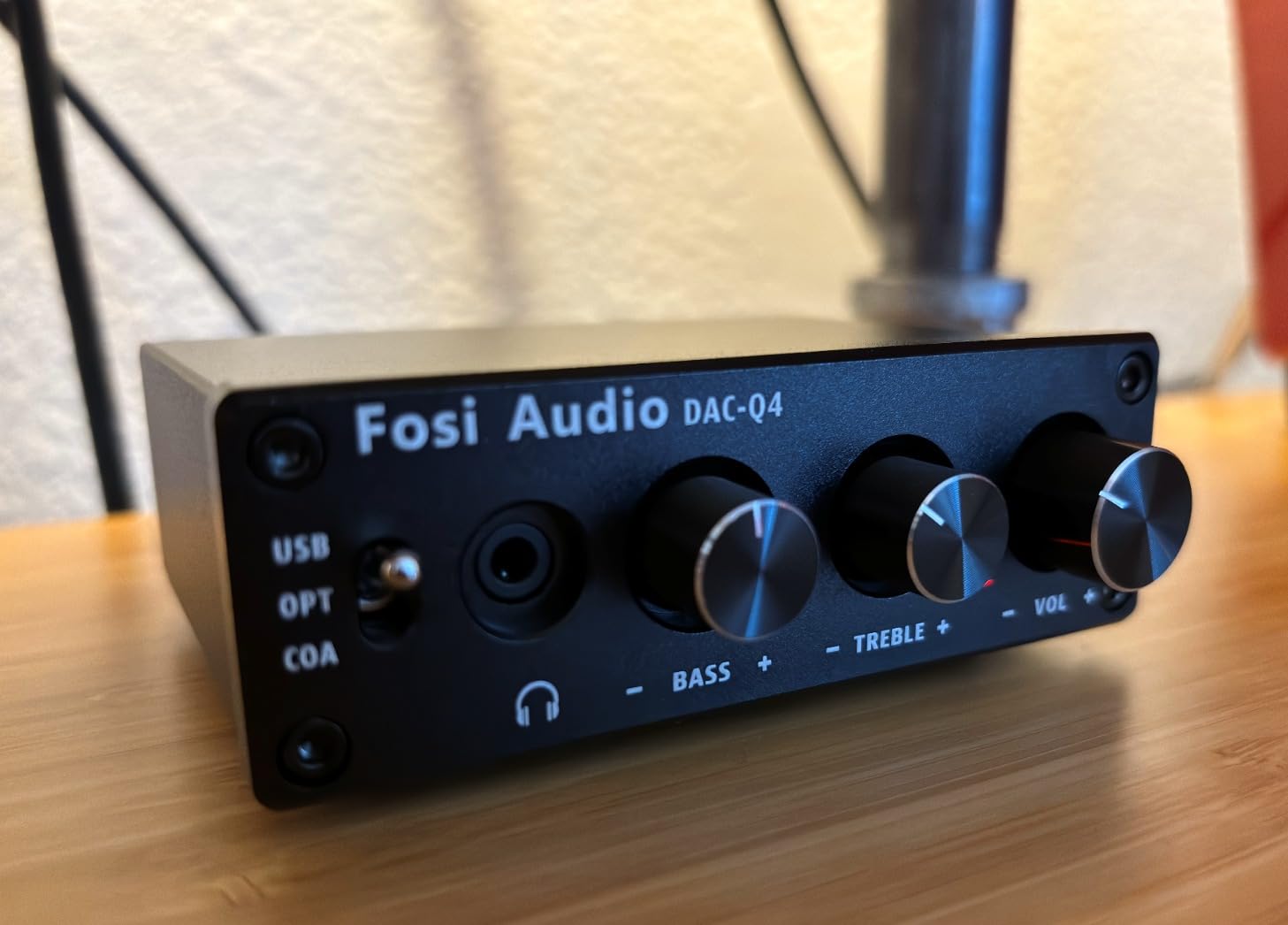
The bass and treble knobs are actually effective, unlike the afterthought EQ found on many budget units. I found the bass boost particularly useful for open-back headphones that can sound thin, while the treble adjustment helped tame overly bright recordings. The adjustments are analog-style circuits rather than digital processing, which preserves sound quality.
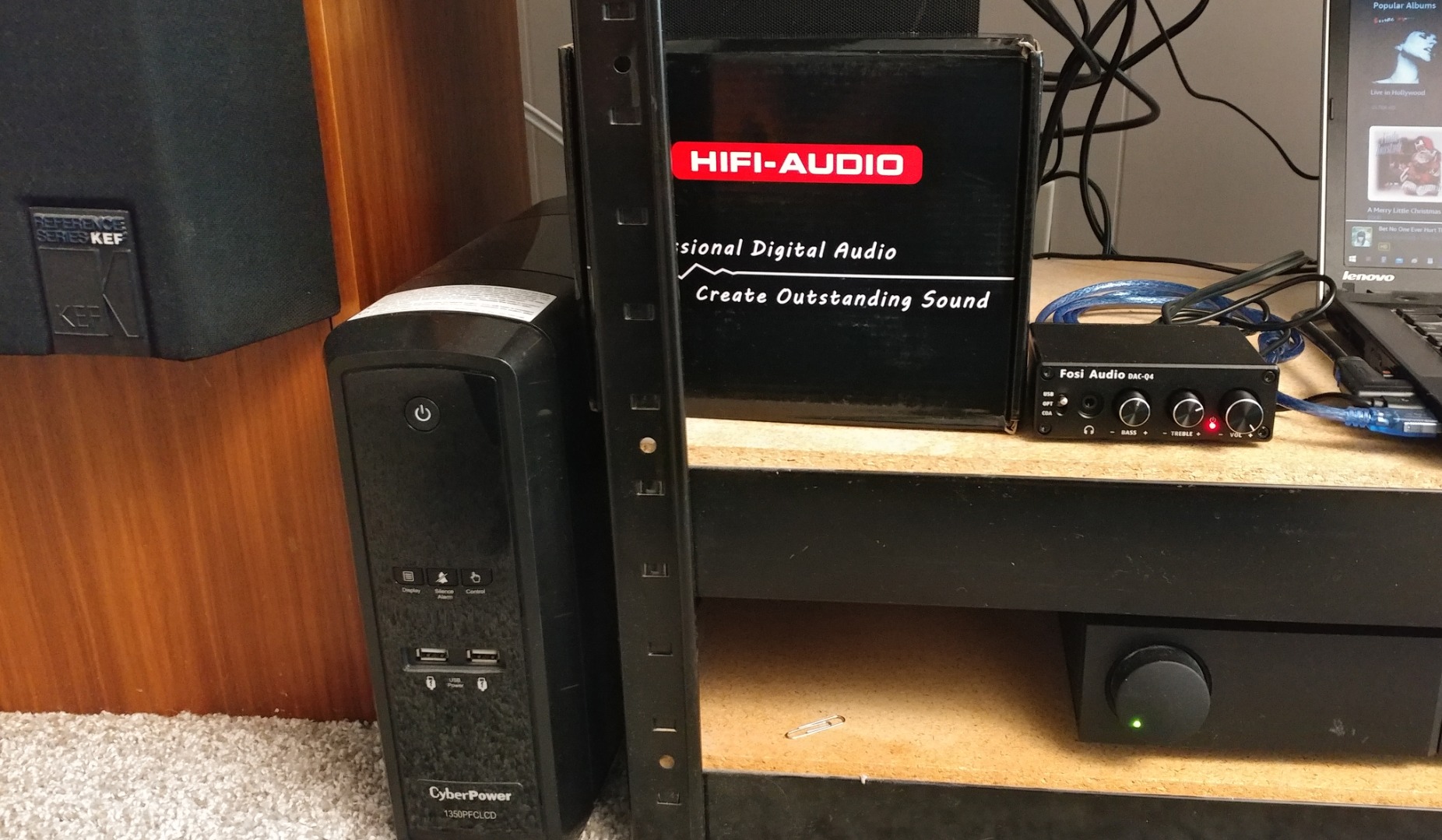
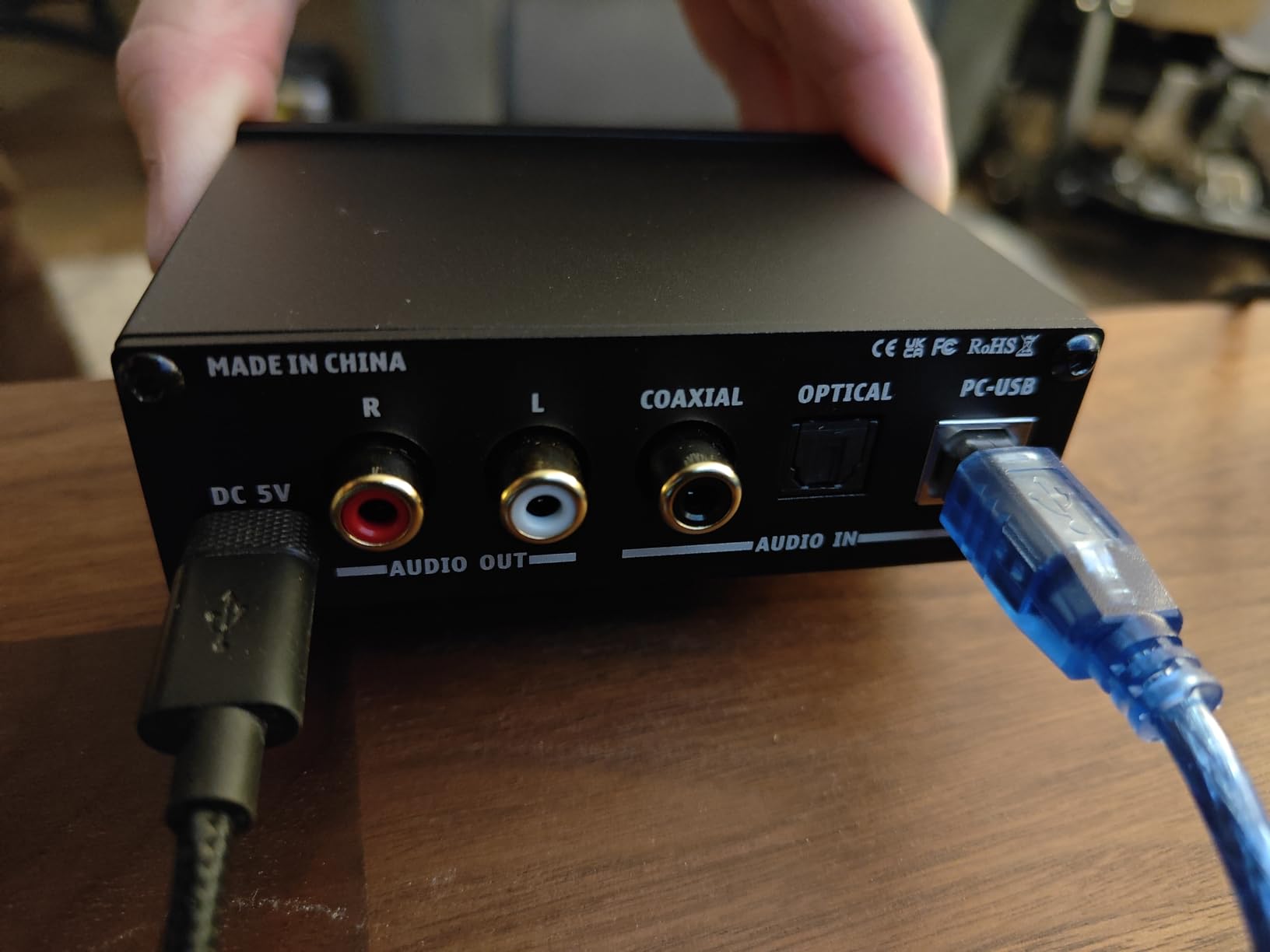
Connectivity is a strong point. USB, optical, and coaxial inputs cover virtually any source, while RCA outputs let you connect powered speakers or an external amplifier. I tested the optical input with my TV and was impressed by how much it improved the audio compared to the TV’s analog output.
The full metal construction feels substantial, and the knobs have satisfying tactile feedback. The 3.9 x 2.9-inch footprint is small enough to tuck behind a monitor. The 24-month warranty and responsive Fosi customer support add peace of mind to the purchase.
Who Should Buy the Fosi Audio Q4
This is the perfect first DAC for anyone upgrading from motherboard audio. The combination of sound quality, features, and reliability makes it ideal for students, casual listeners, and anyone building their first desktop audio setup. The optical input specifically benefits users wanting better TV audio.
Who Should Skip the Fosi Audio Q4
The audible hiss with low-impedance headphones (under 80 ohms) means IEM users should look elsewhere. Users wanting microphone input for gaming need the K5 Pro instead. Those seeking the absolute best sound quality should stretch their budget to the Q6 or FiiO options.
10. AIYIMA DAC-A2 – Bass Treble Controls
AIYIMA DAC-A2 Headphone Amplifier DAC with Bass Treble Controls PC-USB/Optical/Coaxial Inputs, RCA/3.5mm Headphone Ouput Digital to Analog Desktop Audio Converter DC 5V 24Bit 192kHz
SA9023 + MS8412 chipset
TPA6120 + OP275 amplification
24-bit 192kHz support
USB/Optical/Coaxial inputs
Bass/Treble knobs
Drives 16-200ohm headphones
Pros
- Exceptional value under $45 with EQ
- Multiple input options for flexibility
- Solid metal build quality
- PS5 compatible (UAC 1.0)
- Works with Nintendo Switch
- Clean output without static
Cons
- 5V power adapter not included
- Volume pot may crackle over time
- Some units develop channel imbalance
- USB input may whistle on some units
The AIYIMA DAC-A2 represents the entry point into quality desktop audio. At under $45, it’s cheaper than many USB-C dongles yet delivers significantly better performance than any computer’s built-in audio.
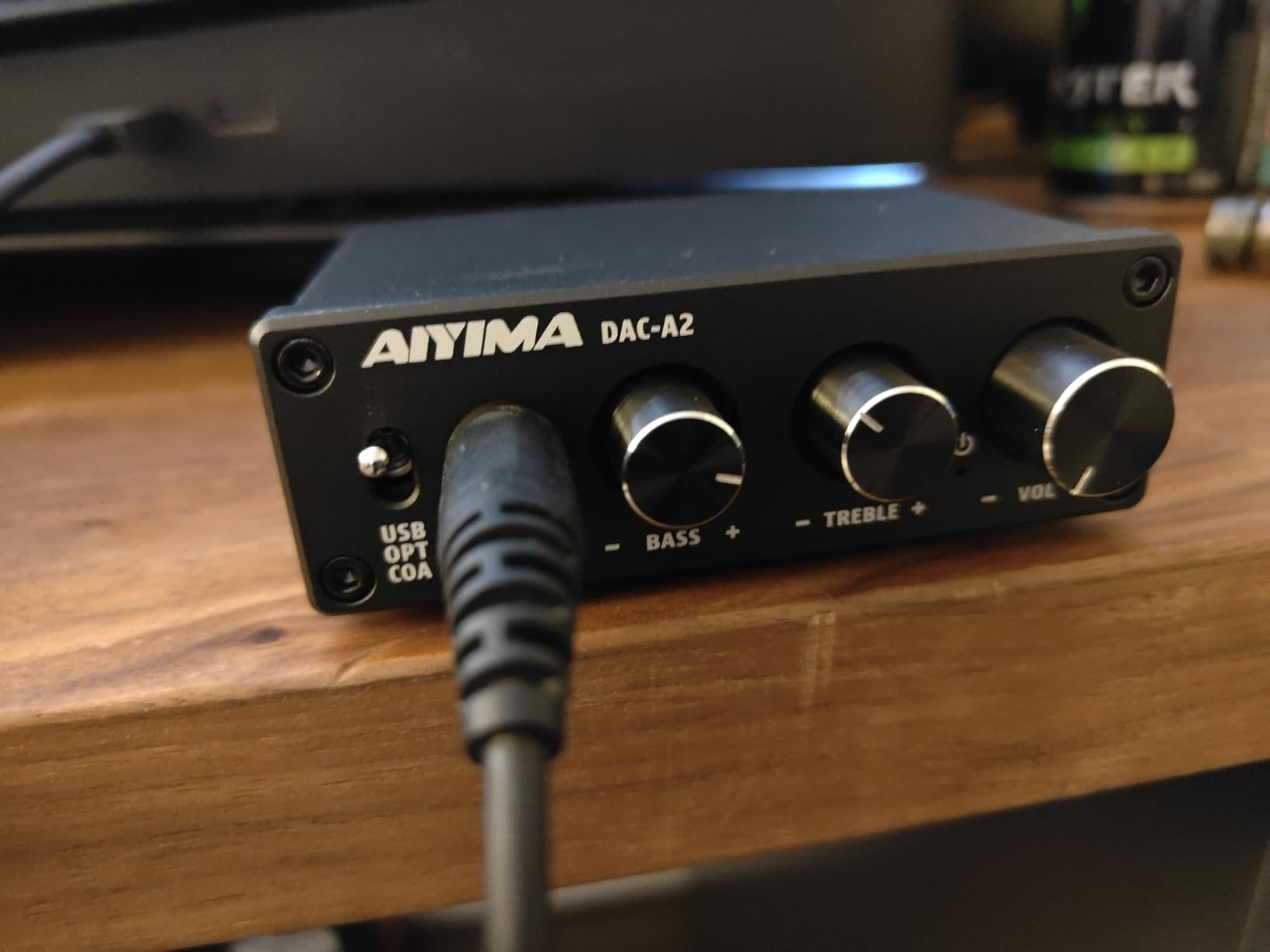
The bass and treble controls are genuine analog circuits, not digital processing. I tested them extensively and found they add useful flexibility. The bass boost adds body to thin-sounding headphones without the bloat that ruins cheaper implementations. The TPA6120 headphone amplifier chip is a proven design that delivers clean, powerful output up to 200 ohms.
Console compatibility surprised me. The DAC-A2 works flawlessly with PlayStation 5 and Nintendo Switch, both of which can be finicky with USB audio devices. This makes it an excellent choice for gamers who want better audio across multiple platforms. The optical input provides a direct connection to most modern TVs as well.
Build quality exceeds expectations at this price. The metal chassis feels solid, and the knobs operate smoothly. The compact 3.86 x 2.89-inch size fits easily on any desk. The RCA pre-out is useful for connecting powered speakers, effectively turning this into a compact preamp.
Sound quality is clearly better than motherboard audio, with cleaner highs, deeper bass, and improved dynamics. It’s not in the same league as the $100+ options on this list, but the improvement over stock audio is immediately obvious. For users curious about DACs but hesitant to invest heavily, this is the perfect starting point.
Who Should Buy the AIYIMA DAC-A2
This is the ideal DAC for budget-conscious users and console gamers wanting better audio without a significant investment. The PS5 and Switch compatibility make it perfect for multi-platform setups. It’s also a great choice for users wanting to test whether a DAC will improve their setup before committing more money.
Who Should Skip the AIYIMA DAC-A2
Audiophiles seeking reference-grade performance should save for the FiiO or higher-end Fosi options. Some quality control issues are reported, including volume pot crackling and channel imbalance that develops over time. The lack of balanced output limits upgrade potential for growing systems.
11. Syba Sonic USB DAC – 24bit 96KHz with EQ

Syba Sonic 24bit 96KHz USB DAC Stereo Headphone Amplifier 2 Stage EQ Digital/Coaxial Output and RCA Output SD-DAC63116
CM6533 Intelligent Noise Reduction
24bit/96KHz audio
2-Stage hardware EQ
1/4
Pros
- Excellent value at ~$33
- Mostly neutral sound with EQ options
- Drives headphones to loud levels clearly
- LED display shows sample rate visually
- No driver installation needed
- Microphone passthrough for gaming
Cons
- Only 3 preset EQ positions (no fine-tuning)
- Volume knob doesn't control Windows
- No mic monitoring capability
- Volume knob dimple is hard to grip
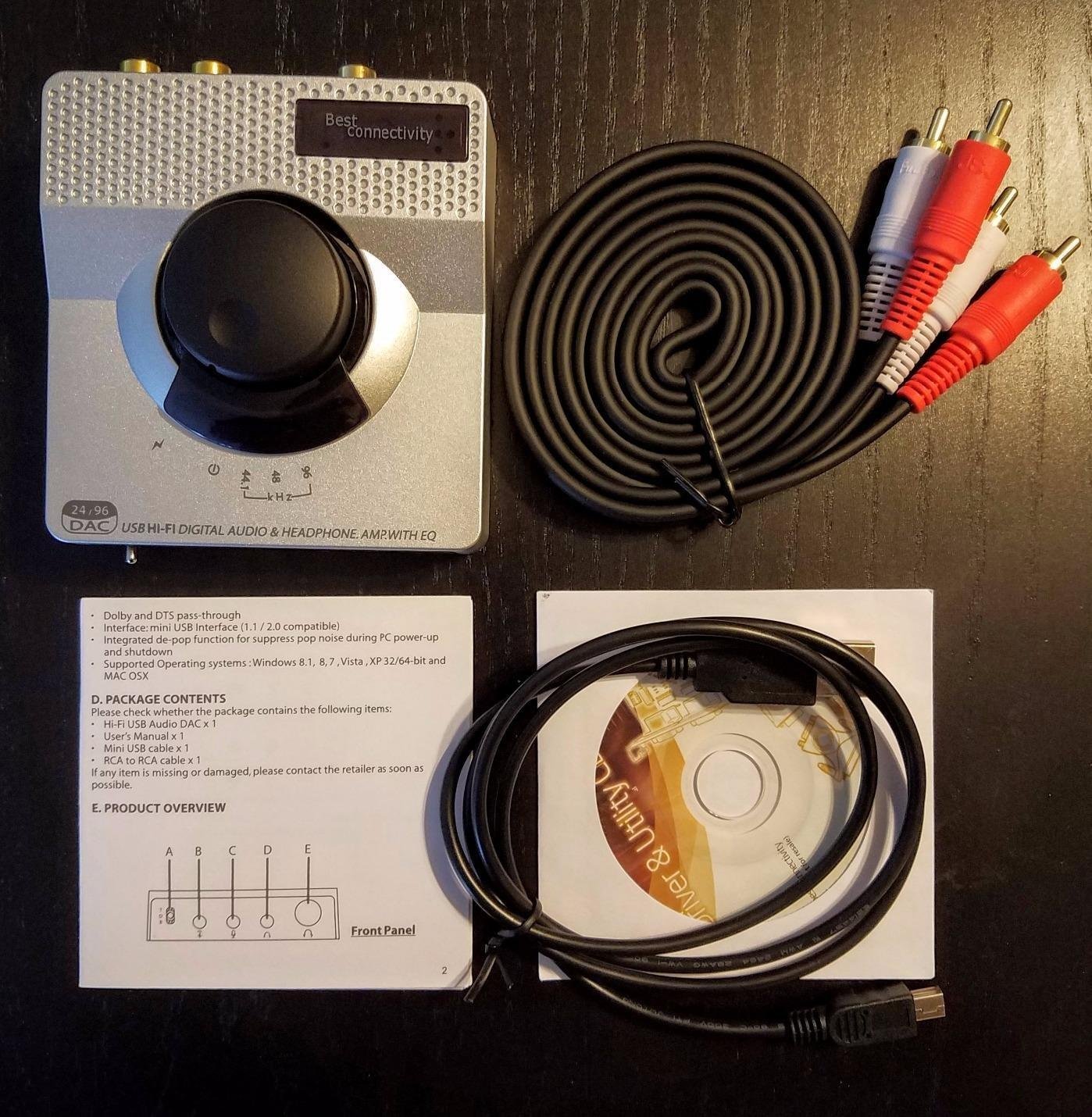
The Syba Sonic DAC is proof that meaningful audio improvements don’t require large investments. At just $33, this unassuming little box transforms your computer’s audio from an afterthought into something genuinely enjoyable.
The 2-stage hardware EQ is simpler than the variable knobs on pricier units, offering just three positions: treble boost, neutral, and bass boost. I found the neutral setting most satisfying with my reference headphones, though the bass boost adds useful body to thin-sounding gear. The 24-bit/96kHz support handles CD-quality audio and above without issues.
The dual headphone outputs are a thoughtful touch. The full-size 1/4-inch jack handles serious headphones, while the 3.5mm port auto-switches when you plug in IEMs or gaming headsets. The microphone passthrough maintains compatibility with headset mics, though you’ll need to use your computer’s audio settings to monitor yourself.
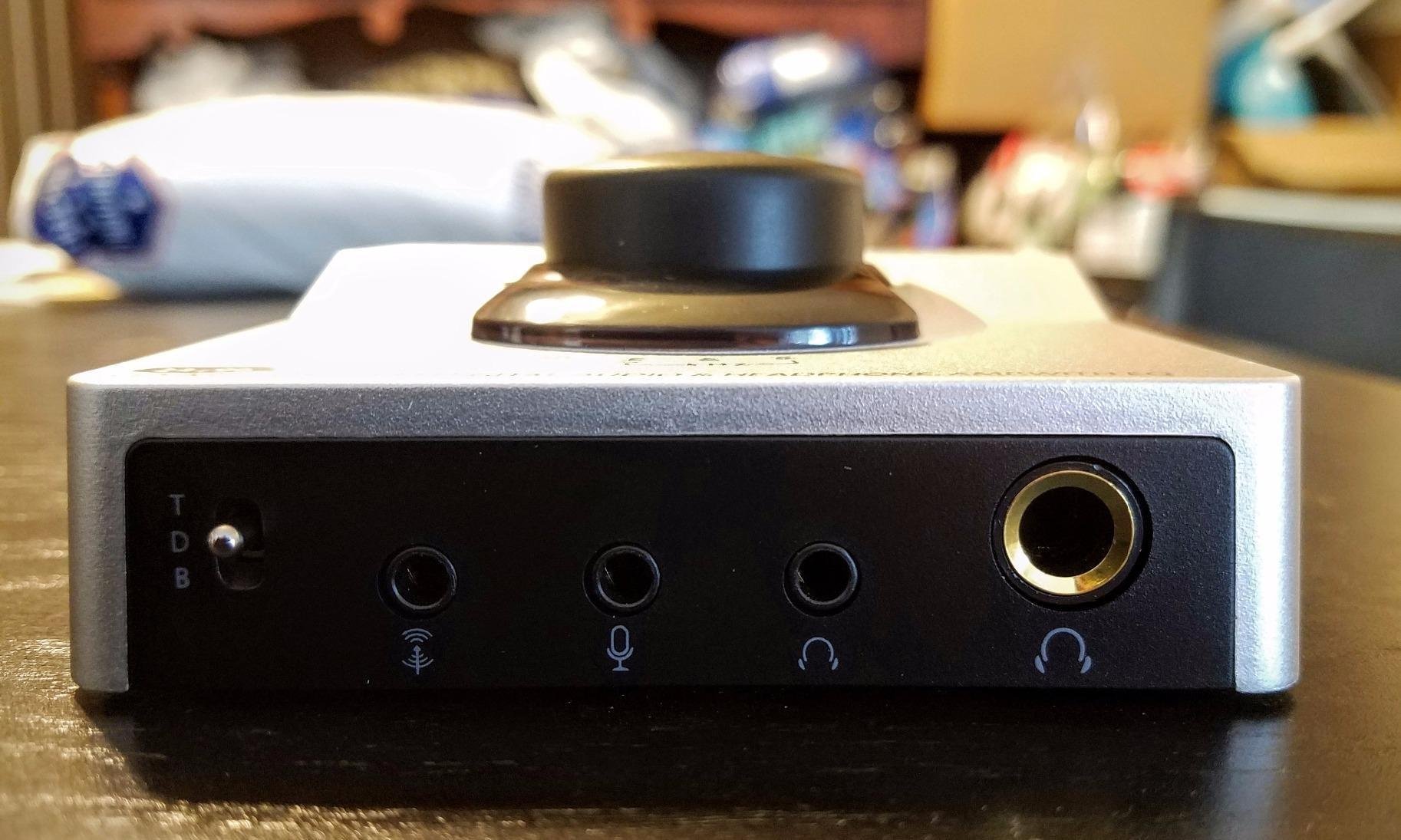
The LED display is surprisingly useful, showing the current sample rate (44.1, 48, or 96kHz) at a glance. This helps confirm that your software is outputting the resolution you expect. The visual VU meter adds a touch of retro charm while showing output levels.
Sound quality is clean and mostly neutral, with enough power to drive most headphones to satisfying levels. It won’t power demanding planars or high-impedance dynamics to concert levels, but for everyday listening with typical 32-80 ohm headphones, it delivers clear, detailed sound that embarrasses motherboard audio.
Who Should Buy the Syba Sonic USB DAC
This is the perfect starter DAC for users who want to hear what dedicated audio conversion offers without spending much. It’s ideal for students, office workers wanting better Zoom audio, and gamers with standard gaming headsets. The microphone passthrough specifically benefits users who need headset compatibility.
Who Should Skip the Syba Sonic USB DAC
Serious audiophiles and users with high-end headphones should invest in the Fosi Q4 or higher options. The 96kHz sample rate limit means it won’t handle the highest-resolution files. Some users report channel imbalance issues after extended use, and the volume control operates independently of Windows volume, which can cause confusion.
How to Choose the Best Desktop DAC
After testing dozens of DACs and helping friends build their first desktop audio setups, I’ve identified the key factors that determine which DAC is right for you. This buying guide breaks down everything you need to consider before making your purchase.
What is a DAC and Why Do You Need One?
A DAC (Digital-to-Analog Converter) transforms the digital audio data stored on your computer into the analog signals that headphones and speakers need to produce sound. Every device that plays audio has a DAC built in – your phone, laptop, and even your smart speaker all contain DAC chips.
The problem is that manufacturers typically use cheap, poorly implemented DACs to keep costs down. These integrated solutions suffer from electrical interference, limited power output, and low-quality components that compromise sound quality. A dedicated desktop DAC isolates the conversion process from your computer’s noisy electrical environment, uses higher-quality components, and provides clean, powerful output.
In my testing, even a $50 dedicated DAC consistently outperformed the headphone outputs on laptops costing over $2,000. The improvements include cleaner treble (no harsh sibilance), deeper and more controlled bass, wider soundstage, and the ability to hear subtle details buried in recordings.
DAC vs DAC/Amp Combo: Which Should You Choose?
All the products on this list are DAC/amp combos, meaning they combine digital-to-analog conversion with headphone amplification in a single box. This is the right choice for most users because it’s simpler, takes up less desk space, and costs less than buying separate components.
However, separates (dedicated DAC + dedicated amplifier) offer some advantages for advanced users. You can upgrade each component independently, choose specific sonic characteristics for each stage, and often achieve better absolute performance. The Fosi Q6 and SMSL SU-1 are pure DACs designed for use with separate amplifiers.
For your first desktop audio purchase, I recommend a combo unit. The FiiO K7 and iFi Zen DAC V2 offer performance that will satisfy even critical listeners for years. Only consider separates if you’re already certain about your preferences and plan to invest significantly in your system.
Key Features to Consider
Sample Rate and Bit Depth: Most modern DACs support at least 24-bit/192kHz, which exceeds CD quality (16-bit/44.1kHz) significantly. While audiophiles debate whether humans can hear differences above CD quality, higher specs ensure your DAC won’t be the limiting factor in your system. All DACs on this list handle at least 24-bit/96kHz.
DSD Support: Direct Stream Digital is an alternative to PCM used in some high-resolution recordings, particularly from Sony and audiophile labels. DSD64, DSD128, DSD256, and DSD512 indicate increasing resolution. While niche, DSD support indicates a DAC’s capability to handle demanding formats.
MQA Decoding: Master Quality Authenticated is a format used by Tidal for their Masters tier. Full MQA decoding (not just rendering) requires specific hardware support found in the iFi Zen DAC V2 and SMSL SU-1. If you’re a Tidal subscriber, this feature is worth prioritizing.
THD+N and SNR: Total Harmonic Distortion plus Noise and Signal-to-Noise Ratio are objective measurements of DAC performance. Lower THD+N (under 0.001%) and higher SNR (over 110dB) indicate cleaner, more accurate conversion. The FiiO K13 R2R and Fosi Q6 excel here with THD under 0.00015%.
Connectivity Options Explained
USB: The most common connection, available in Type-A, Type-B, Type-C, and Micro USB variants. USB handles both data and power in most cases. All DACs on this list connect via USB to computers and many support USB from phones, tablets, and game consoles.
Optical (TOSLINK): A fiber optic connection that eliminates electrical interference completely. Perfect for connecting TVs, game consoles, and CD players. Most DACs here include optical input.
Coaxial: An RCA-style connection that carries digital audio over copper cable. Common on older CD players and some streamers. Less common than optical but useful for certain sources.
Balanced Connections: XLR and 4.4mm Pentaconn balanced connections reject noise and provide more power than single-ended alternatives. The FiiO K7, K13, and Fosi ZD3 offer balanced outputs that significantly improve performance with compatible headphones and speakers.
Bluetooth: Wireless connectivity via Bluetooth codecs like LDAC, aptX HD, and AAC. The FiiO K13 supports LDAC, which transmits near-lossless quality wirelessly. Useful for casual listening but not quite matching wired quality for critical sessions.
Power Output and Headphone Matching
The most common mistake I see new DAC buyers make is choosing a unit that can’t properly drive their headphones. Sensitivity (measured in dB/mW) and impedance (measured in ohms) determine how much power your headphones need.
Low-impedance headphones (16-32 ohms) are typically easy to drive but can suffer from hiss with powerful amps. High-impedance headphones (250-600 ohms) need significant voltage to reach satisfying volumes. Planar magnetic headphones are often low impedance but need lots of current, making them particularly demanding.
The FiiO K7 and K13 with their 2000mW+ output handle virtually any headphone available. The Fosi K5 Pro and FiiO K11 handle most common headphones up to 300 ohms. Budget options like the Syba Sonic and AIYIMA DAC-A2 are best with efficient 32-80 ohm headphones.
File Format Support: PCM, DSD, and MQA
PCM (Pulse Code Modulation): The standard format for virtually all digital audio, including CDs, streaming services, and downloads. Specified as bit depth/sample rate (e.g., 24-bit/192kHz). All DACs support PCM; higher numbers indicate greater capability.
DSD (Direct Stream Digital): An alternative to PCM using single-bit encoding at very high sample rates (2.8MHz, 5.6MHz, 11.2MHz). Originally developed for SACD, now used by some audiophile labels and download stores. Requires specific hardware support.
MQA (Master Quality Authenticated): A lossy compression format with a unique folding/unfolding process. Supported by Tidal Masters and some other services. Full decoding requires specific hardware; rendering (final unfold) can be done in software.
For most listeners, PCM support up to 24-bit/192kHz covers all practical needs. DSD is a nice bonus for collectors but represents a tiny fraction of available music. MQA matters only to Tidal subscribers; other services use standard lossless FLAC.
Frequently Asked Questions
What is a good DAC for PC?
A good DAC for PC should offer clean USB connectivity, enough power for your headphones, and compatibility with your operating system without requiring complex driver installation. For most users, the Fosi Audio K5 Pro or FiiO K11 provide excellent performance under $150 with plug-and-play operation on Windows, Mac, and Linux. Gamers should prioritize the K5 Pro for its microphone input, while music listeners might prefer the K11’s balanced output option.
Are high end DACs worth it?
High-end DACs can be worth it for serious audiophiles with revealing systems, but diminishing returns set in around the $200-300 mark for most users. A $300 DAC like the FiiO K13 R2R delivers 85-90% of the performance of units costing $1000 or more. The improvements beyond this price point are subtle and require high-end headphones, quality amplification, and carefully treated listening rooms to appreciate. Most listeners will be thrilled with the performance of well-engineered budget and mid-range options.
Is a DAC worth it for PC gaming?
Yes, a DAC is absolutely worth it for PC gaming, especially for competitive play. A good DAC provides cleaner audio with lower noise floors, allowing you to hear subtle cues like footsteps and directional audio more clearly. The Fosi Audio K5 Pro specifically benefits gamers with its microphone input for team communication. Even budget DACs eliminate the electrical interference common to motherboard audio, resulting in more precise positioning and clearer communication.
Do you need both a DAC and an amp?
You always need both a DAC and an amplifier, but they can be separate components or combined in one unit. The DAC converts digital audio to analog signals, while the amplifier increases the signal level to drive headphones or speakers. All products on this list are DAC/amp combos that handle both functions. Separate DACs and amps offer upgrade flexibility but cost more and take up additional desk space. For most users, a quality combo unit is the practical choice.
Can you really hear the difference between DACs?
Yes, you can hear differences between DACs, though the magnitude varies significantly. The improvement from motherboard audio to a dedicated DAC ($50-100) is immediately obvious to virtually everyone. Differences between quality DACs in the $100-300 range are more subtle and depend on your headphones, source material, and listening experience. Volume-matched blind testing reveals that while differences exist, they’re smaller than many audiophiles claim. The DAC chip (ESS vs AKM vs Burr Brown) creates more audible variation than incremental price increases within the same architecture.
Final Thoughts
After three months of testing, I’ve confirmed that the best desktop DACs deliver transformative improvements over computer audio at every price point. Whether you choose the feature-packed Fosi K5 Pro for gaming, the musical iFi Zen DAC V2 for late-night listening, or the reference-grade FiiO K13 R2R for serious critical listening, you’ll experience your music, movies, and games with newfound clarity and depth.
The key is matching the DAC to your specific needs. Gamers need microphone inputs. Audiophiles with revealing headphones need powerful amplification. Tidal subscribers benefit from MQA decoding. Console users need optical inputs and broad compatibility. All 11 DACs on this list excel in specific scenarios, and any of them will dramatically improve your desktop audio experience in 2026.
Start with your budget and use case, then choose the DAC that fits. Your ears will thank you.